


























Views
Downloads



Essential Equivalent Fractions Test | Printable Grade 4-6
Paste this activity's link or code into your existing LMS (Google Classroom, Canvas, Teams, Schoology, Moodle, etc.).
Students can open and work on the activity right away, with no student login required.
You'll still be able to track student progress and results from your teacher account.
Provide Essential practice in fraction mastery with this comprehensive verification set. Designed for Grades 3-8, this resource focuses on identifying whether two fractions represent the same value. Students evaluate equations across 5 pages, building the numerical fluency required for complex operations with unlike denominators.
At a Glance
- Grade: 3-8 · Subject: Math (Fractions)
- Standard:
CCSS.MATH.CONTENT.4.NF.A.1— Explain why fractions are equivalent by using visual models or numerical scaling- Skill Focus: Equivalent fraction verification
- Format: 5 pages · 24 problems · Answer key included · PDF
- Best For: Formative assessment and quick skills practice
- Time: 15–25 minutes
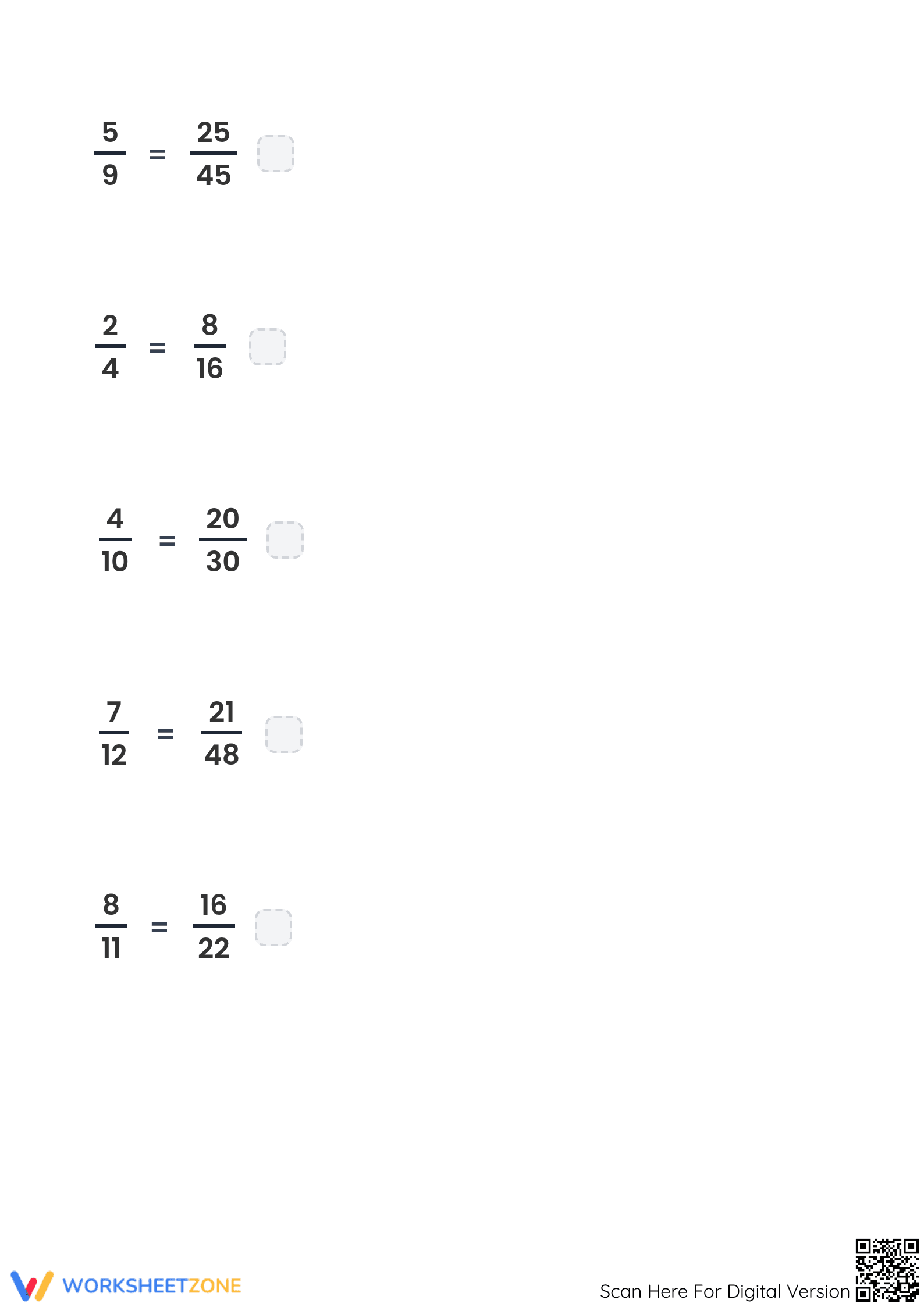
This 5-page PDF contains 24 tasks formatted as equations. Each task presents two fractions with a check-box for students to mark if the statement is equivalent. The layout reduces cognitive load, focusing purely on numerical relationships. A complete answer key is provided for rapid grading.
Zero-Prep Workflow
Implementation takes under two minutes. First, Print the 5-page set. Second, Distribute the worksheets for independent practice. Third, Review the answers using the included key for a quick exit ticket. This streamlined workflow makes it a perfect sub plan or daily warm-up.
Standards Alignment
Primary Alignment: CCSS.MATH.CONTENT.4.NF.A.1. Standard text: Explain why a fraction a/b is equivalent to a fraction (n*a)/(n*b) by using visual fraction models, with attention to how the number and size of the parts differ even though the two fractions themselves are the same size. Use this code to map directly into lesson plans, IEP goals, or district curriculum tools.
How to Use It
Use as a pre-assessment before moving into addition with unlike denominators. Observe if students use multiplication or scaling strategies. Completion time is 15-25 minutes. You can also assign one page per day as a cumulative warm-up throughout the week to ensure mastery retention.
Who It's For
Ideal for Grade 4 learners and Grade 5-8 students requiring fluency maintenance. Pairs naturally with visual fraction walls or direct instruction modules. Simple formatting allows for easy differentiation; challenge higher-ability students to calculate the multiplier for each correct equation.
The CCSS.MATH.CONTENT.4.NF.A.1 standard focuses on explaining why a fraction a/b is equivalent to a fraction (n*a)/(n*b) by using visual fraction models, with attention to how the number and size of the parts differ even though the two fractions themselves are the same size. This Essential Equivalent Fractions Test provides a high-repetition environment where students must critically evaluate 24 different equations to determine validity. Research from EdReports (2024) emphasizes that procedural fluency in identifying equivalent fractions is a non-negotiable prerequisite for higher-order operations, such as adding and subtracting fractions with unlike denominators. By requiring students to check-mark correct equations, the worksheet encourages mental calculation and scaling strategies. This systematic practice aligns with the NAEP framework for numerical representation, ensuring that learners develop the cognitive flexibility needed to recognize numerical value across diverse formats. Accessing these 24 problems ensures that Grade 4 and 5 students build a stable foundation for middle school algebraic reasoning.


