


























Views
Downloads

Grade 8 Fair's Fair Character Traits — Printable Worksheet
Paste this activity's link or code into your existing LMS (Google Classroom, Canvas, Teams, Schoology, Moodle, etc.).
Students can open and work on the activity right away, with no student login required.
You'll still be able to track student progress and results from your teacher account.
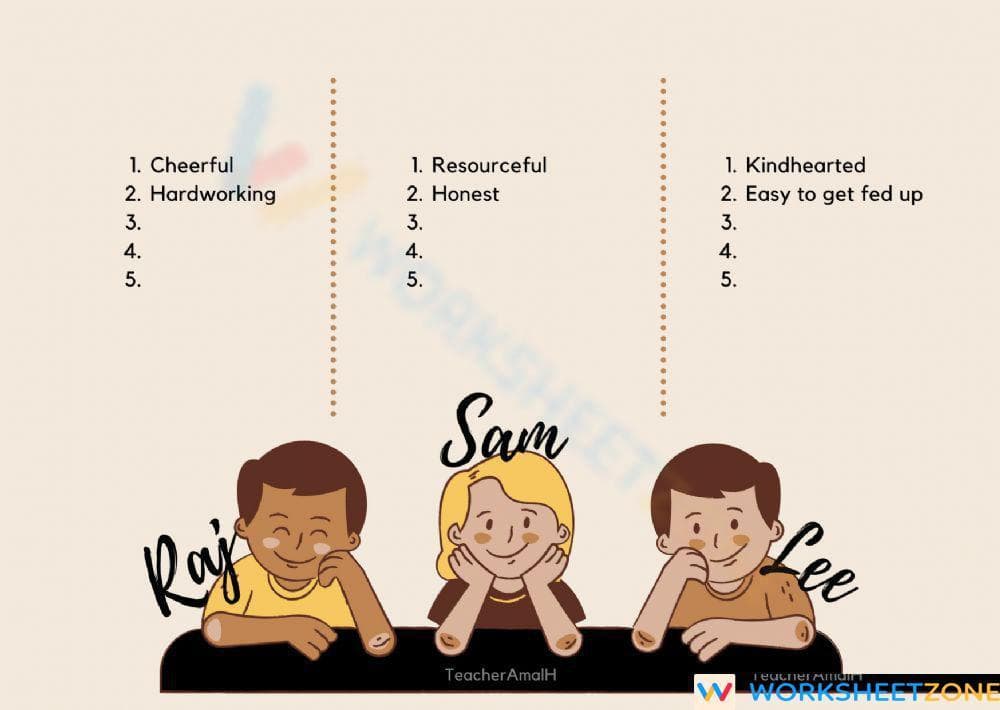
This Grade 8 character analysis worksheet helps students identify and categorize character traits for Raj, Sam, and Lee from the short story "Fair's Fair." Students analyze textual evidence to determine internal characteristics, improving their reading comprehension and literary analysis skills. This focused practice ensures students can articulate how character traits are revealed through story events.
At a Glance
- Grade: 8 · Subject: ELA Literature
- Standard:
CCSS.ELA-LITERACY.RL.8.3— Analyze how story incidents reveal character traits and propel the narrative action- Skill Focus: Character Trait Analysis
- Format: 1 page · 15 tasks · Answer key included · PDF
- Best For: Independent practice and reading comprehension checks
- Time: 15–20 minutes
What's Inside
This single-page PDF features a clean, organized layout focused on the three main protagonists: Raj, Sam, and Lee. The worksheet provides fifteen total slots for identifying characteristics, with several traits pre-filled to scaffold the learning process and model appropriate responses. A complete answer key is provided to facilitate quick grading or student self-correction, making it ideal for independent desk work.
Zero-Prep Workflow
- Print: Generate the single-page PDF in seconds for your entire class.
- Distribute: Hand out the worksheets as students finish reading the short story to capture immediate insights.
- Review: Use the included answer key to check for understanding in less than five minutes.
Total teacher preparation time is under two minutes, making this an excellent option for substitute plans or last-minute lesson adjustments.
Standards Alignment
The primary standard addressed is CCSS.ELA-LITERACY.RL.8.3: "Analyze how particular lines of dialogue or incidents in a story or drama propel the action, reveal aspects of a character, or provoke a decision." By identifying specific traits, students demonstrate their ability to interpret how characterization is built throughout the text. This standard code can be copied directly into lesson plans, IEP goals, or district curriculum mapping tools.
How to Use It
Use this worksheet as a formative assessment immediately following a shared reading of "Fair's Fair." During the activity, circulate and observe if students are relying on specific story events to justify their choices for Raj, Sam, and Lee. Alternatively, assign it as a quick warm-up or exit ticket to gauge individual student mastery of character analysis before moving into deeper thematic discussions. Completion typically takes 15 to 20 minutes.
Who It's For
This worksheet is perfect for 8th and 9th-grade ELA students, including English Language Learners who benefit from the visual character cues and pre-filled examples. It pairs naturally with a character anchor chart or a graphic organizer that tracks character development. The simplified format provides necessary support for struggling readers while allowing advanced students to provide more nuanced trait descriptions.
Effective character analysis is a cornerstone of secondary literacy, as highlighted by Fisher & Frey (2014) in their research on the gradual release of responsibility. This worksheet aligns with CCSS.ELA-LITERACY.RL.8.3 by requiring students to synthesize textual evidence into specific character traits, a skill that NAEP data indicates is critical for transitioning from basic to proficient reading levels. By focusing on Raj, Sam, and Lee, students engage in evidence-based reasoning that mirrors the demands of high-stakes assessments while remaining accessible for classroom use. The 15 tasks provided offer sufficient data points for teachers to identify whether students can distinguish between temporary emotions and permanent character traits. This structured approach to characterization ensures that students develop a robust vocabulary for describing literary figures, which is essential for more complex comparative analysis in later grades.


