




























Views
Downloads


Grade 1 Forces and Direction — Essential Science Worksheet

Paste this activity's link or code into your existing LMS (Google Classroom, Canvas, Teams, Schoology, Moodle, etc.).
Students can open and work on the activity right away, with no student login required.
You'll still be able to track student progress and results from your teacher account.
This forces and direction worksheet helps first graders understand how to manipulate the motion of objects through targeted pushes. By identifying the specific direction needed to stop a rolling ball, students develop a foundational grasp of physical science principles and cause-and-effect relationships. This resource transforms abstract physics concepts into a concrete, visual exercise that is perfectly calibrated for the primary classroom environment.
At a Glance
- Grade: 1 · Subject: Science
- Standard:
1-PS2-1— Compare the effects of different directions of pushes on object motion- Skill Focus: Identifying force direction to stop motion
- Format: 1 page · 5 problems · Answer key included · PDF
- Best For: Introduction to physical science and motion
- Time: 10–15 minutes
What's Inside
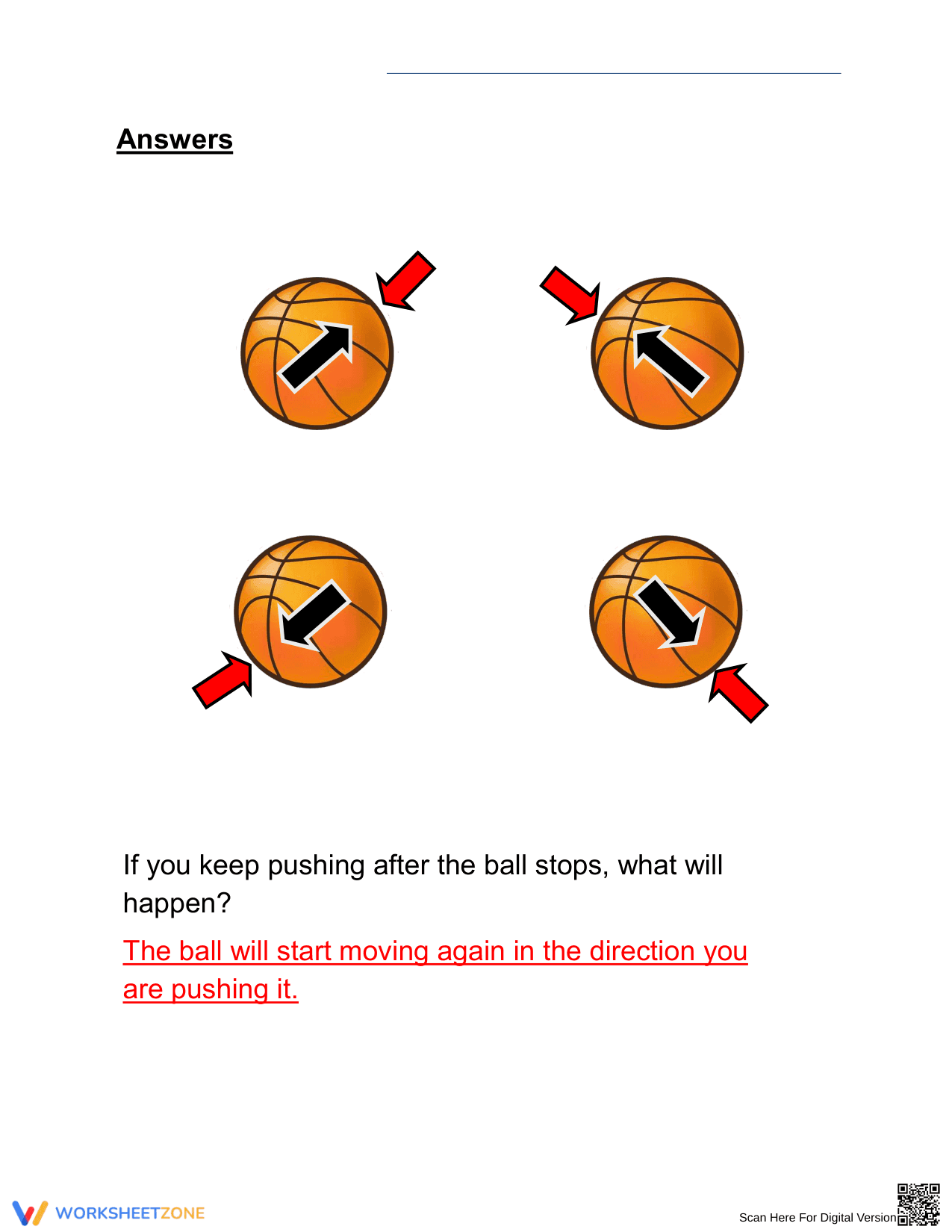
This single-page PDF contains five targeted tasks designed for young learners. The primary activity features four illustrations of rolling balls where students must draw arrows indicating the correct push direction to halt motion. It concludes with a critical thinking prompt asking students to predict the outcome of continued force after an object has already stopped, fostering deep conceptual understanding of equilibrium and continued motion.
Zero-Prep Workflow
This resource is designed for an immediate, high-impact classroom presence with minimal teacher intervention. Teachers can print the worksheet in under 30 seconds, distribute it to the class in one minute, and conduct a full-group review of the concepts in five minutes. This streamlined workflow makes it an ideal choice for emergency sub plans, transition periods, or as a quick check for understanding following a hands-on physical science lab.
Standards Alignment
The worksheet is directly aligned with 1-PS2-1, which requires students to conduct investigations to compare the effects of different directions of pushes on the motion of an object. By visually representing these force vectors, students bridge the gap between physical experience and scientific modeling. This primary standard code can be copied directly into lesson plans, IEP goals, or district curriculum mapping tools.
How to Use It
Use this worksheet as a "Quick Check" immediately after a hands-on activity with balls or toy cars to solidify the observation that force direction matters. During instruction, observe if students draw the arrow directly opposite the motion arrow; this provides a clear formative assessment of their grasp of opposing forces. Expect students to complete the page in approximately 12 minutes, making it a perfect component of a science rotation or station.
Who It's For
This resource is specifically crafted for Grade 1 students but serves as an excellent review for Grade 2 learners who need to revisit physical science fundamentals. It pairs naturally with a simple classroom demonstration using a basketball or soccer ball to show how a hand must move to "catch" or stop the object's path. The clear visuals also support English Language Learners (ELL) in acquiring science-specific vocabulary.
Research indicates that early exposure to physical science concepts like force and motion is critical for developing spatial reasoning and scientific literacy. According to Fisher & Frey (2014), using visual scaffolds—such as the arrow-drawing tasks in this 1-PS2-1 worksheet—helps primary students internalize abstract physical principles by making them visible and concrete. By focusing on the plain-English skill of predicting how direction affects motion, this resource supports the NGSS goal of evidence-based reasoning. Analysis from ScienceDirect TpT Analysis suggests that high-quality, single-topic science worksheets significantly reduce teacher burnout while maintaining rigorous alignment to state frameworks. This 5-task assessment ensures that learners can accurately model force interactions before moving on to more complex kinetic energy concepts in later grades. By reinforcing these concepts early, educators build a solid foundation for future STEM success and critical thinking skills.


