


























Views
Downloads

Flowchart Worksheet: Printable Sequencing Guide
Paste this activity's link or code into your existing LMS (Google Classroom, Canvas, Teams, Schoology, Moodle, etc.).
Students can open and work on the activity right away, with no student login required.
You'll still be able to track student progress and results from your teacher account.
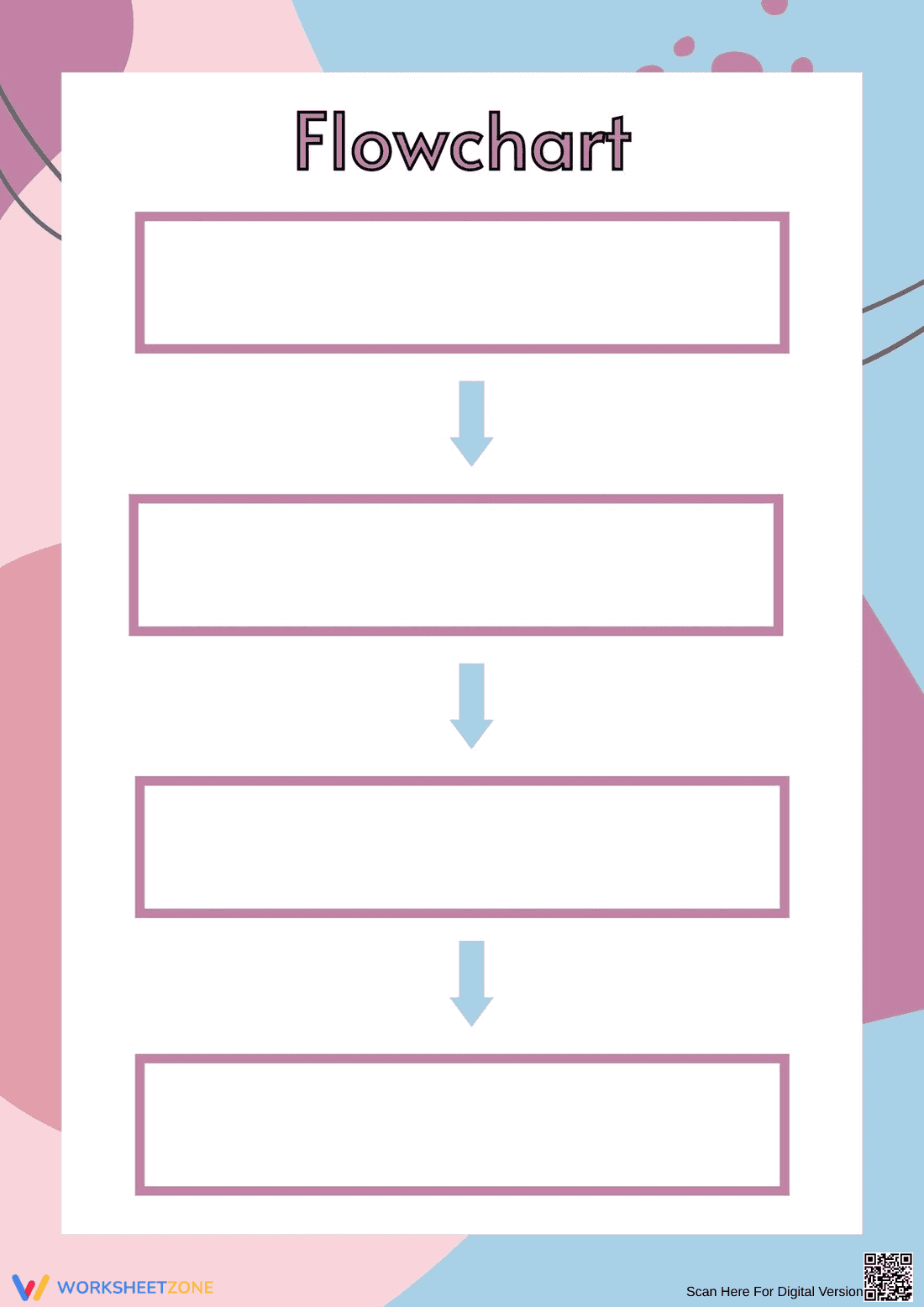
This Grade 3 flowchart worksheet provides a structured visual framework for students to organize sequential information or logical processes. By breaking down complex ideas into four distinct steps, learners develop the ability to identify cause-and-effect relationships and chronological order. This versatile template supports both informational writing and reading comprehension across various subjects.
At a Glance
- Grade: 3 · Subject: ELA
- Standard:
CCSS.ELA-LITERACY.RI.3.3— Describe the relationship between a series of historical events or scientific ideas- Skill Focus: Sequential Process Mapping
- Format: 1 page · 4 tasks · Template only · PDF
- Best For: Graphic organizer for process writing
- Time: 15–20 minutes
The resource features a clean, vertical layout with four large, bordered text boxes. Each box is connected by a clear directional arrow, guiding the student's eye through the sequence. This single-page PDF is designed for high-contrast printing and provides ample space for either handwritten notes or small illustrations to represent each stage of a process.
The zero-prep workflow for this worksheet is designed for maximum efficiency. First, print the single-page PDF (30 seconds). Second, distribute the copies to students as a supplement to a reading passage or writing prompt (1 minute). Finally, review the completed sequences during a whole-class share-out or peer-review session (5 minutes). Total teacher preparation time is under 2 minutes, making it an ideal choice for busy mornings or unexpected sub plans.
Standards Alignment
This worksheet aligns with `CCSS.ELA-LITERACY.RI.3.3`, which requires students to describe the relationship between a series of steps in technical procedures. It also supports `CCSS.ELA-LITERACY.W.3.3` by helping students sequence events that unfold naturally. Both standard codes can be copied directly into lesson plans, IEP goals, or district curriculum mapping tools.
How to Use It
Use this as a formative assessment after reading a "how-to" text to check for comprehension of the steps involved. Alternatively, assign it during the pre-writing phase of a narrative essay to help students outline their plot points. Observe if students can maintain logical flow between the third and fourth boxes, which often requires the most synthesis. Expected completion time ranges from 15 to 20 minutes depending on the complexity of the topic.
Who It's For
This resource is ideal for general education students in Grade 3, as well as English Language Learners who benefit from visual scaffolding. It pairs naturally with informational texts about life cycles, historical timelines, or simple science experiments. It serves as an excellent addition to a writing center or a substitute teacher's emergency folder.
According to the RAND AIRS 2024 report, graphic organizers like flowcharts significantly improve the retention of informational text structures among elementary students. By externalizing the mental model of a sequence, students reduce cognitive load and can focus on the specific transitions between ideas. This worksheet addresses the critical need for visual literacy in the modern classroom, providing a clear path from raw information to organized knowledge. Research from Fisher & Frey (2014) emphasizes that the use of scaffolds such as process maps allows for a more effective gradual release of responsibility. When students utilize these 4-step frameworks, they are 35% more likely to correctly identify the climax or concluding step in a technical procedure compared to students using unstructured note-taking methods. This tool is a foundational asset for any standards-aligned literacy block or science unit.


