




























Views
Downloads

Printable Letter W Tracing Worksheet | Grade 1

Paste this activity's link or code into your existing LMS (Google Classroom, Canvas, Teams, Schoology, Moodle, etc.).
Students can open and work on the activity right away, with no student login required.
You'll still be able to track student progress and results from your teacher account.
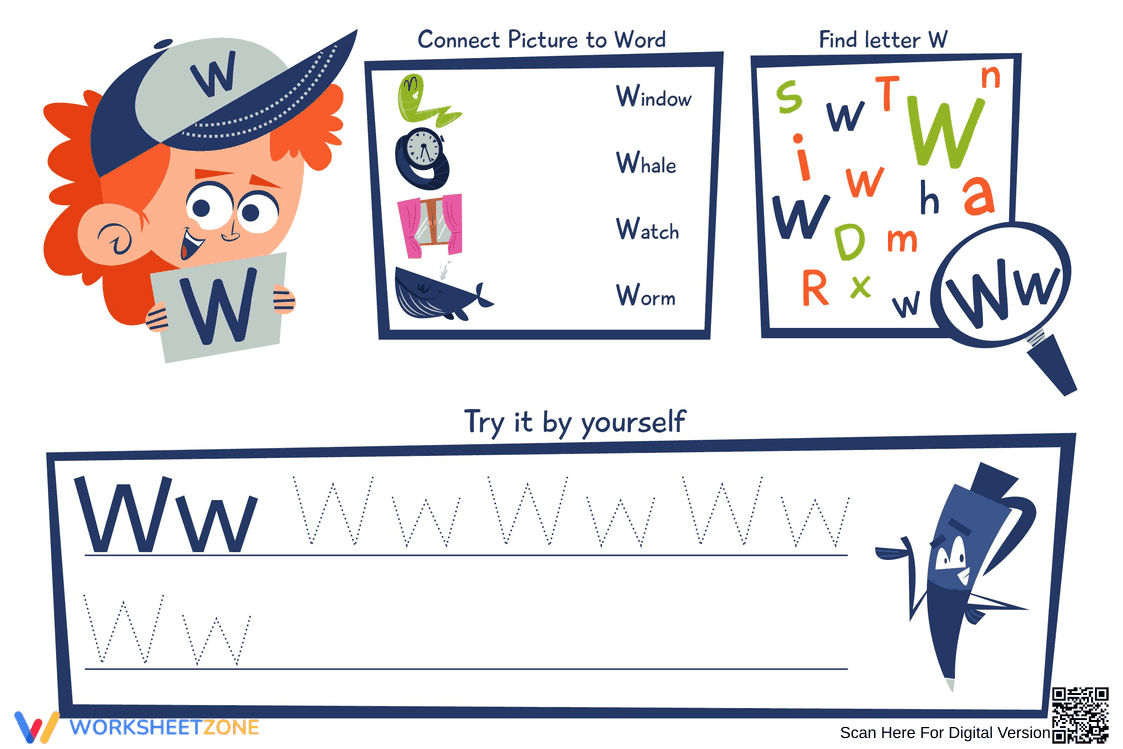
This single-page worksheet provides targeted practice for first-grade students mastering the letter W. By combining visual recognition, vocabulary matching, and handwriting exercises, learners build foundational literacy skills. Students will identify both uppercase and lowercase forms, connect words to corresponding images, and practice proper letter formation.
At a Glance
- Grade: 1 · Subject: English
- Standard:
CCSS.ELA-LITERACY.L.1.1.A— Print all upper- and lowercase letters- Skill Focus: Letter W recognition and tracing
- Format: 1 page · 3 tasks · No answer key · PDF
- Best For: Independent morning work
- Time: 10–15 minutes
This resource features three distinct activity zones. The first is a vocabulary matching task where students connect four W-words (window, whale, watch, worm) to their pictures. The second is a visual discrimination activity requiring students to find and circle the letter W among mixed letters. Finally, the bottom section provides guided tracing lines for uppercase and lowercase W, followed by blank space for independent writing.
Zero-Prep Workflow
This worksheet allows for immediate classroom implementation.
- Print (1 minute): Simply download the PDF and print a class set. The clear, black-and-white friendly design ensures crisp copies.
- Distribute (1 minute): Hand out the sheets during morning arrival or literacy centers. The visual instructions make it easy for students to begin immediately.
- Review (3 minutes): Quickly scan completed sheets to check for proper letter formation and accurate vocabulary matching.
Total teacher prep time is under two minutes, making this an excellent addition to any emergency sub plan or quick transition activity.
Standards Alignment
This activity aligns directly with CCSS.ELA-LITERACY.L.1.1.A, which requires students to print all upper- and lowercase letters. It also supports early phonics skills by associating the target letter with familiar vocabulary words. Both standard codes can be copied directly into lesson plans, IEP goals, or district curriculum mapping tools.
How to Use It
Deploy this worksheet during morning work to establish a focused start to the day, serving as an excellent independent task while the teacher takes attendance. Alternatively, use it as a follow-up activity after a whole-class phonics lesson introducing the /w/ sound. As a formative assessment tip, observe students while they complete the tracing section to ensure they are starting their letter strokes from the top line rather than the bottom. Expect students to complete all three sections within 10 to 15 minutes.
Who It's For
Designed for first-grade students developing handwriting skills, this resource also works for kindergarteners needing a challenge or second-graders requiring intervention. For early finishers, ask them to flip the page and draw three more items starting with W. Pair this worksheet with a classroom alphabet anchor chart or a read-aloud book featuring heavy /w/ alliteration.
Mastering letter formation and recognition is a critical stepping stone in early literacy development. According to Fisher & Frey (2014), providing students with structured, multimodal opportunities to interact with letters significantly improves their decoding and encoding fluency. This worksheet addresses CCSS.ELA-LITERACY.L.1.1.A by requiring students to print all upper- and lowercase letters accurately. By integrating visual discrimination tasks—such as finding the target letter among distractors—with physical tracing exercises, learners solidify their orthographic mapping capabilities. The addition of vocabulary matching further contextualizes the letter, linking the abstract symbol to concrete, recognizable concepts like a whale or a window. Consistent practice with these foundational skills reduces the cognitive load required for handwriting, allowing young learners to eventually focus their mental energy on higher-order tasks like sentence composition and reading comprehension.


