




























Views
Downloads
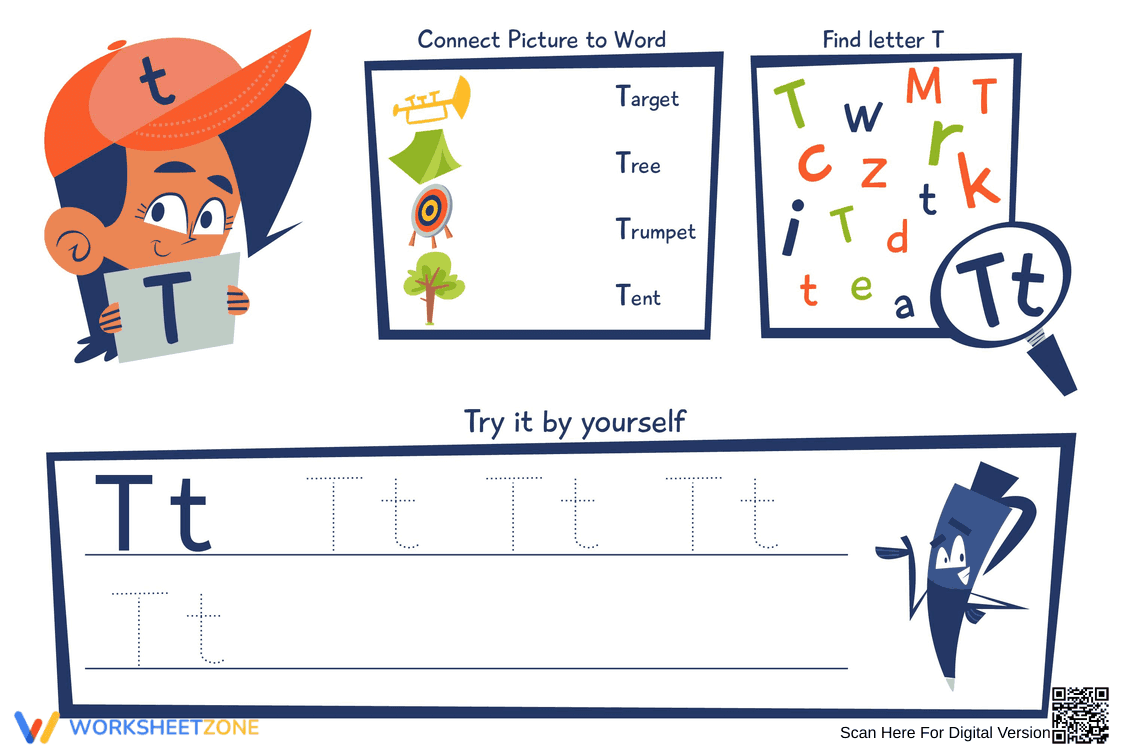

Letter T Tracing & Recognition | Essential Grade 1 Worksheet

Paste this activity's link or code into your existing LMS (Google Classroom, Canvas, Teams, Schoology, Moodle, etc.).
Students can open and work on the activity right away, with no student login required.
You'll still be able to track student progress and results from your teacher account.
This Grade 1 letter T worksheet provides students with a comprehensive approach to alphabet mastery. By combining visual recognition, vocabulary association, and fine motor practice, learners build the foundational skills necessary for fluent writing and reading. Students will identify, find, and write both uppercase and lowercase T with confidence and accuracy.
At a Glance
- Grade: 1 · Subject: English
- Standard:
CCSS.ELA-LITERACY.L.1.1.A— Print all upper- and lowercase letters correctly- Skill Focus: Letter T formation and identification
- Format: 1 page · 12 tasks · Answer key included · PDF
- Best For: Morning work or literacy centers
- Time: 10–15 minutes
This single-page PDF features three distinct activity zones designed to keep young learners engaged. First, a "Connect Picture to Word" section uses four visual cues—Target, Tree, Trumpet, and Tent—to reinforce initial sounds and vocabulary. Second, a "Find Letter T" visual scanning box challenges students to distinguish the target letter from other distractors. Finally, the "Try it by yourself" section provides four guided tracing pairs and a blank line for independent handwriting practice.
This resource is designed for immediate classroom implementation with a zero-prep workflow. First, print the single-page PDF for your group in under 30 seconds. Second, distribute the sheets during your phonics block or as a transition activity, which takes about 1 minute. Third, review the work using the included answer key or a quick visual check to provide instant feedback on letter formation. Total teacher prep time is under 3 minutes, making it an ideal choice for busy mornings or unexpected sub plans.
The primary focus of this worksheet is `CCSS.ELA-LITERACY.L.1.1.A`, which requires students to print all upper- and lowercase letters. Additionally, it supports phonemic awareness by linking sounds to printed letters through the vocabulary matching section. Both standard codes can be copied directly into lesson plans, IEP goals, or district curriculum mapping tools to ensure compliance with state and national frameworks.
Use this worksheet as a formative assessment after introducing the letter T sound. It works best during small-group literacy rotations where a teacher can observe pencil grip and stroke order during the tracing phase. Expect students to complete the page in 10 to 15 minutes, making it an ideal exit ticket for a phonics lesson. Teachers should look for consistent top-to-bottom strokes during the handwriting portion.
This resource is tailored for Grade 1 students but is highly effective for kindergarteners or English Language Learners needing extra support with alphabet recognition. It pairs perfectly with an anchor chart showing the letter T or a physical sand tray writing activity for multisensory reinforcement. The clear layout ensures that students with diverse learning needs can focus on the task without visual overwhelm.
Alphabet recognition and letter formation are critical precursors to reading fluency. According to Fisher & Frey (2014), the gradual release of responsibility—moving from guided tracing to independent production—is essential for motor memory in early writers. This worksheet utilizes this model by providing clear scaffolds before asking for independent letter T production. Research from the NAEP highlights that early mastery of letter-sound correspondence, specifically through the identification of initial sounds in words like "tent" and "tree," correlates strongly with later decoding success. By integrating visual scanning with physical writing, this resource addresses multiple learning modalities. The alignment with CCSS.ELA-LITERACY.L.1.1.A ensures that students are meeting national benchmarks for Grade 1 handwriting. This structured approach reduces cognitive load, allowing young learners to focus on the precision of their letter strokes and the phonemic connection to the letter T.


