


























Views
Downloads
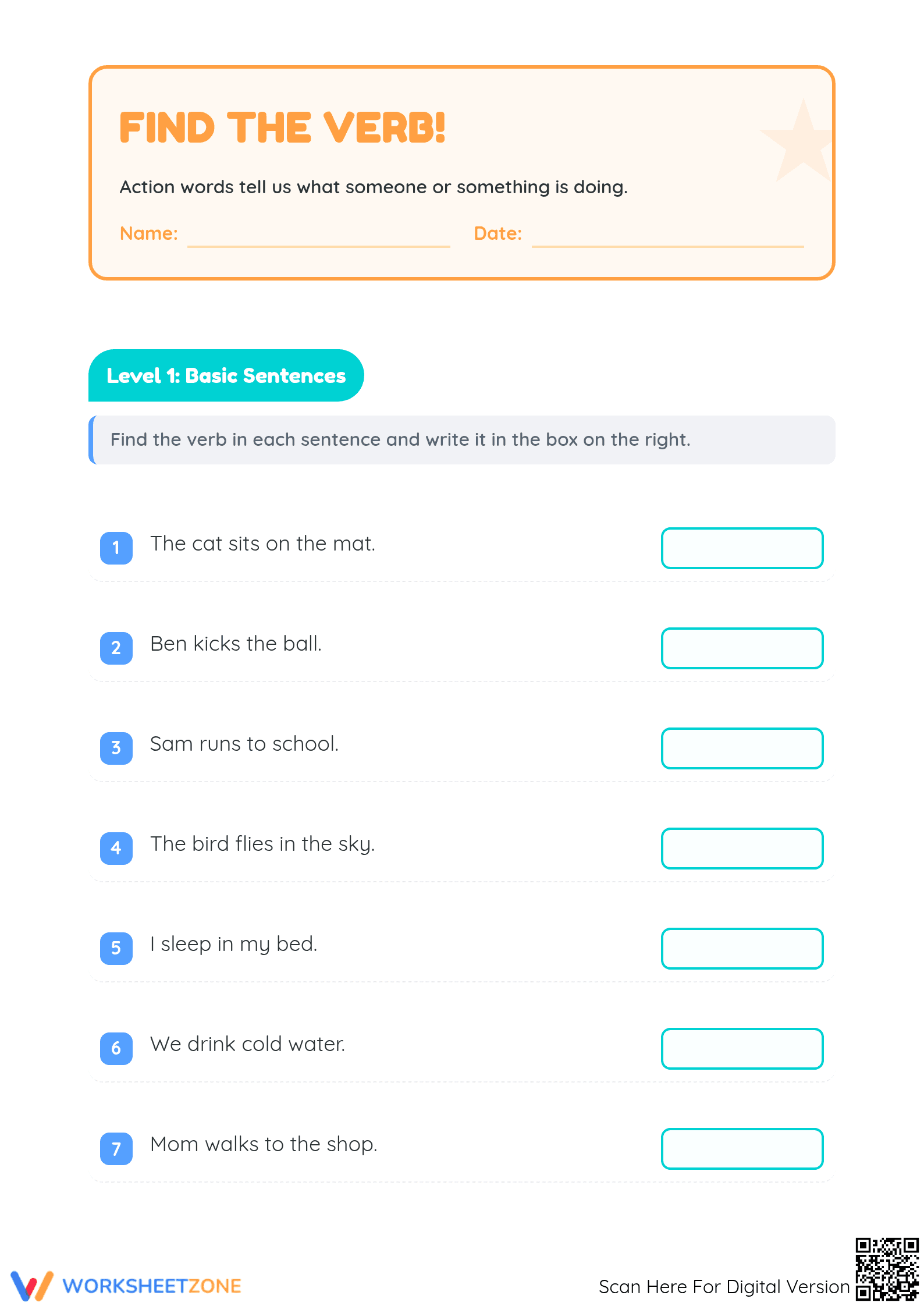


Printable Find the Verbs Worksheet | Grade 3 ELA
Paste this activity's link or code into your existing LMS (Google Classroom, Canvas, Teams, Schoology, Moodle, etc.).
Students can open and work on the activity right away, with no student login required.
You'll still be able to track student progress and results from your teacher account.
Master the art of identifying action words with this comprehensive grammar resource. Students learn to spot verbs as the essential parts of speech that describe what someone or something is doing. By isolating these keywords in sentences, learners build the mechanical foundations necessary for clear writing and sophisticated reading comprehension skills.
At a Glance
- Grade: 3 · Subject: English Language Arts
- Standard:
L.3.1.A— Explain the function of verbs and identify them accurately within various sentence structures- Skill Focus: Action Verb Identification
- Format: 3 pages · 14 problems · Answer key included · PDF
- Best For: Independent grammar practice and formative assessment
- Time: 15–20 minutes
This three-page PDF packet features a structured journey through verb identification. It includes 10 basic sentences for initial practice, a complex sentence requiring multiple verb detection, and a matching activity to connect subjects with appropriate actions. A full answer key is included for quick grading or student self-checking.
Skill Progression
- Guided Practice: Students identify a single verb in 10 simple sentences and record it in a dedicated box to reinforce initial word recognition.
- Supported Practice: Learners transition to a multi-step task, underlining two separate action words within a single longer sentence for increased complexity.
- Independent Practice: The matching section challenges students to pair nouns with logical actions, demonstrating a deeper understanding of verb function.
This structure ensures students build confidence through a gradual release of responsibility, often referred to as the I Do, We Do, You Do model, before increasing task complexity.
Standards Alignment
This resource is explicitly aligned to the L.3.1.A Common Core State Standard, which tasks students with explaining the function of verbs and identifying them in context. By focusing on action words, the worksheet also supports broader ELA literacy goals in syntax and grammar. This standard code can be copied directly into lesson plans, IEP goals, or district curriculum mapping tools.
How to Use It
Use this worksheet as a formative assessment during a unit on parts of speech to check for student understanding. Alternatively, assign it as a quiet sub-plan activity since the clear instructions require zero teacher setup. Observe if students can differentiate between the verb and the subject while they work to identify potential instructional gaps. Completion usually takes 15 to 20 minutes.
Who It's For
Designed for third-grade classrooms, this worksheet is also suitable for second graders ready for a challenge or fourth graders needing a refresher on basic grammar mechanics. It pairs perfectly with narrative writing lessons or anchor charts that list common action words to help struggling learners find the right vocabulary.
Grammar instruction is most effective when students engage in active identification within contextualized sentences, moving beyond rote memorization. This Grade 3 worksheet is specifically aligned to the L.3.1.A standard, which requires students to explain and apply the function of verbs as the engine of the sentence. By providing 14 distinct tasks across three scaffolded levels, the resource supports the gradual release of responsibility model. According to Fisher & Frey (2014), scaffolded practice allows students to consolidate their understanding of parts of speech before progressing to more complex syntactical analysis. The inclusion of basic sentence identification, multi-verb detection, and noun-verb matching ensures that learners approach the concept from multiple cognitive angles. This systematic approach to identifying action verbs builds a foundation for stronger narrative and informational writing. Educators can use these results to track mastery of essential grammar mechanics and inform subsequent instructional steps in ELA curriculum mapping.


