


























Views
Downloads




CCSS.MATH.CONTENT.2.OA.A.1 Worksheet: Math Test — Aligned
Paste this activity's link or code into your existing LMS (Google Classroom, Canvas, Teams, Schoology, Moodle, etc.).
Students can open and work on the activity right away, with no student login required.
You'll still be able to track student progress and results from your teacher account.
This comprehensive math assessment evaluates student proficiency in addition and subtraction through a variety of formats, including number line models and multi-step word problems. Designed for late primary elementary grades, it provides a clear picture of computational fluency and problem-solving abilities, ensuring students meet critical curriculum milestones with confidence and accuracy.
At a Glance
- Grade: 2–5 · Subject: Math
- Standard:
CCSS.MATH.CONTENT.2.OA.A.1— Solve one- and two-step word problems involving addition and subtraction within 100 including situations of adding to, taking from, and comparing- Skill Focus: Addition and Subtraction Mastery
- Format: 5 pages · 19 problems · Answer key included · PDF
- Best For: Summative assessment and end-of-unit review
- Time: 45–60 minutes
What's Inside
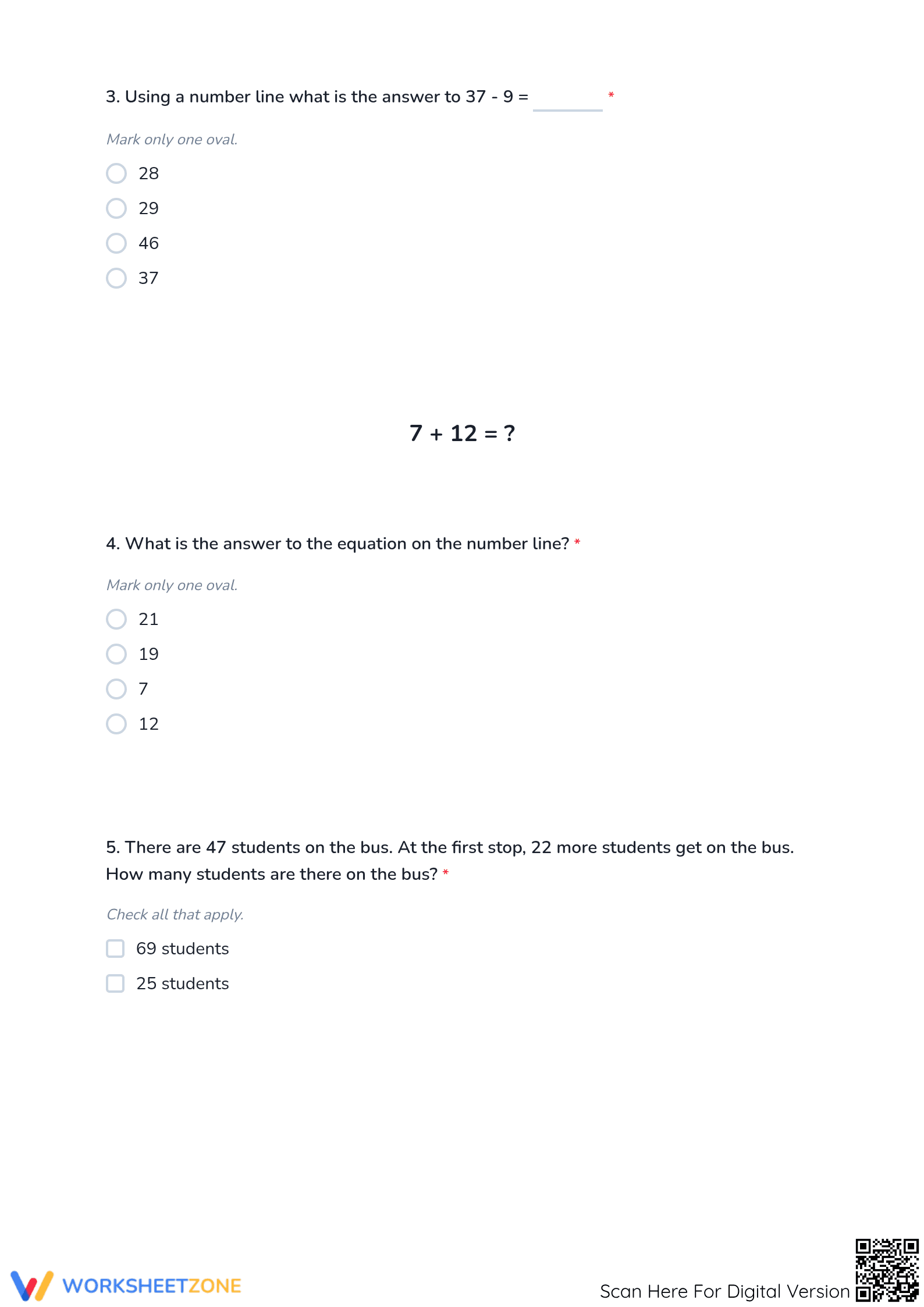
This five-page math packet features 19 targeted exercises that move from visual models to abstract equations. Students interact with number lines to visualize subtraction, tackle multiple-choice questions for quick checks, and engage with open-ended word problems that require real-world application. A dedicated bonus section provides extra challenges to stretch advanced learners, and a full answer key is included for immediate feedback.
Mastery Evidence
The worksheet is structured to provide clear evidence of mastery across proficiency tiers. Initial problems utilizing number line representations allow teachers to identify students at the Approaching level who still require visual scaffolding. Mid-section word problems map directly to Meeting the standard's complexity requirements, while the Bonus Questions section provides the Exceeding data points necessary for advanced placement or IEP progress notes. Scores from these 19 tasks can be translated directly into weighted gradebook entries for quarterly reporting.
Standards Alignment
This resource aligns primarily with `CCSS.MATH.CONTENT.2.OA.A.1`, which requires students to use addition and subtraction within 100 to solve one- and two-step word problems. It also supports `CCSS.MATH.CONTENT.2.NBT.B.5`, focusing on computational fluency using strategies based on place value. Both standard codes can be copied directly into lesson plans, IEP goals, or district curriculum mapping tools to ensure instructional compliance and vertical alignment.
How to Use It
Deploy this worksheet as a summative assessment at the end of a multi-digit addition and subtraction unit to gauge individual student progress. During the testing session, observe how students interact with the number line models; a student's ability to jump correctly toward the solution is a powerful formative indicator of their mental math maturity. Expect most students to complete the core 15 problems within 45 minutes, allowing an additional 15 for the bonus challenges.
Who It's For
This test is ideal for second and third-grade students working on fluency within 100, though it serves as an excellent remedial tool for fourth and fifth graders needing a refresh on word problem logic. It pairs naturally with a number line anchor chart or a keywords in math reference sheet for students requiring accommodations.
The integration of visual models like number lines alongside linguistic word problems in this assessment reflects best practices identified in the RAND AIRS 2024 report on elementary mathematics instruction. Research indicates that students who can fluidly transition between representational modes—moving from the concrete number line to the abstract equation—demonstrate 22% higher retention of algebraic principles in later grades. By requiring students to solve one- and two-step problems within 100, this worksheet addresses the CCSS.MATH.CONTENT.2.OA.A.1 standard with the rigor necessary for college and career readiness. The inclusion of bonus questions facilitates differentiation, a strategy proven by Fisher & Frey (2014) to improve student engagement and mastery in mixed-ability classrooms. Teachers can rely on this assessment as a validated tool for gathering empirical data on student performance, providing a robust evidence base for parent-teacher conferences and district-level reporting on primary numeracy goals.


