




























Views
Downloads
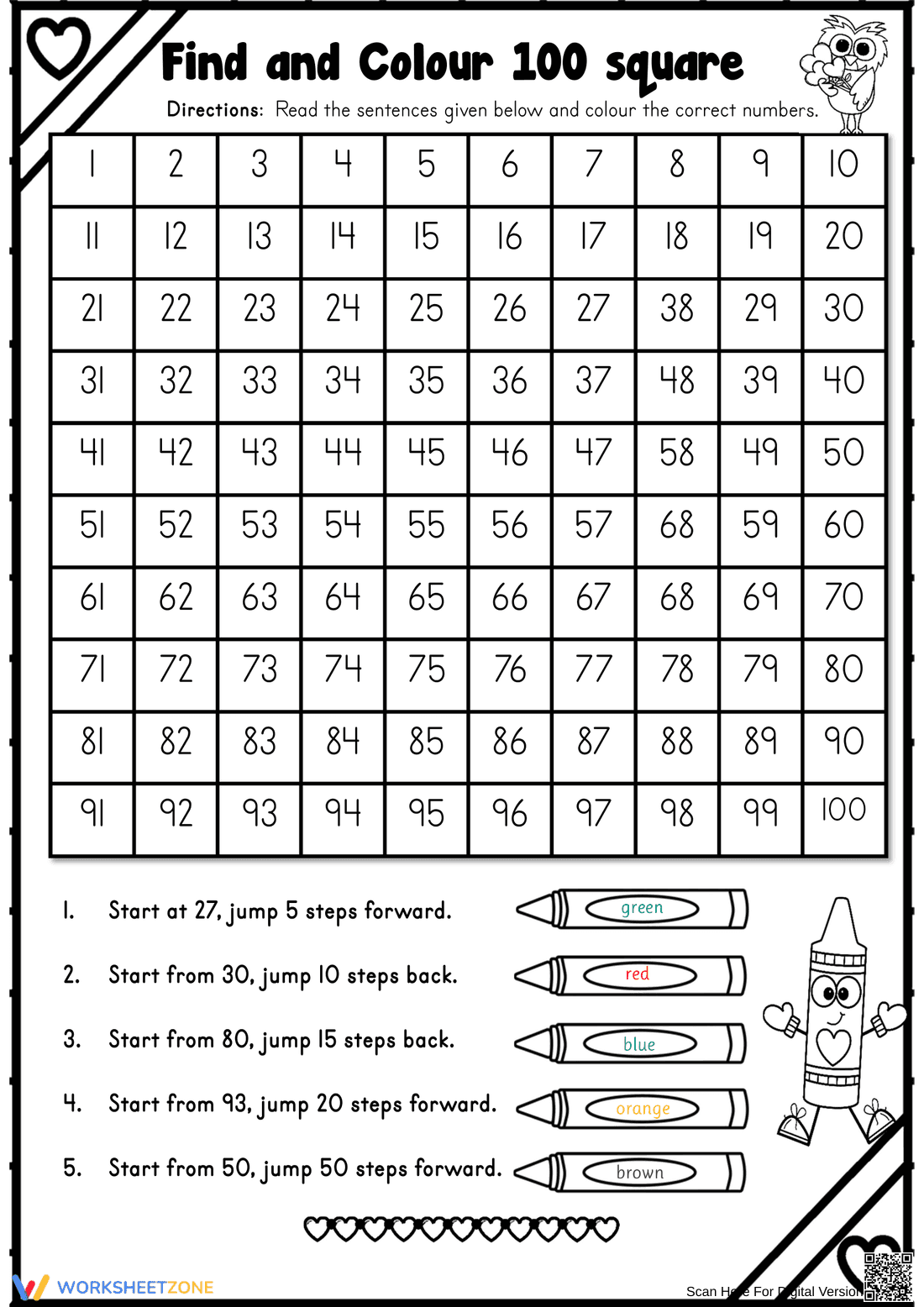

Valentine's Day 100 Chart Math | Essential Grade 3-5

Paste this activity's link or code into your existing LMS (Google Classroom, Canvas, Teams, Schoology, Moodle, etc.).
Students can open and work on the activity right away, with no student login required.
You'll still be able to track student progress and results from your teacher account.
This Valentine's Day themed math worksheet helps students master number patterns and mental arithmetic using a 100-square grid. By following specific "jump" instructions, learners practice adding and subtracting multi-digit numbers within 100. It transforms standard computation into a visual coloring activity that reinforces place value and numerical relationships.
At a Glance
- Grade: 3-5 · Subject: Math
- Standard:
CCSS.MATH.CONTENT.3.NBT.A.2— Fluently add and subtract within 1000 using strategies and algorithms- Skill Focus: 100-Chart Navigation
- Format: 1 page · 5 problems · Answer key included · PDF
- Best For: Seasonal morning work or math centers
- Time: 15–20 minutes
The worksheet features a clear 1-100 number grid and five specific word-based instructions. Each task requires students to identify a starting number, perform a "jump" (addition or subtraction), and color the resulting square according to a specific crayon color. The layout includes festive Valentine's Day illustrations, making it an engaging alternative to traditional drill sheets.
Zero-Prep Workflow
- Print: Generate the single-page PDF in seconds for your entire class.
- Distribute: Hand out the sheets with a basic set of crayons; no additional manipulatives are required.
- Review: Use the visual patterns on the completed 100-chart for a quick 5-minute check for understanding.
Total teacher preparation time is under two minutes, making it an ideal sub plan or transition activity during holiday weeks.
Standards Alignment
This activity aligns with `CCSS.MATH.CONTENT.3.NBT.A.2`, focusing on the ability to fluently add and subtract within 100. While the chart only goes to 100, the logic of "jumping" by tens and ones builds the foundational mental models required for larger three-digit operations. Both standard codes can be copied directly into lesson plans, IEP goals, or district curriculum mapping tools.
How to Use It
Use this worksheet as a formative assessment during the first ten minutes of math class to check for number sense fluency. Teachers should observe if students are counting by ones or recognizing vertical jumps as tens. It also serves as an excellent "early finisher" task during Valentine's Day week. Expected completion time ranges from 15 to 20 minutes depending on student familiarity with the 100-square layout.
Who It's For
This resource is tailored for elementary students in grades 3 through 5 who benefit from visual math supports. It is particularly effective for English Language Learners (ELLs) due to the repetitive sentence structures and for students with IEPs who require concrete manipulatives like a number grid. Pair this with a hundreds-chart anchor chart or a direct instruction lesson on mental math strategies.
According to the RAND AIRS 2024 report, visual aids like 100-charts are critical for developing the mental number line necessary for advanced arithmetic. This worksheet utilizes the CCSS.MATH.CONTENT.3.NBT.A.2 standard to bridge the gap between concrete counting and abstract calculation. By requiring students to "jump" forward and back, the activity reinforces the inverse relationship between addition and subtraction. Research from Fisher & Frey (2014) suggests that integrating coloring and following multi-step directions can increase engagement and retention of mathematical concepts in primary and intermediate grades. The 5 specific tasks provide enough data for teachers to identify common misconceptions in place value, such as failing to move vertically for tens. This printable resource offers a structured yet festive way to maintain academic rigor during seasonal holidays while providing immediate feedback through the visual pattern created on the grid.


