


























Views
Downloads

Essential Spring Vowels Worksheet | Preschool ELA Printable
Paste this activity's link or code into your existing LMS (Google Classroom, Canvas, Teams, Schoology, Moodle, etc.).
Students can open and work on the activity right away, with no student login required.
You'll still be able to track student progress and results from your teacher account.
Help young learners master vowel sounds with this themed Spring Words vowel practice sheet. This resource encourages students to identify pictures, pronounce words aloud, and transcribe the correct vowel sounds to complete seasonal vocabulary. It provides a focused path toward early literacy through phonemic awareness and spelling reinforcement.
At a Glance
- Grade: Preschool · Subject: ELA - Phonics
- Standard:
CCSS.ELA-LITERACY.RF.K.3.B— Associate common vowel sounds with their respective written graphemes- Skill Focus: Vowel Identification & Spelling
- Format: 2 pages · 8 problems · Answer key included · PDF
- Best For: Early phonics practice and seasonal review
- Time: 10–15 minutes
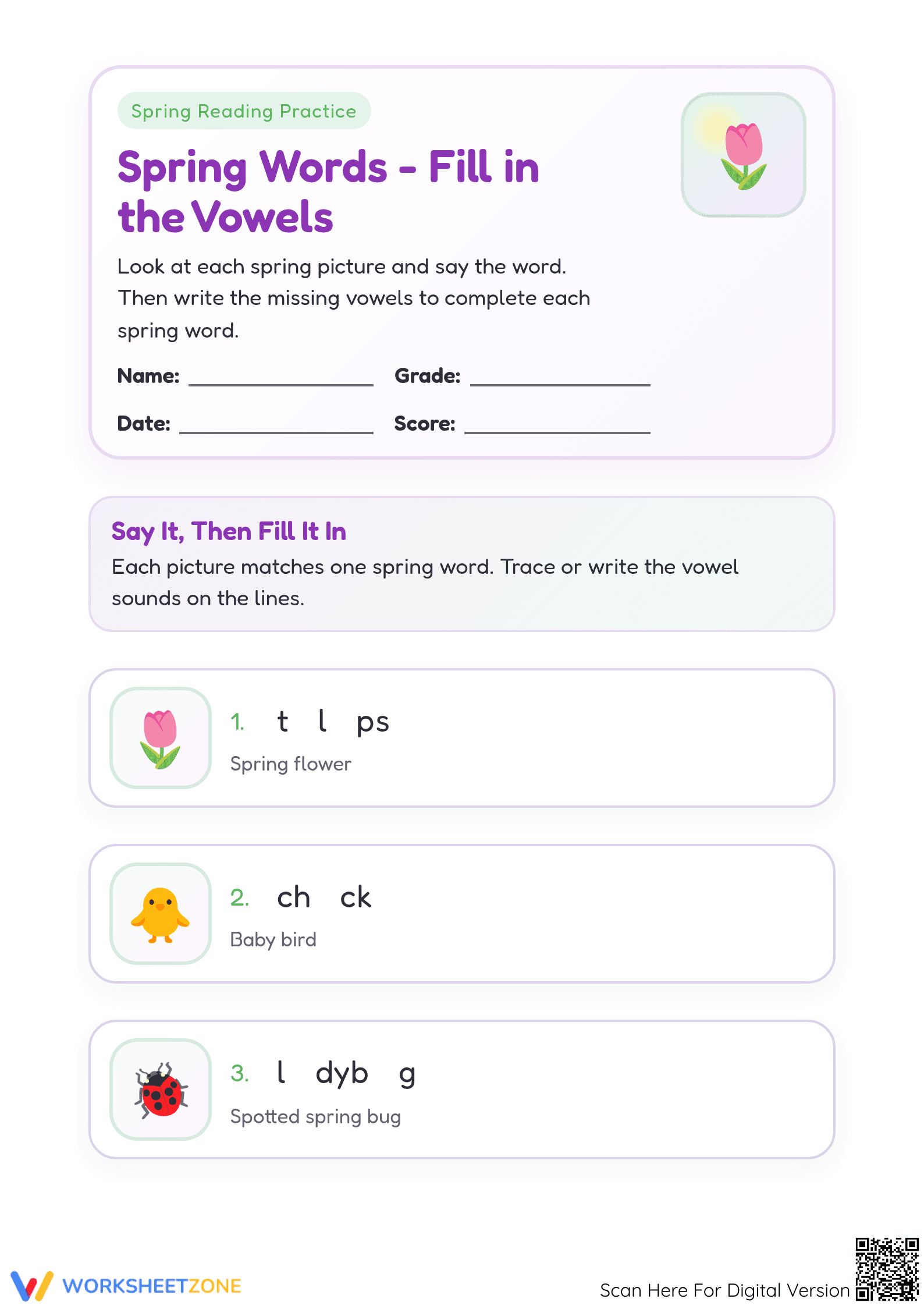
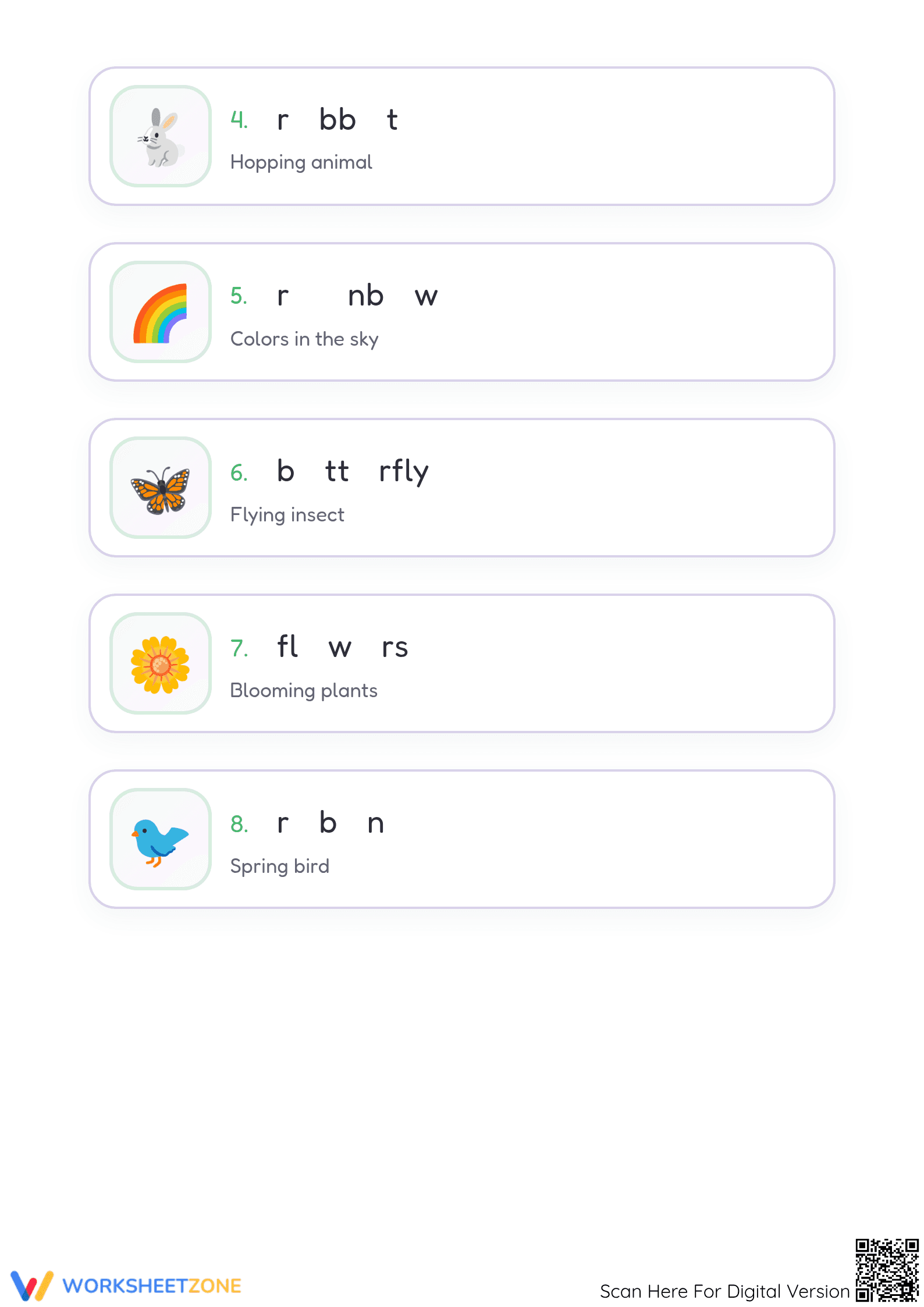
The Fill in the Vowels - Spring packet consists of two high-quality PDF pages. Each page features clear, colorful illustrations of spring items such as tulips, chicks, ladybugs, and rainbows. Below each image, students find a partially spelled word with blank spaces specifically designated for missing vowels. The set includes a total of eight distinct practice items, ensuring a manageable session for preschool-aged children. A full answer key is provided for quick verification.
This resource is designed for a zero-prep workflow to maximize instructional efficiency. Step 1: Print the two-page document (30 seconds). Step 2: Distribute to students and explain the Say It, Then Fill It In prompt (1 minute). Step 3: Review the completed vowels as a group to reinforce phonetic sounds (2 minutes). Preparation takes under two minutes, making it an ideal choice for morning work, sub plans, or transition activities during the spring semester.
The primary standard addressed is CCSS.ELA-LITERACY.RF.K.3.B, which requires students to associate the long and short sounds with the common spellings for the five major vowels. By requiring children to look at an object, produce its name, and determine the missing vowel, the activity bridges the gap between auditory processing and written representation. This standard code can be copied directly into lesson plans, IEP goals, or district curriculum mapping tools.
Integrate this worksheet during direct instruction on vowel sounds or as a quiet center activity. Use it after introducing a Word of the Day to see if students can apply their knowledge to other seasonal terms. A useful formative-assessment observation tip is to listen as students say the word before writing; if they struggle to articulate the vowel sound clearly, it may indicate a need for additional modeling. Completion typically takes ten to fifteen minutes.
This printable is tailored for Preschool and Kindergarten students who are beginning to recognize letters and their corresponding sounds. It is also beneficial for English Language Learners who need visual cues to support vocabulary acquisition. To enhance the lesson, pair this worksheet with a spring-themed picture book or a vowel sound anchor chart displayed in the classroom. The visual scaffolding ensures that even emergent readers can participate successfully.
Effective literacy instruction in early childhood emphasizes the critical role of phonological awareness as a precursor to successful reading. According to the foundational research of Fisher & Frey (2014), the gradual release of responsibility model is most effective when students are given structured opportunities to apply phonics skills to familiar contexts. This spring-themed resource utilizes standard CCSS.ELA-LITERACY.RF.K.3.B to guide preschoolers through the process of associating vowel sounds with their written symbols. By identifying the medial or initial vowel in words like chick or tulip, students develop the orthographic mapping skills necessary for long-term decoding proficiency. The inclusion of eight targeted tasks allows for sufficient repetition without overwhelming the learner, providing a clear data point for teachers monitoring early spelling progress. Such evidence-based practice ensures that foundational ELA skills are cemented through engaging, high-interest materials suitable for classroom or home use.


