


























Views
Downloads

Printable Number Bonds to 10 Worksheet | Grade K-1
Paste this activity's link or code into your existing LMS (Google Classroom, Canvas, Teams, Schoology, Moodle, etc.).
Students can open and work on the activity right away, with no student login required.
You'll still be able to track student progress and results from your teacher account.
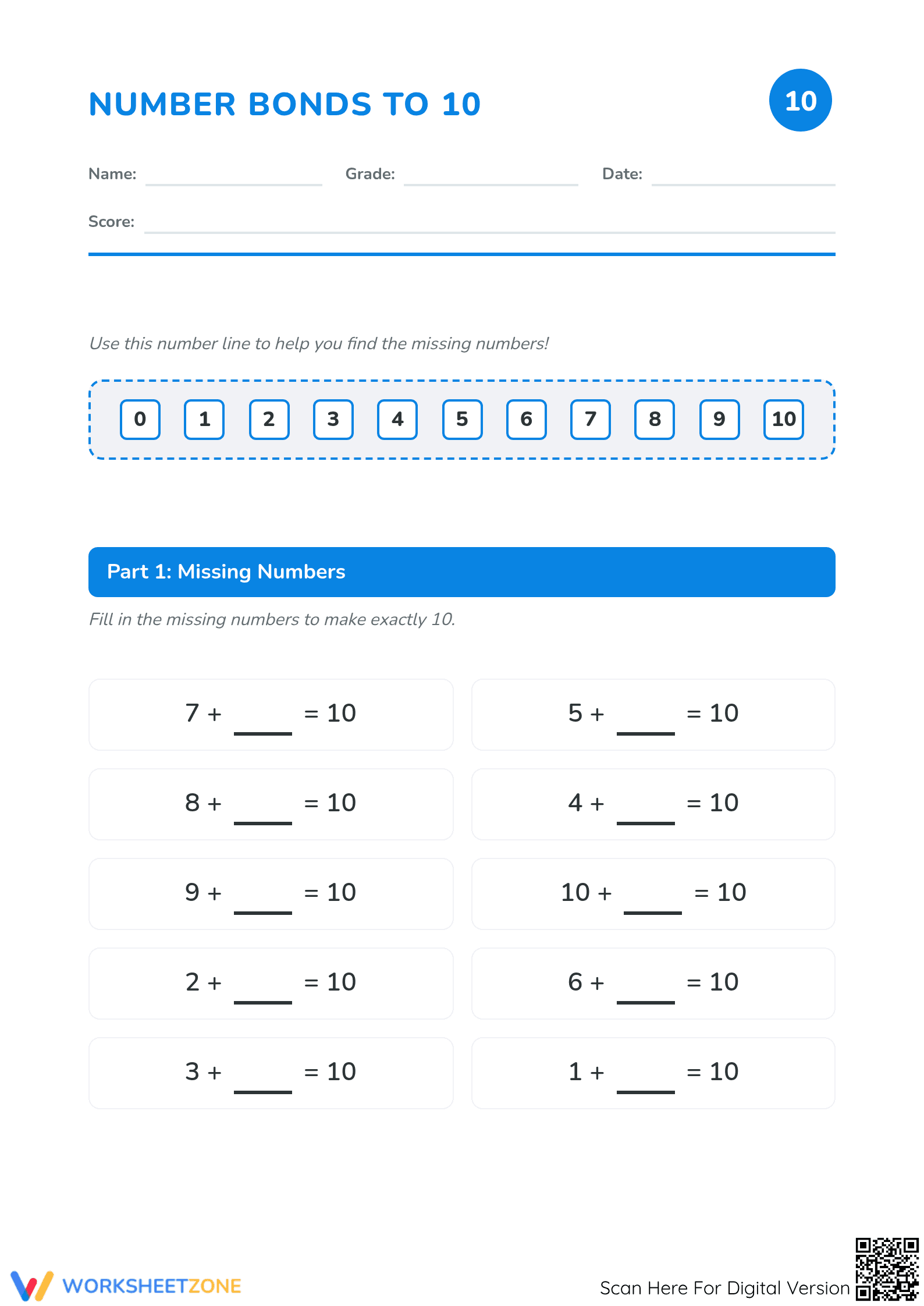
Mastering number pairs is a fundamental step toward algebraic thinking and mental math fluency. This comprehensive five-page worksheet helps students visualize and internalize number bonds to 10 through a variety of structured activities. By moving from concrete ten frames to abstract story problems, learners develop a deep conceptual understanding of how numbers combine to form a whole.
At a Glance
- Grade: K–1 · Subject: Math
- Standard:
K.OA.A.4— Find the number that makes 10 for any number from 1 to 9- Skill Focus: Number Bonds to 10
- Format: 5 pages · 50 problems · Answer key included · PDF
- Best For: Independent practice and small group instruction
- Time: 25–40 minutes
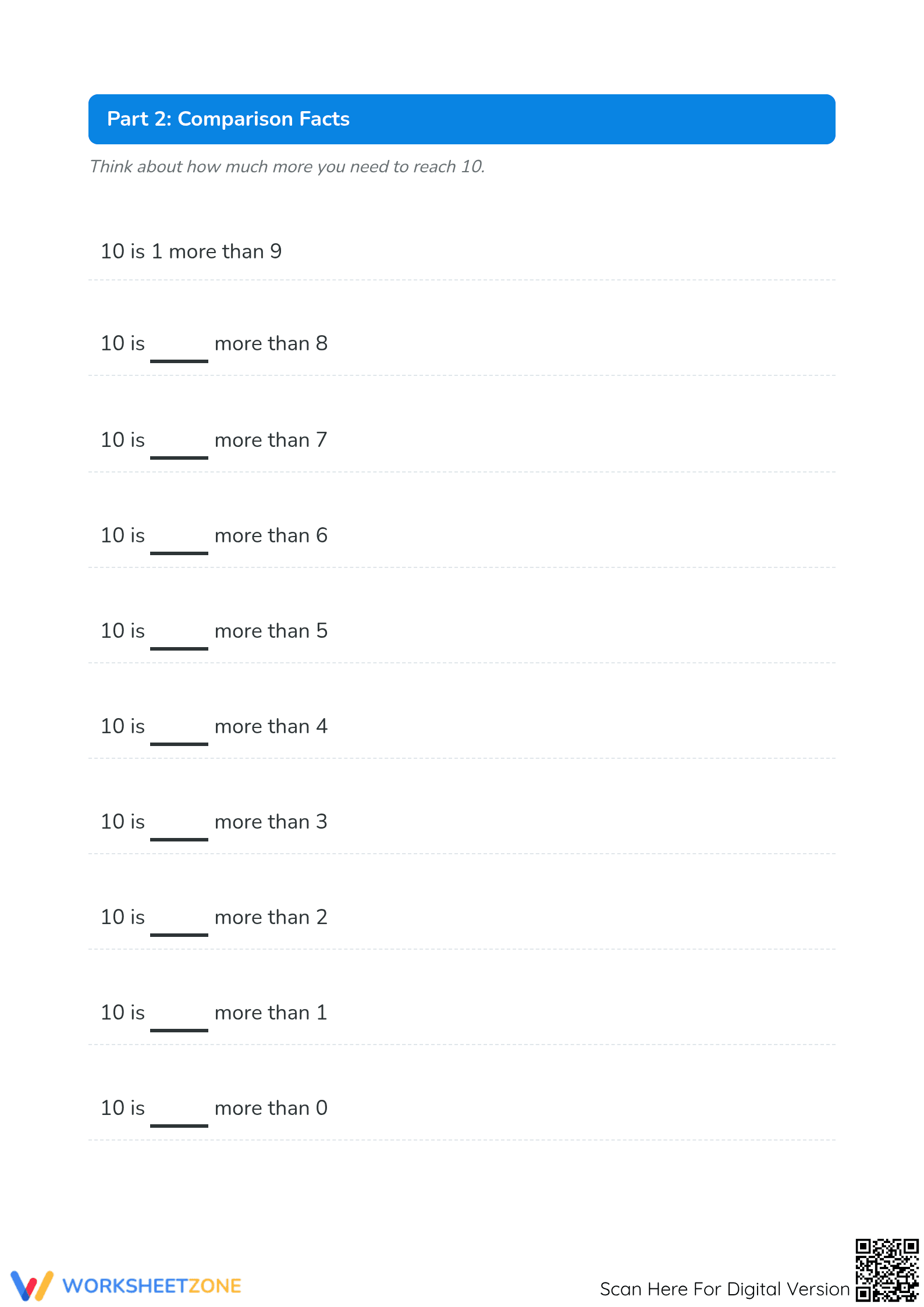
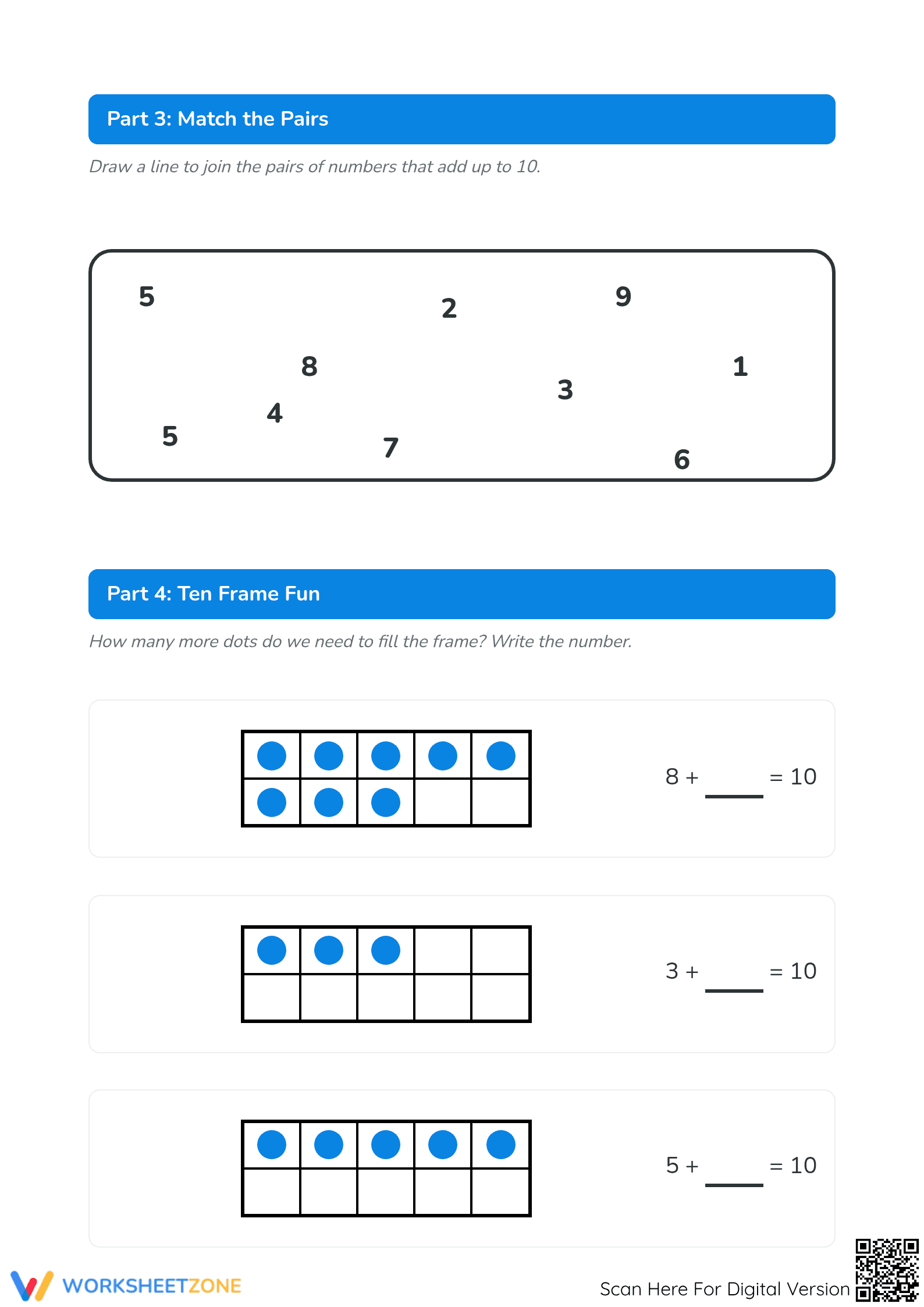
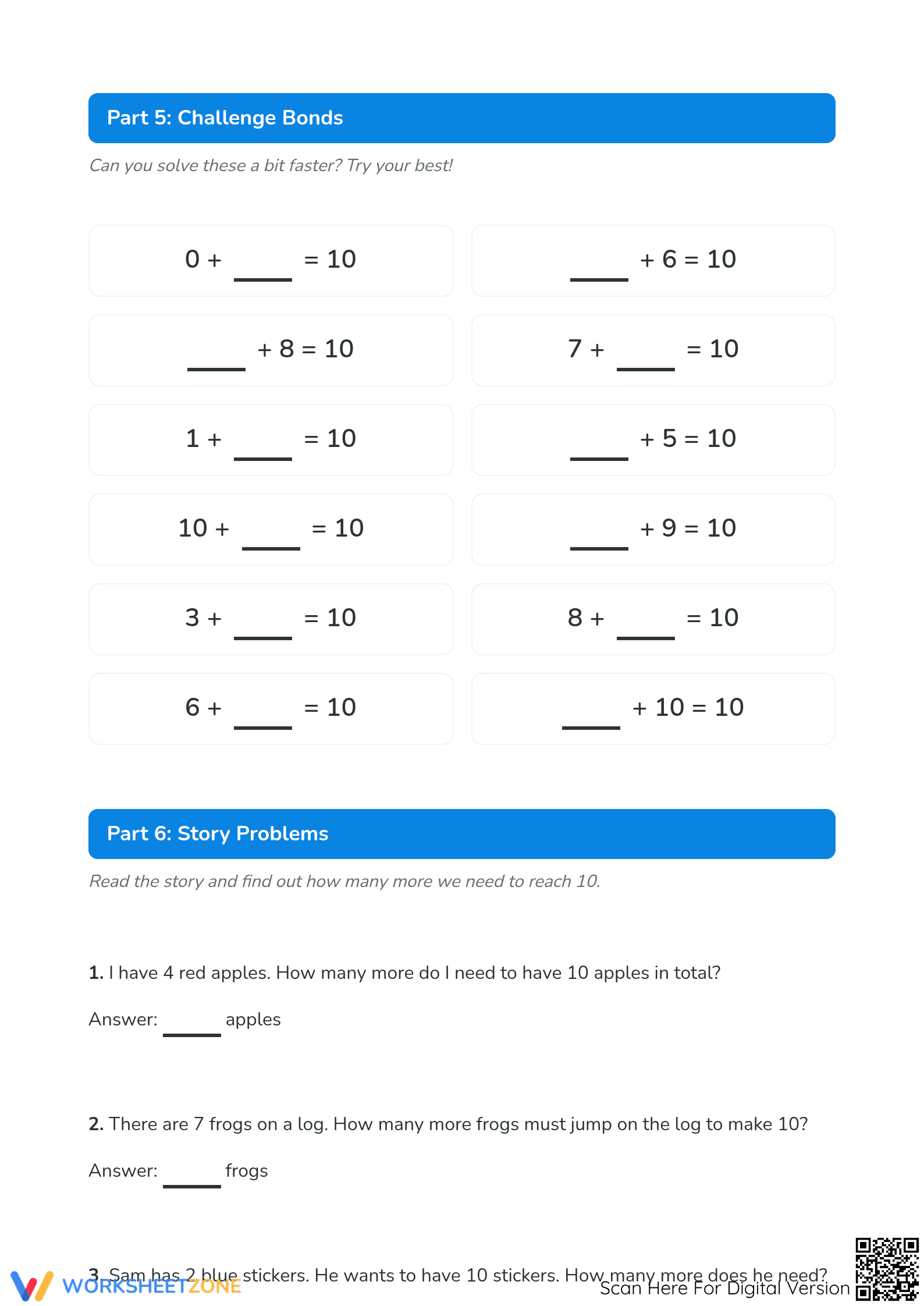
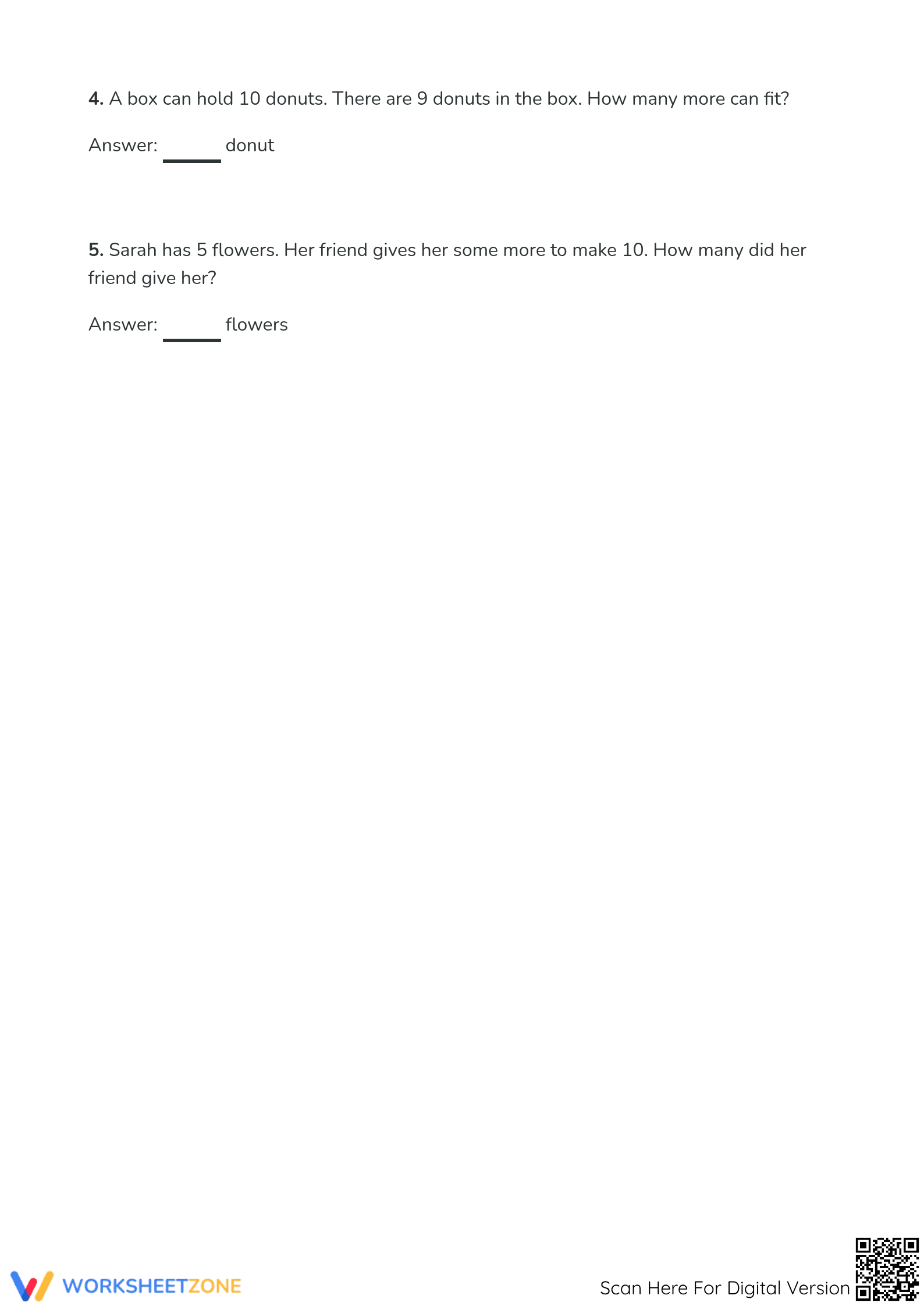
This robust packet contains five unique pages designed to keep students engaged while reinforcing the same core concept. It includes missing number equations, comparison fact sentences, a "match the pairs" visual activity, and ten-frame illustrations for visual support. The final sections challenge students with "Challenge Bonds" and multi-step story problems, ensuring a complete mastery check. A full answer key is provided for quick grading or student self-correction.
Teachers can integrate this resource into their math block with absolutely no preparation required. First, print the five-page packet for each student (less than 1 minute). Next, distribute the materials and allow students to use the included number line for support as they work through the six distinct parts (2 minutes). Finally, review the answers as a whole class or use the answer key for rapid individual assessment (5 minutes). Total teacher prep time is under two minutes.
The primary focus is K.OA.A.4: "For any number from 1 to 9, find the number that makes 10 when added to the given number, e.g., by using objects or drawings, and record the answer with a drawing or equation." It also supports 1.OA.C.6 regarding addition and subtraction within 20, demonstrating fluency for addition and subtraction within 10. Both standard codes can be copied directly into lesson plans, IEP goals, or district curriculum mapping tools.
Use this packet as a cumulative review after introducing number bonds with physical manipulatives like counters or Rekenreks. It serves as an excellent formative assessment to see which students still rely on visual supports versus those who have reached mental fluency. During the activity, circulate and observe if students are "counting on" from the first number or if they can recall the pair automatically from memory.
This resource is tailored for Kindergarten and First Grade students, though it provides valuable remediation for Second Grade learners struggling with basic fact fluency. It is particularly effective for English Language Learners due to the visual ten frames and consistent sentence structures. Pair this worksheet with a "Ways to Make 10" anchor chart for a supported learning environment.
Early mastery of number bonds is a critical predictor of later success in multi-digit addition and subtraction. According to a RAND AIRS 2024 analysis, students who internalize "friendly numbers" like ten demonstrate significantly higher confidence when transitioning to regrouping and mental math strategies in higher grades. This worksheet aligns with the Fisher & Frey (2014) gradual release of responsibility model by moving students from scaffolded ten-frame visuals to independent application in word problems. By providing multiple modes of representation—equations, diagrams, and text—the resource ensures that learners with different processing styles can access the content. Fluent identification of pairs to ten is a foundational pillar that prevents mathematical plateaus in later elementary education. This packet provides the high-repetition, low-stress practice necessary for long-term retention of these essential mathematical facts.


