


























Views
Downloads
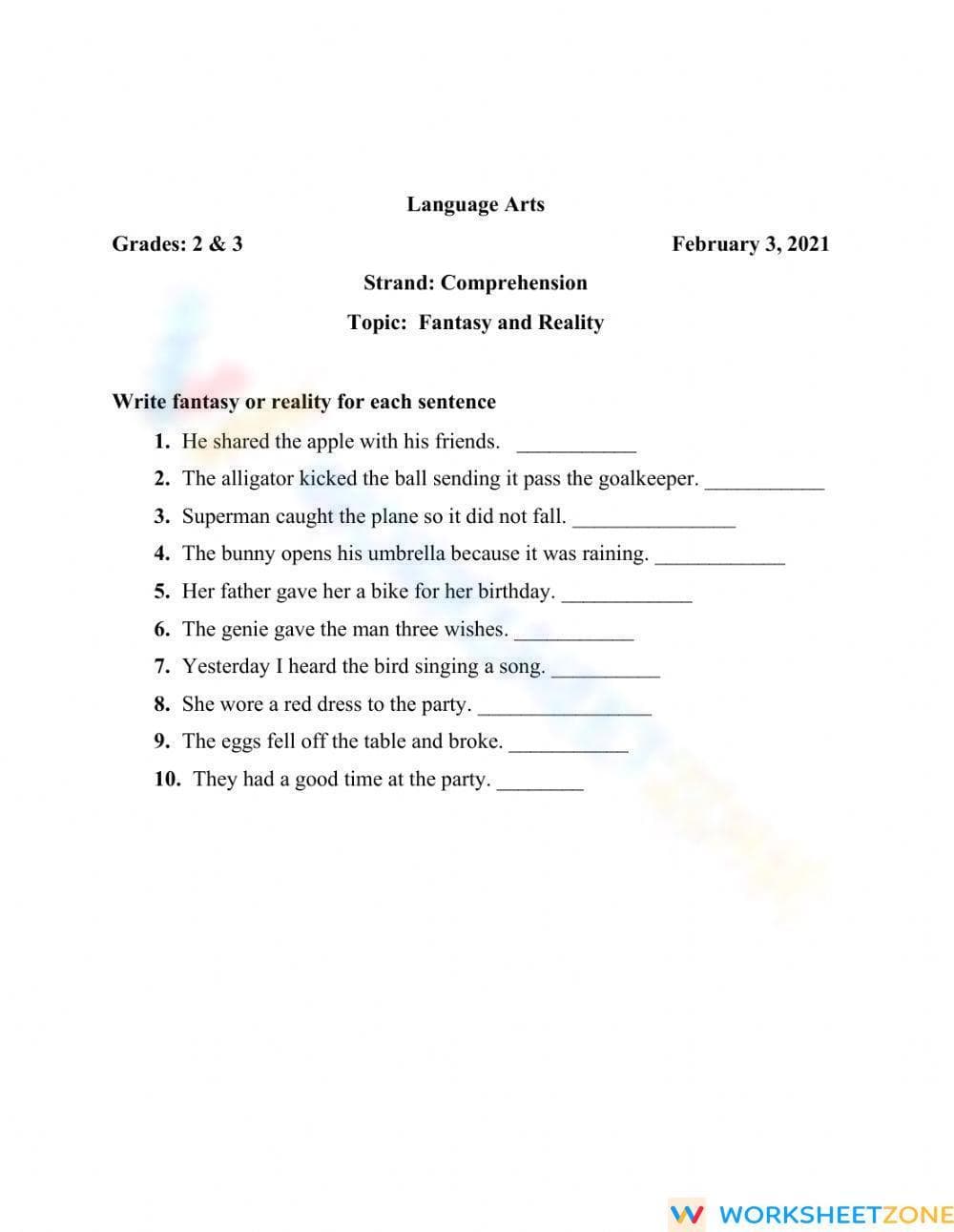

Grade 2-4 Fantasy or Reality — Printable ELA Worksheet
Paste this activity's link or code into your existing LMS (Google Classroom, Canvas, Teams, Schoology, Moodle, etc.).
Students can open and work on the activity right away, with no student login required.
You'll still be able to track student progress and results from your teacher account.
Developing strong reading comprehension requires distinguishing make-believe from reality. This worksheet invites Grade 2-4 students to analyze ten sentences to determine if events are fantasy or reality. By engaging with these tasks, learners build the cognitive framework needed to identify genre elements and narrative logic with precision.
At a Glance
- Grade: 2-4 · Subject: English Language Arts
- Standard:
CCSS.ELA-LITERACY.RL.2.1— Ask and answer questions about key details in a text- Skill Focus: Distinguishing fantasy from reality
- Format: 1 page · 10 problems · Answer key included · PDF
- Best For: Independent practice and quick formative assessment
- Time: 10–15 minutes
What's Inside
This single-page resource features ten sentences that challenge students to apply world knowledge to literary concepts. Each prompt includes a dedicated line for classification, ensuring an organized workspace. From talking genies to birthday celebrations, the content covers relatable and imaginative scenarios. The PDF format is optimized for printing and includes an answer key.
Zero-Prep Workflow
- Print: Send the document to your printer for immediate use (30 seconds).
- Distribute: Hand out sheets and define the terms (1 minute).
- Review: Check answers using the provided key (5 minutes).
This process requires less than two minutes of preparation, making it an ideal choice for substitute plans.
Standards Alignment
Aligned to CCSS.ELA-LITERACY.RL.2.1, this resource requires students to demonstrate understanding of key details. By determining the feasibility of a sentence, students perform detail analysis. Supporting standards include CCSS.ELA-LITERACY.RL.3.1, focusing on using text evidence. Both standard codes can be copied directly into lesson plans, IEP goals, or district curriculum mapping tools.
How to Use It
Incorporate this worksheet during guided practice to reinforce narrative structure. It serves as an excellent formative-assessment tool; teachers should observe if students struggle with anthropomorphic characters to identify needs for further instruction. The expected completion time is 10 to 15 minutes, making it a perfect warm-up activity before transitioning into longer reading passages.
Who It's For
This activity is designed for Grade 2-4 students refining their ability to distinguish literal and figurative language. It provides natural differentiation for English Language Learners through clear vocabulary. This worksheet pairs naturally with a short fictional story or an anchor chart. It is also effective for small-group intervention for students requiring additional repetitions.
According to the RAND AIRS 2024 report, categorizing information into domains like fantasy and reality is a critical milestone. This Grade 2-4 worksheet utilizes CCSS.ELA-LITERACY.RL.2.1 to bridge identification and literary analysis. By evaluating ten scenarios ranging from genies to birthday parties, students strengthen their schema for genre conventions. Mastery ensures learners can process complex literary texts with greater accuracy. Researchers like Fisher & Frey (2014) emphasize that such guided practice facilitates the gradual release of responsibility, moving students from modeling to independent verification. This resource provides the necessary scaffolding to secure essential comprehension anchors before students progress to nuanced literary devices. Discernment between realistic and imaginative events remains a foundational skill that supports lifelong literacy across all academic subject areas.


