


























Views
Downloads
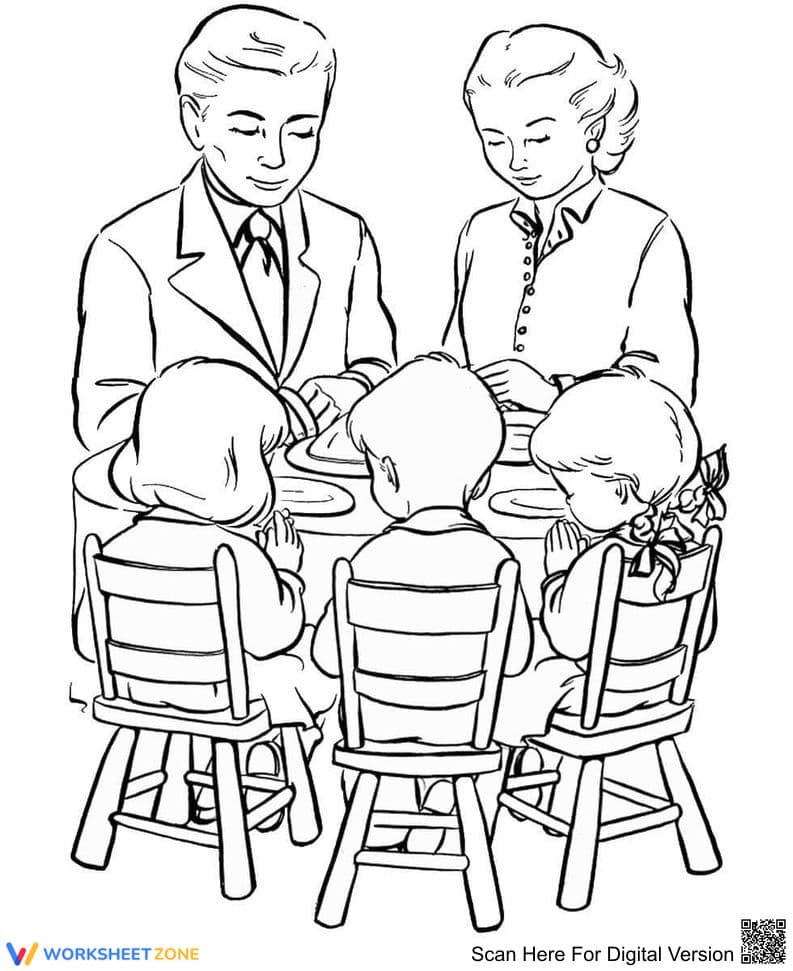

Family Meal Coloring Page — Printable Grade K-2 Activity
Paste this activity's link or code into your existing LMS (Google Classroom, Canvas, Teams, Schoology, Moodle, etc.).
Students can open and work on the activity right away, with no student login required.
You'll still be able to track student progress and results from your teacher account.
This printable family meal coloring page provides early learners with a creative outlet while building fine motor skills and vocabulary. Students color a detailed illustration of a family gathered around a dinner table, creating natural opportunities to discuss family traditions, daily routines, and descriptive language in the classroom.
At a Glance
- Grade: K · Subject: English
- Standard:
CCSS.ELA-LITERACY.SL.K.4— Describe familiar people, places, things, and events- Skill Focus: Fine motor skills and vocabulary
- Format: 1 page · 1 problem · No answer key · PDF
- Best For: Morning work or transition times
- Time: 15–20 minutes
Inside this single-page PDF, educators will find a high-quality, black-and-white line drawing featuring a mother, father, and three children sitting together at a dining table. The illustration includes distinct details like clothing patterns, chairs, and table settings that encourage careful coloring. Because this is an open-ended creative task, no answer key is required.
Zero-Prep Workflow
This resource is designed for immediate classroom implementation.
- Print (1 minute): Download the PDF and print copies. The crisp line art ensures low ink consumption.
- Distribute (1 minute): Hand out the sheets with crayons or markers.
- Review (0 minutes): No formal grading is necessary.
Total teacher prep time is under 2 minutes, making this an excellent addition to any emergency sub plan.
Standards Alignment
This activity aligns with CCSS.ELA-LITERACY.SL.K.4: Describe familiar people, places, things, and events and, with prompting and support, provide additional detail. While primarily a coloring task, the visual subject matter serves as an excellent prompt for oral language development regarding family structures and daily meals. Both standard codes can be copied directly into lesson plans, IEP goals, or district curriculum mapping tools.
How to Use It
Use this worksheet as a calming morning work activity as students arrive. Alternatively, it serves as an effective transition task after recess. As a formative assessment observation tip, teachers can ask individual students to name the family members they are coloring, assessing expressive vocabulary. Expected completion time ranges from 15 to 20 minutes.
Who It's For
This resource is primarily designed for Kindergarten and early elementary students developing their fine motor control and basic vocabulary. It naturally accommodates diverse learners, as students can engage with the material at their own developmental level without the pressure of right or wrong answers. For a comprehensive lesson, pair this coloring page with a read-aloud book about family traditions or a direct instruction lesson on healthy eating.
Integrating creative tasks like this family meal coloring page supports foundational early childhood development and fine motor coordination. Aligned with CCSS.ELA-LITERACY.SL.K.4, which requires students to describe familiar people, places, things, and events, this visual prompt bridges the gap between fine motor practice and oral language acquisition. According to a recent ScienceDirect TpT Analysis, incorporating familiar, culturally relevant imagery into early learning materials significantly increases student engagement and provides a comfortable context for vocabulary expansion. When young children color scenes they recognize from their own daily lives, such as a shared family dinner, they are much more likely to initiate spontaneous conversations with peers and teachers. This natural interaction reinforces expressive language skills in a low-stress, creative environment. This simple yet effective tool demonstrates how art-based activities can directly support broader literacy and communication objectives in the early elementary classroom.


