


























Views
Downloads

Fact or Opinion Worksheet | Essential Grade 3 ELA Practice
Paste this activity's link or code into your existing LMS (Google Classroom, Canvas, Teams, Schoology, Moodle, etc.).
Students can open and work on the activity right away, with no student login required.
You'll still be able to track student progress and results from your teacher account.
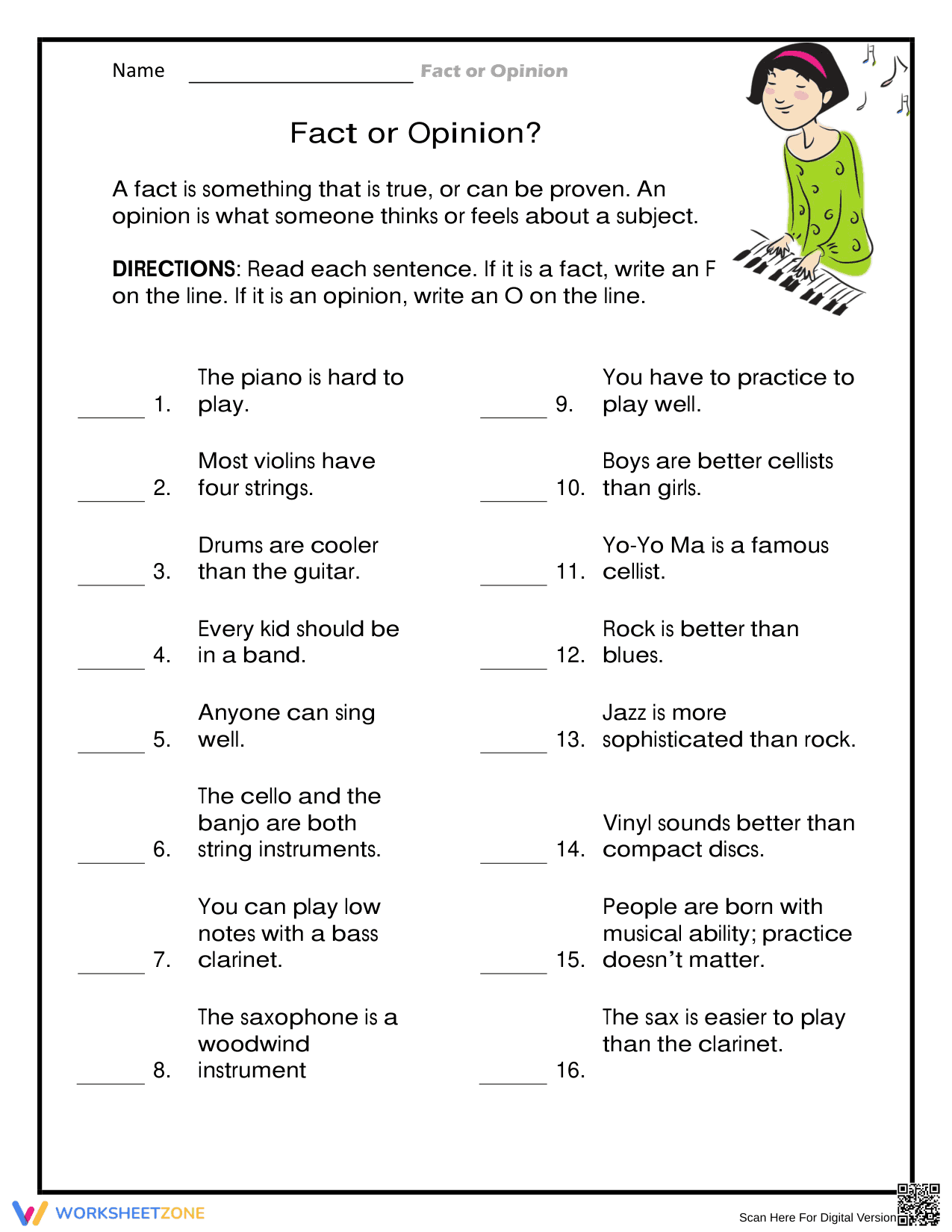
Differentiating between objective truth and subjective perspective is a cornerstone of critical literacy. This Grade 3 English Language Arts worksheet provides students with targeted practice in identifying facts and opinions through 16 engaging musical-themed sentences. By mastering this skill, students develop the analytical tools necessary for effective reading comprehension and persuasive writing.
At a Glance
- Grade: 3 · Subject: ELA
- Standard:
CCSS.ELA-LITERACY.RI.2.8— Describe how reasons support specific points the author makes in a text- Skill Focus: Distinguishing Fact vs. Opinion
- Format: 1 page · 16 problems · Answer key included · PDF
- Best For: Independent practice or bell-ringer activity
- Time: 15–20 minutes
The "Facts For Me" worksheet features a clean, student-friendly layout with a clear definition of the core concepts at the top. The single-page PDF contains 16 diverse sentences related to musical instruments and culture, ranging from provable statements like "Most violins have four strings" to subjective claims such as "Drums are cooler than the guitar." A full answer key is provided to ensure quick and accurate grading.
This resource is designed for a zero-prep workflow to maximize instructional efficiency. Teachers can print the single-page PDF in under 30 seconds, distribute it to the class in less than a minute, and review the 16 items using the provided key in about 60 seconds. This total teacher prep time of under two minutes makes it an ideal solution for emergency sub plans or quick transitions.
The worksheet is aligned with `CCSS.ELA-LITERACY.RI.2.8`, which requires students to identify how authors use reasons to support points. By determining if a statement is a provable fact or a personal opinion, students learn to evaluate the strength of evidence in informational texts. This standard code can be copied directly into lesson plans, IEP goals, or district curriculum mapping tools to track student progress toward mastery.
For optimal results, use this worksheet as a formative assessment after a direct instruction lesson on evidence and claims. Alternatively, assign it as a morning warm-up to reinforce critical thinking skills. Teachers should observe whether students can explain why a statement is an opinion, specifically looking for signal words like "better," "hard," or "should" as an indicator of advanced understanding.
This practice set is intended for students in Grades 2 through 4 who are building foundational reading skills. It is particularly effective for learners who benefit from concrete examples and clear formatting. The musical theme provides a neutral, high-interest context that pairs naturally with informational passages about history or fine arts, providing a bridge between grammar and content-area literacy.
Distinguishing facts from opinions is a vital component of information literacy according to RAND AIRS 2024. Research by Fisher & Frey (2014) emphasizes that students must move beyond mere identification to understand how these elements function within a broader argumentative structure. This worksheet facilitates that transition by providing 16 instances where students must evaluate the verifiability of a claim. Mastery of the `CCSS.ELA-LITERACY.RI.2.8` standard ensures that learners are prepared for more complex textual analysis in upper elementary grades. By isolating the skill of evidence evaluation, educators can pinpoint specific gaps in logic or vocabulary that might otherwise be obscured in longer reading passages. This structured approach to ELA practice supports the development of rigorous academic habits and informed citizenship, as identified by NAEP as a key indicator of college and career readiness in the 21st century.


