


























Views
Downloads

Essential Fact and Opinion Worksheet | Grade 2 ELA
Paste this activity's link or code into your existing LMS (Google Classroom, Canvas, Teams, Schoology, Moodle, etc.).
Students can open and work on the activity right away, with no student login required.
You'll still be able to track student progress and results from your teacher account.
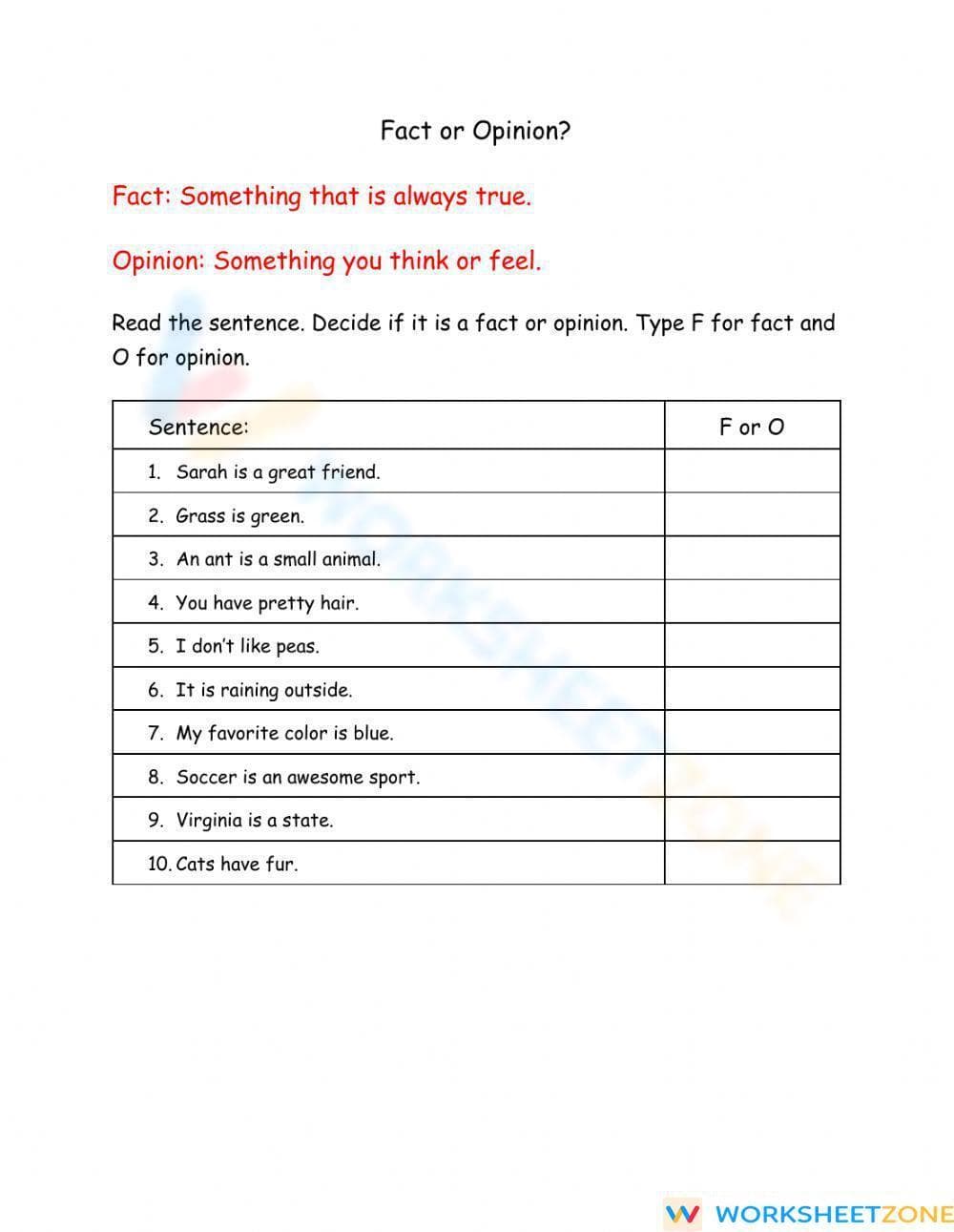
This Grade 2 fact and opinion worksheet helps students distinguish between objective truths and subjective viewpoints through focused sentence analysis. By evaluating ten distinct statements, learners develop critical reading skills necessary for comprehension and media literacy. This resource ensures students can identify evidence-based facts versus personal feelings, establishing a strong foundation for analytical thinking.
At a Glance
- Grade: 2 · Subject: ELA
- Standard:
CCSS.ELA-LITERACY.RI.2.8— Describe how reasons support specific points the author makes in a text- Skill Focus: Fact vs. Opinion Distinction
- Format: 1 page · 10 problems · Answer key included · PDF
- Best For: Independent practice and quick formative assessment
- Time: 10–15 minutes
This single-page PDF features a clear, accessible layout designed for young readers. It begins with concise definitions of "Fact" and "Opinion" to provide immediate scaffolding. The core task consists of a structured table with ten sentences ranging from scientific observations like "Grass is green" to personal preferences such as "I don't like peas." Students simply record an "F" or "O" for each, making it ideal for both digital and print use.
The zero-prep workflow for this resource is designed for maximum efficiency. Teachers can print the single-page document in less than 30 seconds. Distributing the worksheet to a standard classroom takes approximately one minute, with the self-explanatory instructions allowing students to begin immediately. Reviewing the ten responses with the class requires only two minutes, resulting in a total teacher engagement time of under five minutes. This makes it an ideal choice for morning work, sub plans, or transition periods.
This resource is primarily aligned to CCSS.ELA-LITERACY.RI.2.8, which requires students to describe how reasons support specific points in a text by identifying factual evidence. It also supports CCSS.ELA-LITERACY.RI.2.6 by helping students identify the main purpose of a text, including what the author wants to answer, explain, or describe. Both standard codes can be copied directly into lesson plans, IEP goals, or district curriculum mapping tools.
Use this worksheet as a formative assessment after a direct instruction lesson on author's purpose. It serves as an excellent exit ticket to gauge student mastery of the distinction between fact and opinion before moving on to complex texts. During completion, observe if students struggle with statements involving adjectives like "great" or "awesome," which often signal opinions. Most students will complete the exercise in 10 to 12 minutes.
This resource is tailored for Grade 2 students but is highly effective for Grade 3 review or English Language Learners (ELL) requiring vocabulary-rich, low-stakes practice. The simple sentence structures accommodate various reading levels while focusing strictly on the logic of the statements. It pairs naturally with informational text units or anchor charts that list common opinion signal words like "favorite," "best," and "believe."
Mastering the distinction between facts and opinions is a cornerstone of early literacy and critical thinking development. According to the RAND AIRS 2024 report, students who receive explicit instruction in identifying statement types show a improvemnt in evaluating the credibility of informational texts. This worksheet targets the CCSS.ELA-LITERACY.RI.2.8 standard by providing the repetition necessary for cognitive automaticity in distinguishing objective reality from subjective experience. Research from Fisher & Frey (2014) emphasizes that the gradual release of responsibility begins with such focused, scaffolded practice before students apply these skills to longer, more complex passages. By isolating the skill of fact and opinion identification in ten distinct tasks, this resource ensures that Grade 2 learners can accurately categorize information, which is a vital prerequisite for higher-order reasoning and evidence-based writing in later elementary grades.


