


























Views
Downloads
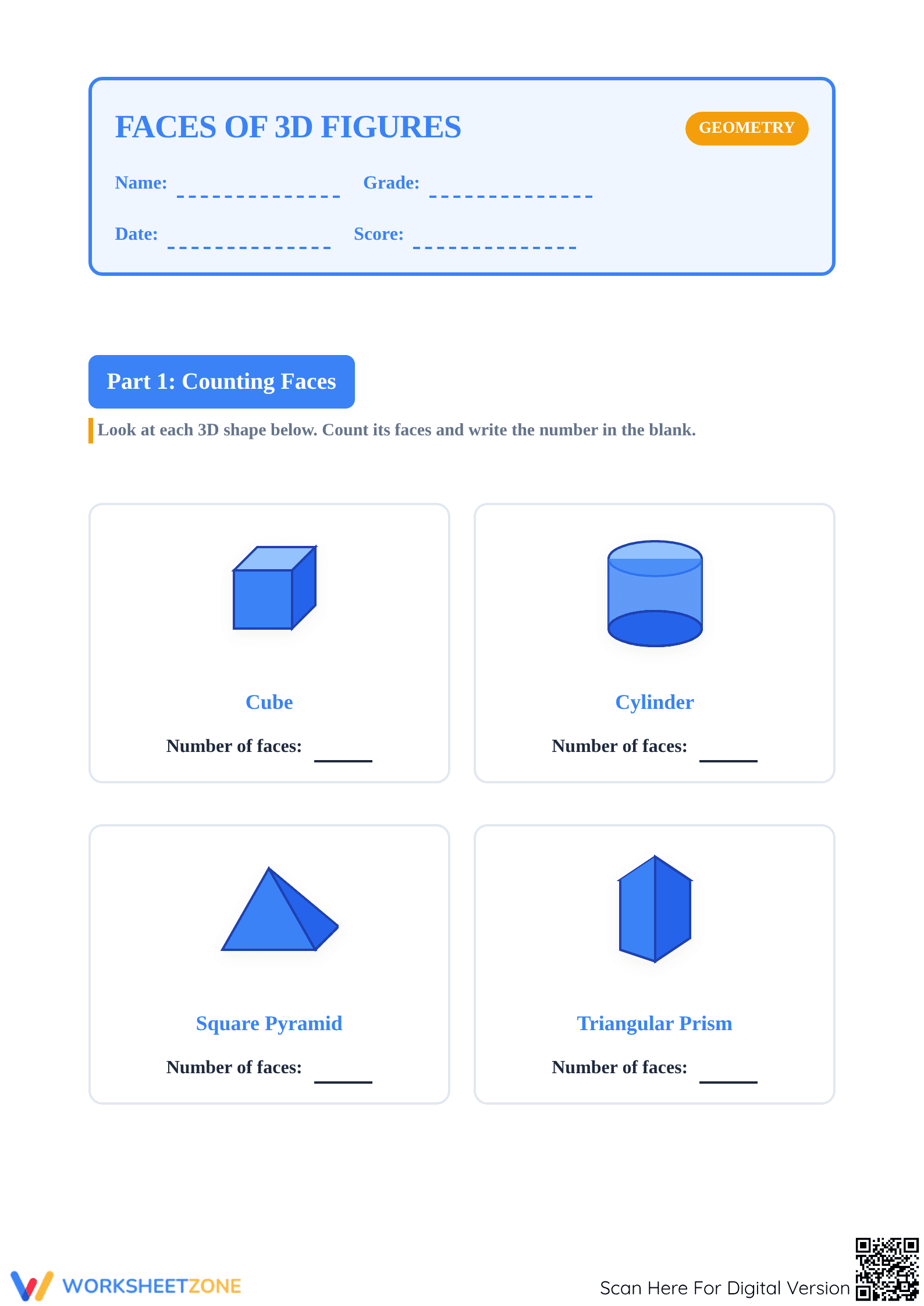



Printable Faces of 3D Figures Worksheet | Grade 2 Math
Paste this activity's link or code into your existing LMS (Google Classroom, Canvas, Teams, Schoology, Moodle, etc.).
Students can open and work on the activity right away, with no student login required.
You'll still be able to track student progress and results from your teacher account.
Identifying the geometric attributes of three-dimensional shapes is a foundational skill in primary mathematics. This worksheet provides students with a structured way to recognize and count faces on common 3D figures like cubes, spheres, and prisms. By focusing on observable physical properties, learners develop the spatial reasoning necessary for advanced geometry and real-world measurement applications.
At a Glance
- Grade: 2 · Subject: Geometry
- Standard:
CCSS.MATH.CONTENT.2.G.A.1— Recognize and draw shapes having specified attributes, such as a given number of equal faces- Skill Focus: Identifying faces on 3D figures
- Format: 5 pages · 25 problems · Answer key included · PDF
- Best For: Independent geometry practice and homework assignments
- Time: 20–30 minutes
This comprehensive 5-page resource includes a variety of tasks designed to solidify student understanding of 3D shape attributes. Each page features clear illustrations of geometric solids, including cubes, rectangular prisms, cones, and cylinders. Students are prompted to identify and record the number of faces for each figure. The package includes a detailed answer key for rapid grading and immediate student feedback.
The zero-prep workflow for this resource is designed for maximum efficiency. Teachers can print the entire 5-page set in under 60 seconds. Distribution to a standard class takes less than 2 minutes. Reviewing the answers using the provided key requires approximately 5 minutes of teacher time. This makes it an ideal choice for emergency sub plans or last-minute instructional shifts.
This worksheet is strictly aligned to CCSS.MATH.CONTENT.2.G.A.1. The standard requires students to recognize and draw shapes having specified attributes, such as a given number of angles or a given number of equal faces. This practice focuses specifically on the "faces" component of the standard. This standard code can be copied directly into lesson plans, IEP goals, or district curriculum mapping tools.
Use this worksheet during the independent practice portion of a geometry lesson. After introducing the concept of faces, edges, and vertices, assign the first two pages to gauge student understanding. A helpful formative assessment tip is to observe if students are counting the "hidden" faces in 2D representations of 3D solids. Completion typically takes 25 minutes.
This resource is designed for Grade 2 students but is also suitable for Grade 3 review or Grade 1 enrichment. It supports English Language Learners by providing clear visual representations of each geometric term. Pair this with physical manipulatives or an anchor chart for best results.
According to the RAND AIRS 2024 report on elementary mathematics, the early acquisition of spatial reasoning skills through attribute identification is a primary predictor of later success in high school geometry. Research by Fisher & Frey (2014) emphasizes the importance of gradual release models, where students move from concrete manipulation to semi-concrete representations on paper. This worksheet bridges that gap by providing high-quality visual stimuli that require students to mentally rotate 3D figures to identify hidden faces. By engaging with these 25 structured problems, students reinforce their ability to classify shapes based on definitive physical characteristics. The inclusion of a full answer key ensures that teachers can maintain a high pace of instruction while providing the corrective feedback necessary for mastery of the standard CCSS.MATH.CONTENT.2.G.A.1. This alignment makes it a reliable tool for district-wide standard assessment and routine classroom practice.


