


























Views
Plays


Expository Writing Quiz | Grade 6-8 Essential Guide
Paste this activity's link or code into your existing LMS (Google Classroom, Canvas, Teams, Schoology, Moodle, etc.).
Students can open and work on the activity right away, with no student login required.
You'll still be able to track student progress and results from your teacher account.
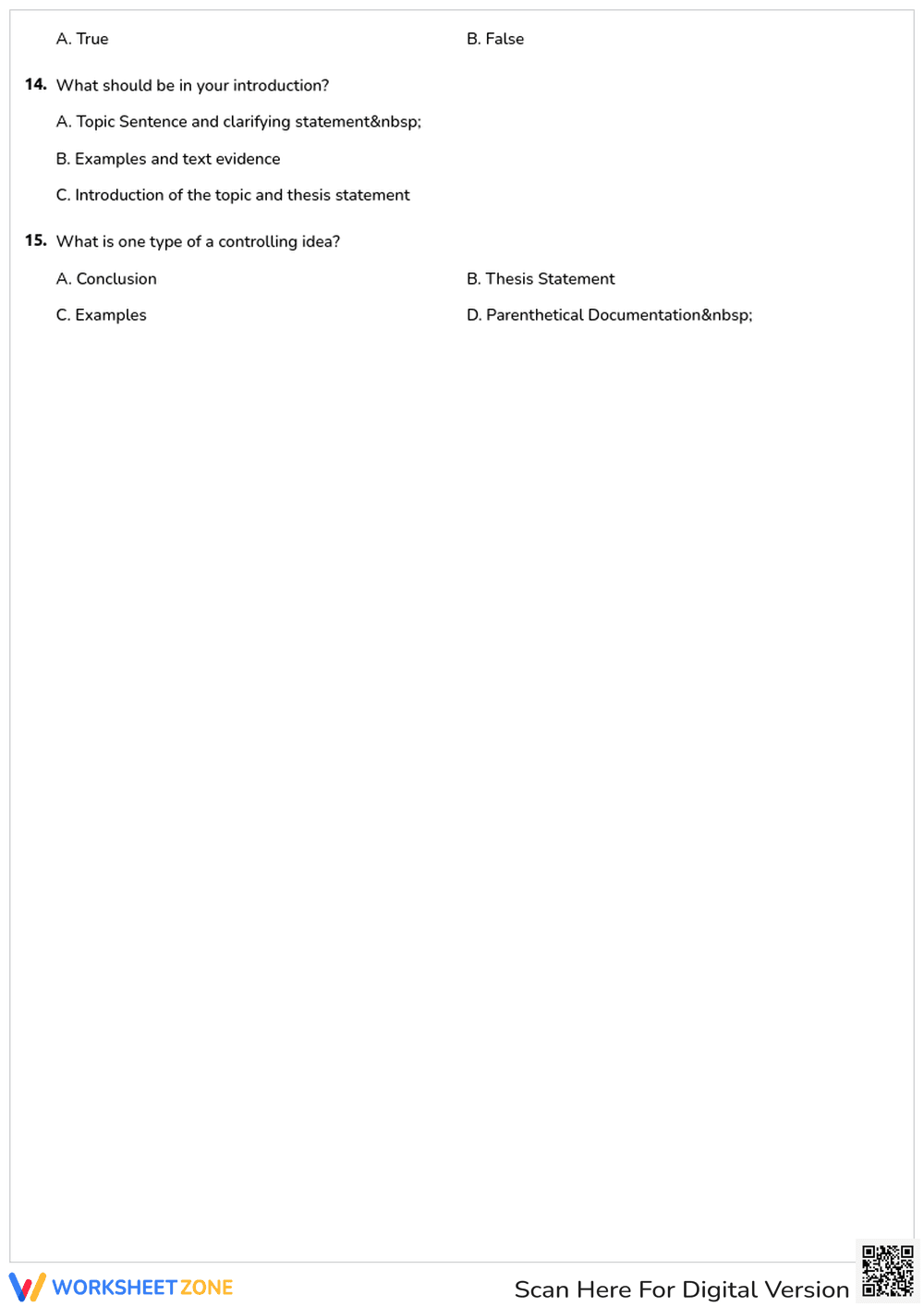
This Grade 6-8 expository writing worksheet provides a comprehensive review of essay structure and formal writing conventions. Students demonstrate their understanding of controlling ideas, thesis placement, and the integration of textual evidence. By identifying correct parenthetical documentation and paragraph components, learners solidify the foundational skills required for academic writing success and informational text production.
At a Glance
- Grade: 6-8 · Subject: ELA Writing
- Standard:
CCSS.ELA-LITERACY.W.6.2— Write informative/explanatory texts to examine a topic and convey ideas clearly- Skill Focus: Expository Essay Structure
- Format: 2 pages · 15 problems · Answer key included · PDF
- Best For: Formative assessment or unit review
- Time: 15–20 minutes
The resource consists of a two-page assessment featuring 15 targeted questions. It utilizes a mix of multiple-choice and true/false formats to evaluate student knowledge of essay anatomy. Key topics include the distinction between topic sentences and thesis statements, the proper use of parenthetical citations, and the required elements of an introductory paragraph. A clear layout ensures readability for middle school students.
Zero-Prep Workflow
- Print: Select the two-page PDF and print enough copies for your class in under 1 minute.
- Distribute: Hand out the quiz as a bell-ringer or exit ticket to gauge student mastery of writing concepts.
- Review: Use the included answer key to grade or facilitate a peer-review session immediately after completion.
Total teacher preparation time is under 2 minutes, making this an ideal resource for sub plans or last-minute review sessions.
Standards Alignment
The primary focus is `CCSS.ELA-LITERACY.W.6.2`, which requires students to write informative/explanatory texts to examine a topic and convey ideas, concepts, and information through the selection, organization, and analysis of relevant content. It specifically addresses the organizational components necessary for clear communication. Both standard codes can be copied directly into lesson plans, IEP goals, or district curriculum mapping tools.
How to Use It
Assign this worksheet as a mid-unit formative assessment after teaching the components of an introductory paragraph and body paragraph structure. During the activity, circulate to observe if students struggle with the placement of the thesis statement versus the topic sentence. This provides an immediate data point for small-group intervention. Completion typically takes 15 to 20 minutes.
Who It's For
This resource is designed for middle school students in grades 6, 7, and 8 who are developing their formal writing skills. It is particularly useful for students who need a refresher on academic citations and essay organization. It pairs naturally with a mentor text or an anchor chart detailing the standard essay method.
This expository writing assessment aligns with CCSS.ELA-LITERACY.W.6.2, focusing on the structural integrity of informational texts. By testing knowledge of controlling ideas and evidence integration, the worksheet supports the development of coherent writing. According to the RAND AIRS 2024 report, explicit instruction in text structure and the mechanics of evidence-based writing significantly improves student outcomes in secondary literacy. The 15-question format provides a reliable snapshot of student readiness for full-length essay composition. Research from Fisher & Frey (2014) emphasizes that checking for understanding through targeted quizzes allows educators to identify misconceptions in the writing process before students begin drafting. This resource serves as a bridge between conceptual knowledge of writing and the practical application of those skills in academic settings, ensuring students meet rigorous grade-level expectations for clarity and organization.


