


























Views
Downloads

Solar System Coloring Worksheet | Grade 1 Essential
Paste this activity's link or code into your existing LMS (Google Classroom, Canvas, Teams, Schoology, Moodle, etc.).
Students can open and work on the activity right away, with no student login required.
You'll still be able to track student progress and results from your teacher account.
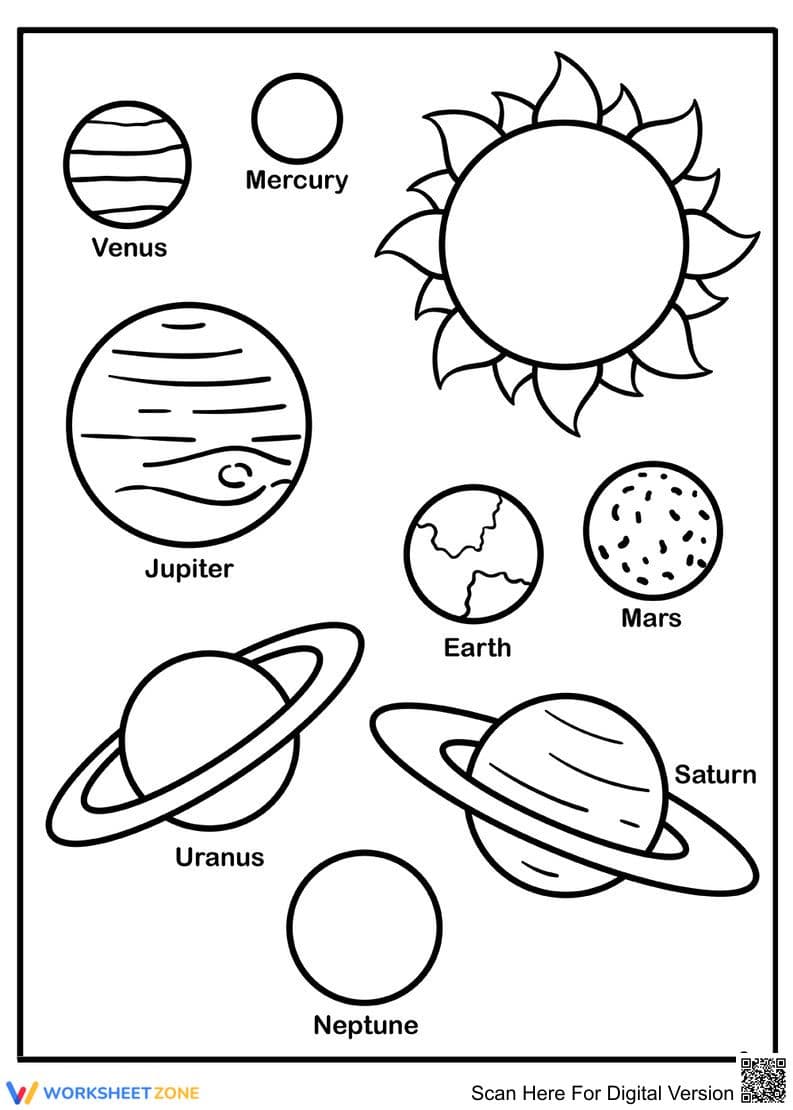
This solar system coloring worksheet helps young learners identify the eight planets and the sun while developing fine motor skills. By engaging with visual representations of Mercury, Venus, Earth, and others, students build foundational space science vocabulary. It provides a creative way to introduce astronomical patterns and celestial bodies in early elementary classrooms.
At a Glance
At a Glance
- Grade: 1 · Subject: Science
- Standard:
1-ESS1-1— Use observations of the sun, moon, and stars to describe patterns- Skill Focus: Planet identification and coloring
- Format: 1 page · 9 items · No answer key · PDF
- Best For: Early finishers or science center activity
- Time: 15–20 minutes
What's Inside
This single-page PDF features clear, high-contrast line art of the Sun and all eight planets in our solar system. Each celestial body is labeled with its correct name in a legible font, serving as a built-in word bank. The layout is spacious, allowing students to use crayons, markers, or colored pencils without crowding the page or losing detail in the rings of Saturn and Uranus.
Zero-Prep Workflow
The zero-prep workflow for this resource is designed for maximum efficiency in busy classrooms. First, print the single-page PDF (30 seconds). Next, distribute the sheets to your class or science center (1 minute). Finally, review the planet names as a group while students color (5 minutes). Total teacher preparation time is under 2 minutes, making it an ideal sub plan or transition activity.
Standards Alignment
This worksheet aligns with `1-ESS1-1`, which requires students to observe and describe patterns of objects in the sky. By visualizing the relative sizes and features of the planets, students begin to understand the composition of our solar system. This standard code can be copied directly into lesson plans, IEP goals, or district curriculum mapping tools.
How to Use It
Use this worksheet during the "Engage" phase of a 5E science lesson to spark curiosity about space. It also works well as a formative assessment tool; observe if students can point to specific planets like Saturn or Jupiter when prompted during the activity. Expected completion time is 15 to 20 minutes depending on the detail of coloring and student age.
Who It's For
This resource is perfect for Kindergarten through 2nd-grade students, particularly those who benefit from kinesthetic and visual learning. It is an excellent pairing for a read-aloud book about space or an introductory anchor chart showing the order of the planets from the sun. It is also suitable for English Language Learners who need visual aids for science vocabulary.
According to the RAND AIRS 2024 report on early childhood education, integrating creative arts like coloring with core content areas such as science significantly improves retention of domain-specific vocabulary. This worksheet facilitates that integration by pairing planet labels with visual identification tasks. By focusing on 1-ESS1-1, the activity moves beyond simple art into observational science, helping students recognize the sun and planets as distinct objects in the sky. Research from Fisher & Frey (2014) suggests that visual scaffolds, such as labeled diagrams, are essential for English Language Learners and early readers to bridge the gap between spoken words and scientific concepts. This 1-page resource provides 9 distinct opportunities for students to engage with astronomical terminology in a low-stakes, high-engagement format. It serves as a foundational step toward more complex NGSS mastery in later elementary grades.


