


























Views
Downloads

Essential Exercise Worksheet | Grade 2 Science Printable
Paste this activity's link or code into your existing LMS (Google Classroom, Canvas, Teams, Schoology, Moodle, etc.).
Students can open and work on the activity right away, with no student login required.
You'll still be able to track student progress and results from your teacher account.
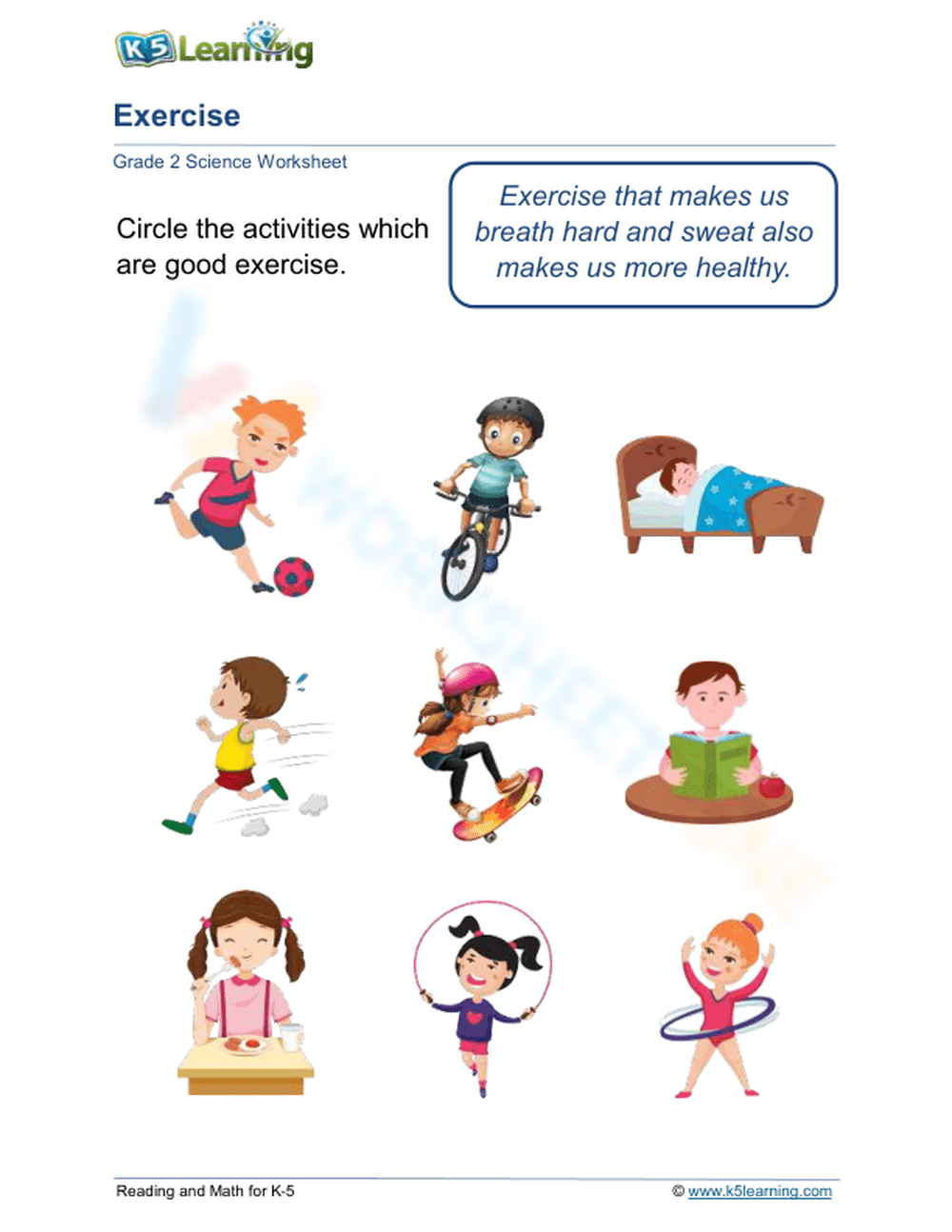
This Grade 2 science worksheet helps young learners differentiate between sedentary activities and physical exercise. By evaluating nine common daily actions, students develop a foundational understanding of how movement contributes to physical health. This engaging activity serves as an ideal introduction to life science and health units focusing on human body needs and wellness outcomes.
At a Glance
- Grade: 2 · Subject: Science
- Standard:
2-LS1-1— Identify and categorize human behaviors that promote physical health and survival- Skill Focus: Identifying exercise activities
- Format: 1 page · 9 problems · Answer key included · PDF
- Best For: Health and wellness introductory lessons
- Time: 10–15 minutes
The worksheet features a clear, single-page layout with nine vibrant illustrations depicting diverse activities such as playing soccer, reading, sleeping, and jumping rope. It includes a specific instructional callout explaining that exercise making us breathe hard and sweat contributes to overall health. A comprehensive answer key is provided to ensure quick and accurate grading for teachers or parents.
This resource is designed for immediate classroom integration with zero teacher preparation required. The three-step workflow is simple: Print the PDF in seconds, Distribute to students for independent or guided work, and Review the circling choices as a whole class for a quick check. Total prep time is under 2 minutes, making it an excellent option for sub plans, morning work, or quick formative assessments.
This activity aligns with 2-LS1-1, focusing on the basic needs of living organisms and the behaviors that support growth and health. Students apply critical thinking to categorize environmental and behavioral factors that impact physical well-being. This standard code can be copied directly into lesson plans, IEP goals, or district curriculum mapping tools to document adherence to life science objectives.
Incorporate this worksheet during the explain phase of a science lesson on the human body or healthy habits. Use it as a quick check for understanding after discussing the importance of physical activity and its effects on the heart. A helpful formative-assessment tip is to observe whether students recognize that even fun activities like hula-hooping or skateboarding count as exercise. Completion typically takes 10 to 15 minutes.
The worksheet is tailored for Grade 2 students but is also appropriate for Grade 1 enrichment or Grade 3 review. It supports diverse learners through clear visual cues, making it accessible for English Language Learners and students with varying reading levels. It pairs naturally with a healthy living anchor chart or a short reading passage about the circulatory system and muscles.
According to research from Fisher & Frey (2014) on the gradual release of responsibility, structured visual categorization tasks like this 2-LS1-1 exercise worksheet provide the necessary supported practice phase for early elementary science. By evaluating nine distinct scenarios, students move from simply recognizing movement to understanding its physiological impact on overall health. The inclusion of immediate feedback via a provided answer key aligns with evidence-based practices for reinforcing correct conceptual models in life science. Such activities are essential for developing the health literacy required by modern curricula, ensuring students can identify actionable steps for personal wellness and long-term vitality. This resource effectively bridges the gap between abstract health concepts and concrete daily choices, serving as a critical component of early science education. Furthermore, it prepares students for more complex investigations into human body systems and the specific biological benefits of cardiovascular activity.


