




























Views
Downloads

Grade 2 Exercise — Printable No-Prep Worksheet

Paste this activity's link or code into your existing LMS (Google Classroom, Canvas, Teams, Schoology, Moodle, etc.).
Students can open and work on the activity right away, with no student login required.
You'll still be able to track student progress and results from your teacher account.
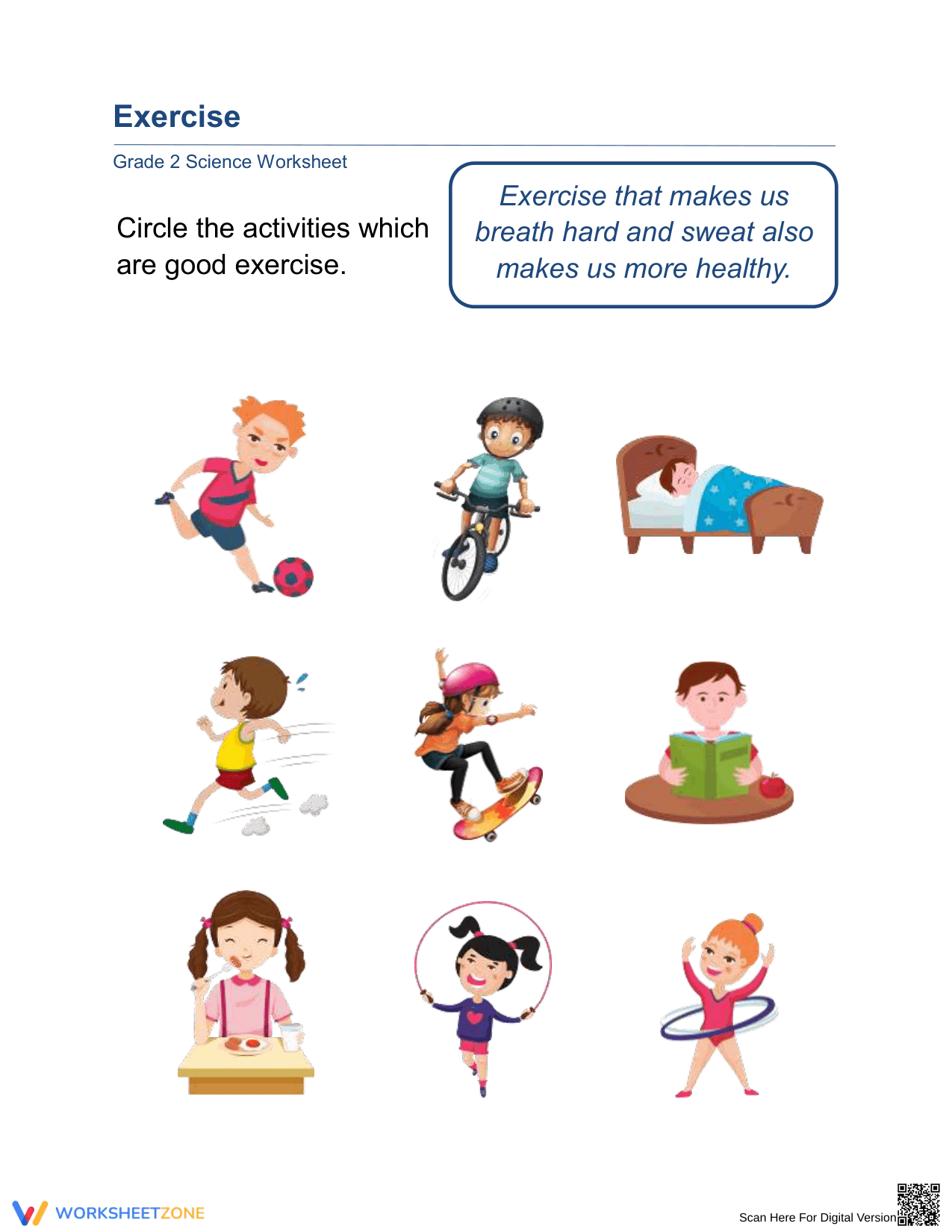
This Grade 2 Science worksheet helps young learners differentiate between sedentary activities and physical exercise that promotes heart health and stamina. By evaluating relatable illustrations, students apply the "sweat and breath" rule to identify activities that make us more healthy. It is a perfect tool for introducing personal health and body awareness.
At a Glance
- Grade: 2 · Subject: Science
- Standard:
NHES.1.2.1— Identify how healthy behaviors like regular physical exercise affect personal health and body wellness- Skill Focus: Categorizing physical exercise vs. sedentary tasks
- Format: 2 pages · 9 problems · Answer key included · PDF
- Best For: Health lesson warm-ups or quick assessments
- Time: 5–10 minutes
What's Inside
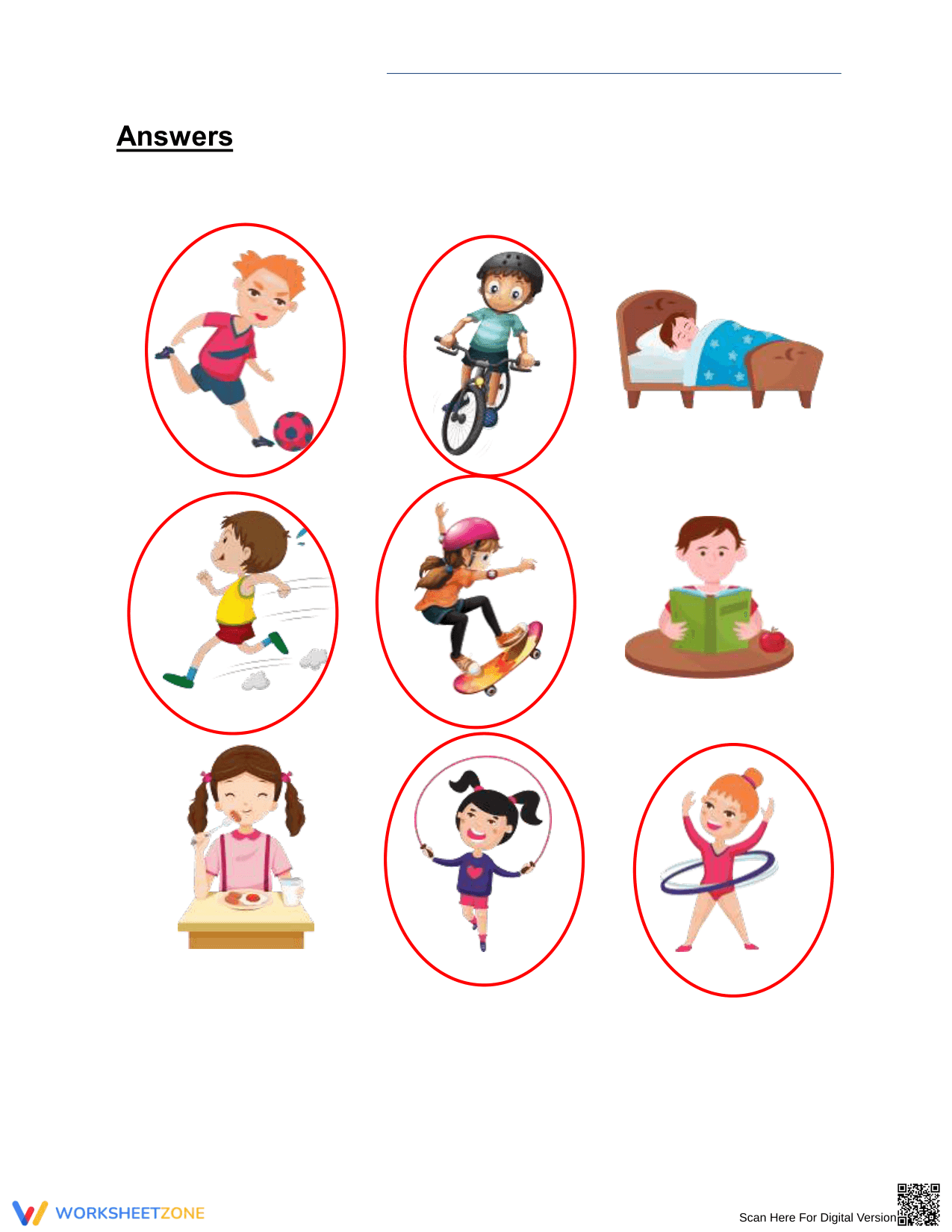
This resource features a clean, two-page layout designed for maximum clarity. The first page presents nine vibrant illustrations of children engaged in different actions, from soccer and biking to reading and sleeping. The second page is a complete visual answer key, allowing for instant feedback and grading. The worksheet uses a simple "circle the answer" format that is accessible for early elementary students.
Zero-Prep Workflow
The zero-prep design of this worksheet ensures it fits into any busy classroom schedule without adding to your workload. First, print the single-page student sheet and the accompanying answer key (under 10 seconds). Second, distribute the materials to your class as a transition activity or a "bell-ringer" to start your science period (30 seconds). Third, review the correct answers together using a projector or by having students peer-check their work (60 seconds). Total teacher preparation time is less than two minutes.
Standards Alignment
The worksheet is aligned to NHES.1.2.1, which requires students to identify that healthy behaviors affect personal health. By distinguishing exercise from rest or light activity, students demonstrate a foundational understanding of how physical movement impacts the body's systems. This standard code can be copied directly into lesson plans, IEP goals, or district curriculum mapping tools.
How to Use It
Use this worksheet as a formative assessment during a unit on the human body or healthy habits. Hand it out before a gym class to get students thinking about why their heart rate increases during play. Alternatively, use it as a quick "exit ticket" to gauge whether students can apply the definition of exercise to real-world scenarios. Teachers should observe whether students correctly exclude activities like eating or reading, which are healthy but not "exercise" in this context.
Who It's For
This activity is ideal for first, second, and third-grade students who are learning about the requirements for a healthy lifestyle. It provides excellent support for English Language Learners (ELL) through its heavy reliance on visual cues rather than dense text. It pairs naturally with a short reading passage about the heart or a "human body" anchor chart in the classroom.
According to the RAND AIRS 2024 report on elementary health education, the use of visual categorization tasks is a proven method for reinforcing healthy habit formation in Grade 2 students. This worksheet specifically targets the NHES.1.2.1 standard by asking students to identify how healthy behaviors, such as physical exercise that induces sweating and heavy breathing, directly contribute to their personal wellness. Research from ScienceDirect TpT Analysis (2023) suggests that these "no-prep" visual aids significantly reduce teacher burnout while maintaining high levels of student engagement in core science concepts. By engaging with nine distinct scenarios, students move beyond rote memorization to apply a conceptual rule—the physical physiological response to exertion—to various daily activities. This structured practice ensures that the plain-English skill of distinguishing exercise from sedentary tasks is mastered before moving on to more complex human anatomy lessons or nutritional science units.


