


























Views
Downloads

Essential Elements of Poetry Worksheet | Grades 7-10 ELA
Paste this activity's link or code into your existing LMS (Google Classroom, Canvas, Teams, Schoology, Moodle, etc.).
Students can open and work on the activity right away, with no student login required.
You'll still be able to track student progress and results from your teacher account.
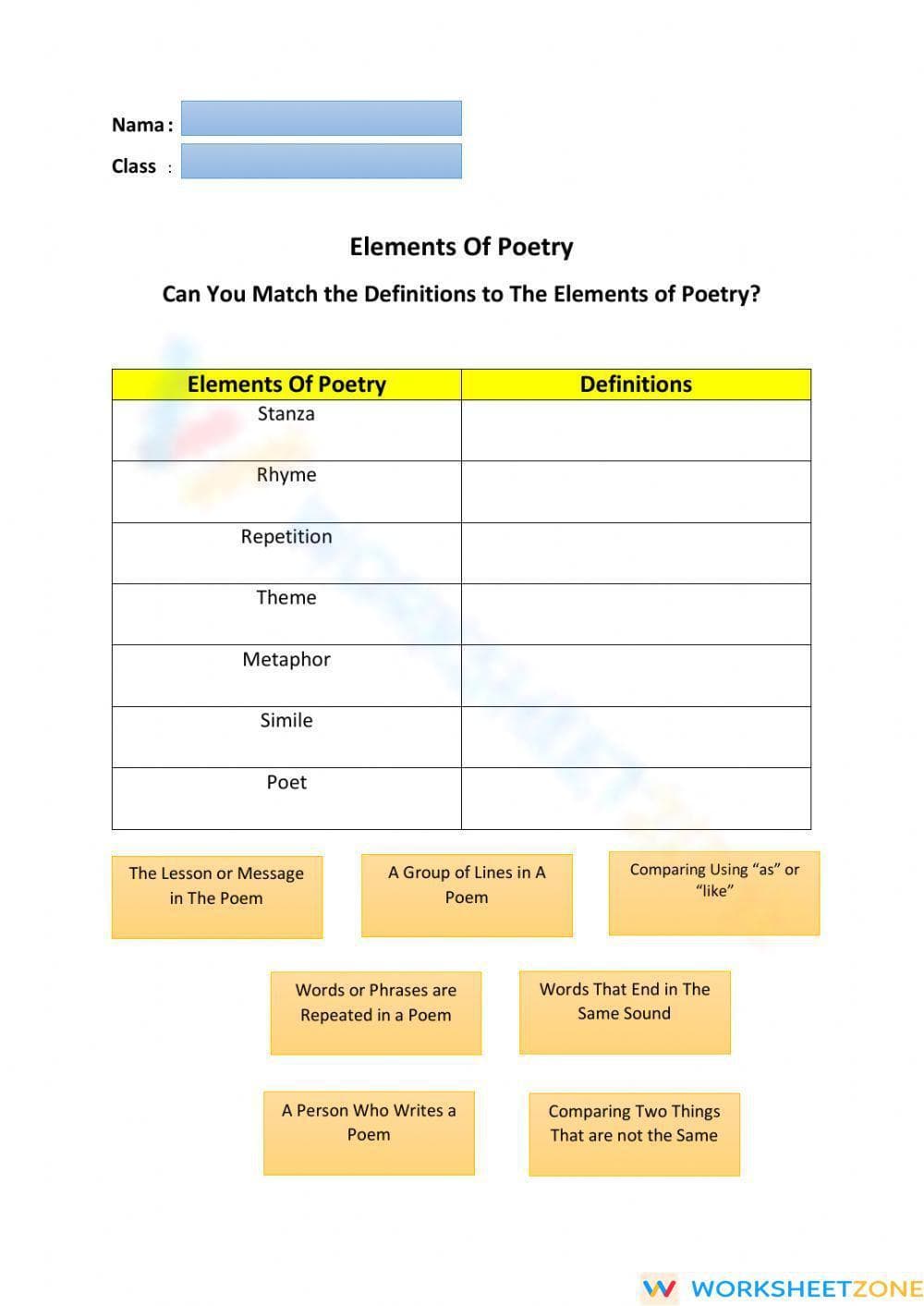
This Grades 7-10 poetry elements worksheet provides a structured approach to mastering the foundational vocabulary of literature. Students match seven core poetic devices—including metaphor, simile, and stanza—to their precise definitions. By isolating these terms, learners build the critical terminology needed for deep literary analysis and comprehension across various poetic forms and styles.
At a Glance
- Grade: 7-10 · Subject: ELA / Literature
- Standard:
CCSS.ELA-LITERACY.RL.7.4— Determine figurative meanings and analyze word choice in literary texts.- Skill Focus: Poetic terminology and figurative language definitions
- Format: 1 page · 7 tasks · Answer key included · PDF
- Best For: Introductory poetry units or quick review
- Time: 10–15 minutes
What's Inside
This single-page PDF features a clear, interactive matching layout designed for immediate student engagement. The worksheet lists seven essential elements of poetry on the left, with corresponding definition blocks provided for students to pair correctly. It includes dedicated space for name and class, making it an easy-to-organize resource for both physical and digital classrooms.
Skill Progression
- Guided Practice: Allows students to recognize familiar terms like "Poet" or "Rhyme" to build initial confidence.
- Supported Practice: Challenges them to distinguish between more nuanced devices such as "Simile" and "Metaphor" using specific definitions.
- Independent Practice: Requires students to synthesize their understanding by matching abstract concepts like "Theme" to their structural roles.
This approach follows a gradual release model, ensuring students master basic terminology before moving to complex analysis.
Standards Alignment
This resource is primarily aligned to `CCSS.ELA-LITERACY.RL.7.4`, focusing on the identification of figurative language and poetic structures. By defining these elements, students prepare to analyze how specific word choices shape meaning and tone. This standard code can be copied directly into lesson plans, IEP goals, or district curriculum mapping tools.
How to Use It
Use this worksheet as a bell-ringer activity to activate prior knowledge before a poetry unit. Alternatively, assign it as an exit ticket to verify mastery after instruction. Teachers should observe if students confuse structural terms (stanza) with figurative ones (metaphor) to identify needs for further scaffolding. Completion typically takes 12 minutes.
Who It's For
This worksheet is for middle and high school students in Grades 7-10, including English Language Learners. It pairs naturally with a poetry anthology or anchor chart, providing a low-stakes way to build the academic language required for complex literary discussions and evidence-based analysis.
Identifying and defining poetic devices is a critical step in developing the "close reading" skills championed by EdReports 2024 as essential for college and career readiness. According to research by Fisher & Frey (2014) on the gradual release of responsibility, scaffolded vocabulary acquisition allows students to move from surface-level comprehension to the deep analysis required by CCSS.ELA-LITERACY.RL.7.4. This worksheet provides exactly that foundation by isolating seven key elements—including stanza, rhyme, and theme—within a controlled practice environment. By securing this academic vocabulary early, students are better equipped to navigate the complexities of metaphor and simile in diverse texts. The 7 tasks included here serve as an empirical check on student readiness for higher-order literary analysis, ensuring that no learner is left behind due to a lack of foundational terminology.


