


























Views
Downloads

Grade 2 Animal Vocabulary — Printable No-Prep Worksheet
Paste this activity's link or code into your existing LMS (Google Classroom, Canvas, Teams, Schoology, Moodle, etc.).
Students can open and work on the activity right away, with no student login required.
You'll still be able to track student progress and results from your teacher account.
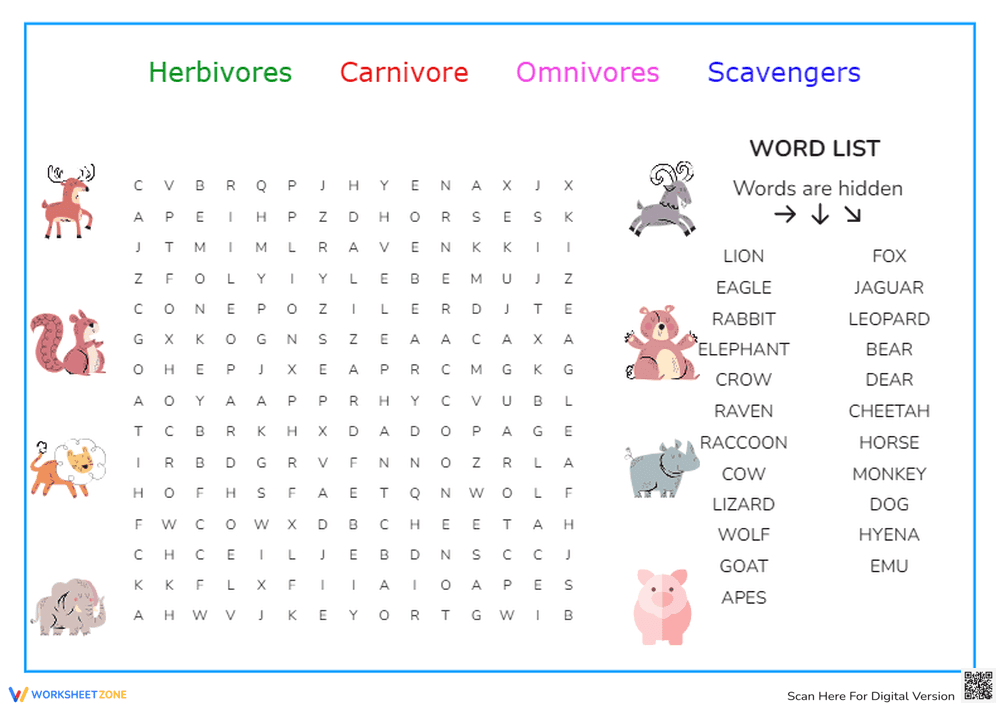
This Grade 2 vocabulary worksheet helps students identify and spell twenty-three animal names while reinforcing classification concepts. By searching for words horizontally, vertically, and diagonally, learners build visual discrimination and word recognition skills. This engaging activity strengthens spelling patterns and vocabulary acquisition in a fun, interactive format.
At a Glance
- Grade: Grade 2 · Subject: ELA & Science
- Standard:
CCSS.ELA-LITERACY.L.2.5— Identify real-life connections between words and their use.- Skill Focus: Animal vocabulary and spelling
- Format: 1 page · 23 words · Word search puzzle · PDF
- Best For: Morning work, early finishers, sub plans
- Time: 15–20 minutes
This single-page PDF features a grid containing 23 hidden animal names, including lion, cheetah, raccoon, and lizard. The worksheet displays colorful illustrations of animals like squirrels, lions, and elephants to engage young learners. A clear word list on the right side guides students, indicating that words are hidden horizontally, vertically, and diagonally. The top header introduces animal classifications—herbivores, carnivores, omnivores, and scavengers—providing a thematic connection to science curriculum.
Zero-Prep Workflow
This resource requires less than 2 minutes of total teacher preparation time. First, print the single-page PDF for your class. Second, distribute the sheets along with pencils and highlighters. Third, review the completed puzzles or have students read the animal names aloud to practice pronunciation. This self-explanatory layout makes it an ideal option for emergency sub plans or independent desk work.
Standards Alignment
This worksheet aligns with the Common Core State Standard `CCSS.ELA-LITERACY.L.2.5`, which requires students to demonstrate understanding of word relationships and nuances in word meanings. By identifying animal names, students build the foundational vocabulary necessary for reading comprehension. Both standard codes can be copied directly into lesson plans, IEP goals, or district curriculum mapping tools.
How to Use It
Use this worksheet during independent practice after a science lesson on animal diets, or as a morning warm-up activity. While students work, observe their scanning techniques to assess visual tracking skills and letter-pattern recognition. Expect students to complete the puzzle within 15 to 20 minutes, depending on their familiarity with the vocabulary terms.
Who It's For
This activity is designed for second-grade students, but it also serves as excellent spelling practice for struggling third graders or English language learners. Pair this worksheet with an introductory anchor chart about herbivores and carnivores to help students categorize the words they find in the puzzle.
According to the ScienceDirect TpT Analysis, structured vocabulary activities like word searches support orthographic mapping and spelling retention in early elementary students. By repeatedly scanning for specific letter sequences, learners reinforce their mental orthographic representations of complex words. This worksheet targets the standard CCSS.ELA-LITERACY.L.2.5 by helping students connect printed words to real-world animal concepts. The inclusion of 23 distinct vocabulary terms provides sufficient repetition to build familiarity without causing cognitive fatigue. Teachers can confidently integrate this resource into their daily routines, knowing that visual search tasks promote cognitive focus and pattern recognition. The clear layout and thematic grouping of animals make it a highly effective tool for reinforcing spelling patterns and vocabulary acquisition in diverse classroom settings, ensuring that students develop the foundational language skills necessary for reading success.


