


























Views
Downloads


Evolution and Natural Selection — Essential Worksheet
Paste this activity's link or code into your existing LMS (Google Classroom, Canvas, Teams, Schoology, Moodle, etc.).
Students can open and work on the activity right away, with no student login required.
You'll still be able to track student progress and results from your teacher account.
This evolution and natural selection worksheet helps students explain how populations change over time through inherited traits and environmental pressures. By analyzing a structured reading passage, learners identify the mechanisms of variation and survival. This resource ensures students can articulate the relationship between genetic diversity and long-term adaptation in biological systems.
At a Glance
- Grade: 6-10 · Subject: Biology
- Standard:
MS-LS4-4— Explain how genetic variations increase an individual's probability of surviving and reproducing- Skill Focus: Natural Selection Mechanisms
- Format: 2 pages · 5 problems · Answer key included · PDF
- Best For: Introductory biology lessons and review
- Time: 25–35 minutes
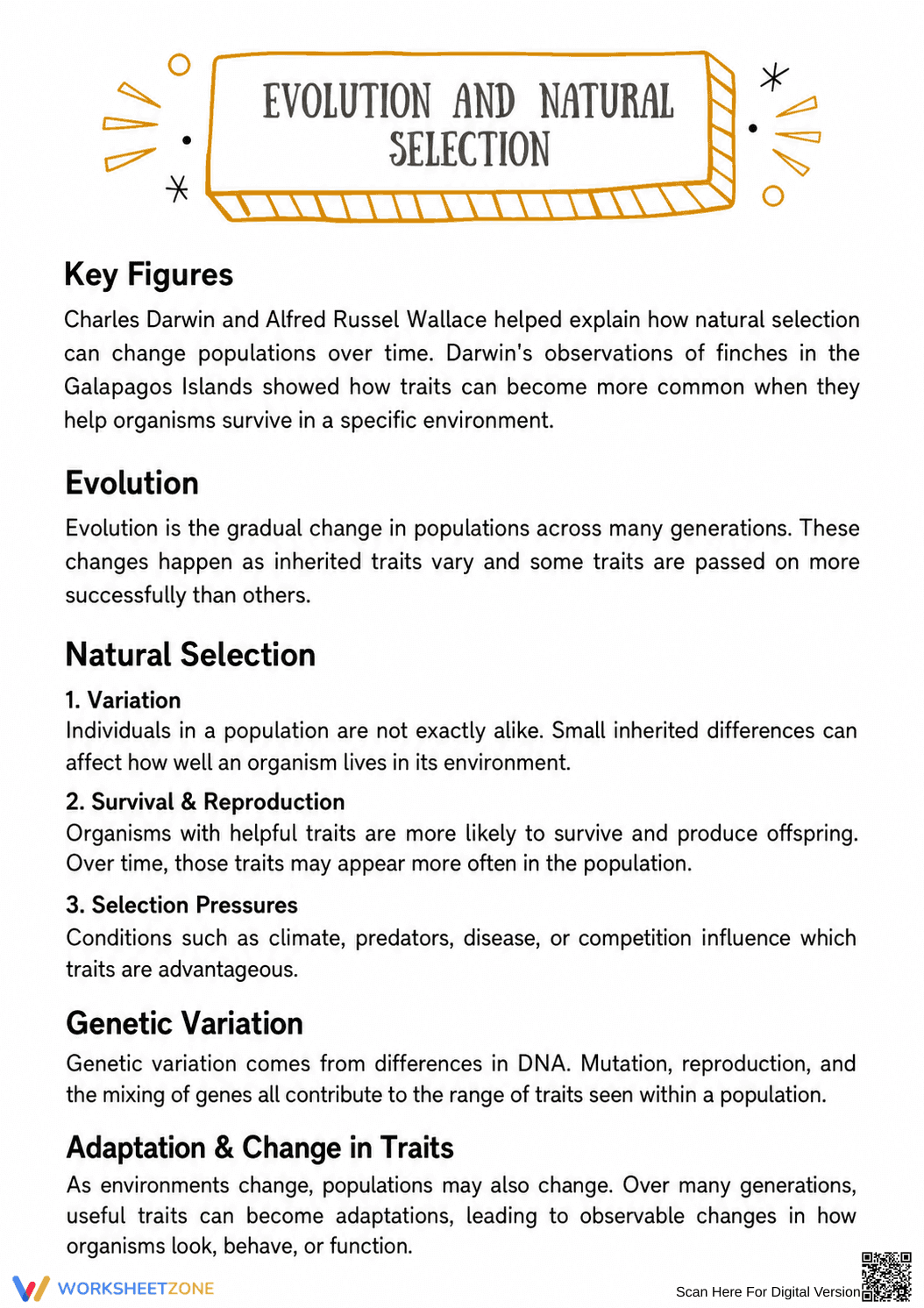
The resource consists of a comprehensive one-page reading passage followed by a dedicated question sheet. The text breaks down complex biological concepts into digestible sections covering key figures like Darwin, the definition of evolution, and the four pillars of natural selection: variation, survival, selection pressures, and genetic variation. The second page provides five open-ended short-answer questions designed to elicit evidence-based responses.
Zero-Prep Workflow
- Print: Generate the two-page PDF in less than 1 minute for your entire class.
- Distribute: Hand out the self-contained reading and question set with zero additional setup required.
- Review: Use the included answer key to facilitate a 10-minute group discussion or grade assignments quickly.
Total teacher preparation time is under 2 minutes, making this an ideal solution for sub plans or last-minute lesson reinforcements.
This resource aligns primarily with MS-LS4-4, focusing on how variation leads to differential survival. It also supports HS-LS4-2 by illustrating the process of evolution through four factors: the potential for a species to increase in number, genetic variation, competition for resources, and the proliferation of organisms better able to survive. Both standard codes can be copied directly into lesson plans, IEP goals, or district curriculum mapping tools.
Use this worksheet during the "Explain" phase of a 5E lesson cycle to solidify concepts after an initial simulation. It also serves as an effective formative assessment tool; observe student responses to question five regarding genetic variation to gauge their understanding of DNA's role in evolution. Completion typically takes 30 minutes, fitting perfectly into a standard class period.
This material is ideal for middle school life science students and introductory high school biology learners. The clear headings and scaffolded text make it particularly accessible for English Language Learners (ELL) or students requiring reading support. It pairs naturally with a Galapagos finch simulation or an anchor chart detailing selection pressures.
According to the RAND AIRS 2024 report, high-quality science literacy materials that integrate reading comprehension with domain-specific inquiry significantly improve student retention of complex biological processes. This worksheet addresses the need for structured evidence-based writing in the science classroom by requiring students to synthesize information about MS-LS4-4. By focusing on the mechanics of natural selection—specifically variation and selection pressures—the resource provides the necessary scaffolding for students to move from rote memorization to conceptual mastery. Research from Fisher & Frey (2014) emphasizes that gradual release models, supported by clear informational texts, allow students to develop the academic vocabulary required for high-stakes assessments. This 2-page PDF provides a reliable framework for teaching evolution, ensuring that learners can explain how traits become more common over many generations based on environmental fitness and reproductive success.


