


























Views
Downloads

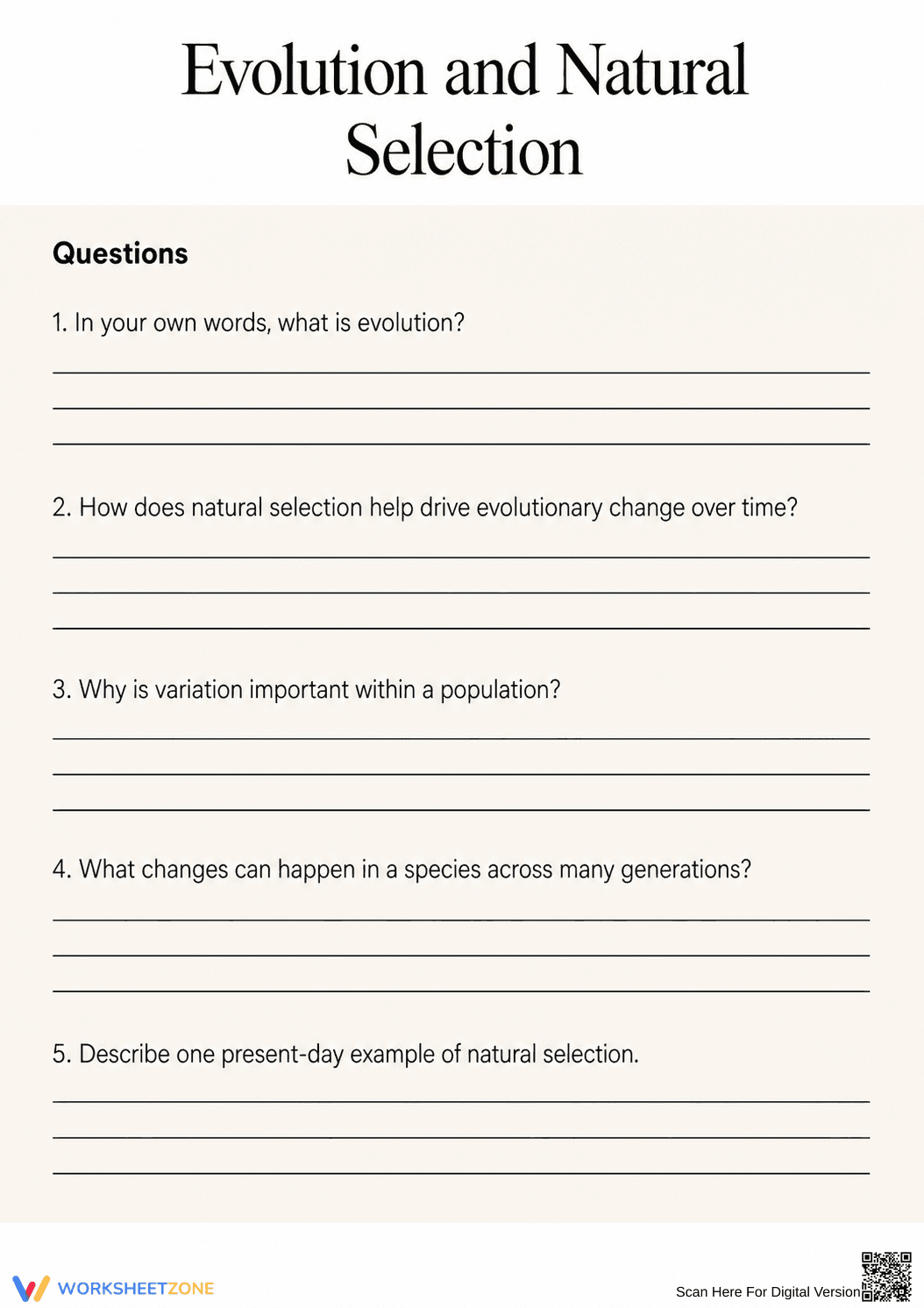

Evolution and Natural Selection — Essential Worksheet
Paste this activity's link or code into your existing LMS (Google Classroom, Canvas, Teams, Schoology, Moodle, etc.).
Students can open and work on the activity right away, with no student login required.
You'll still be able to track student progress and results from your teacher account.
This Grade 6-10 science worksheet provides a comprehensive reading passage that clarifies the relationship between evolution and natural selection. Students analyze the text to define key biological terms and explain how environmental pressures drive population changes over time. It ensures learners can distinguish between these often-confused concepts through evidence-based writing.
At a Glance
- Grade: 6-10 · Subject: Biology
- Standard:
MS-LS4-4— Explain how genetic variations increase survival and reproduction probabilities in specific environments- Skill Focus: Evolutionary Mechanisms
- Format: 2 pages · 9 problems · Answer key included · PDF
- Best For: Introduction to natural selection units
- Time: 25–35 minutes
What's Inside
The resource consists of a two-page PDF. The first page features a detailed informational text divided into three clear sections: Evolution, How Evolutionary Change Happens, and Natural Selection. Following the text are 9 structured comprehension questions that require students to synthesize information, provide real-world examples, and use scientific vocabulary like variation and adaptation. A full answer key is provided for efficient grading.
Zero-Prep Workflow
- Print: Select the two-page PDF and print enough copies for your class in under 30 seconds.
- Distribute: Hand out the worksheets as a silent reading activity or a collaborative partner task.
- Review: Use the included answer key to facilitate a whole-class discussion or check for understanding.
Total teacher preparation time is under two minutes, making this an ideal sub plan or last-minute lesson addition.
Standards Alignment
This worksheet is aligned with MS-LS4-4: "Construct an explanation based on evidence that describes how genetic variations of traits in a population increase some individuals' probability of surviving and reproducing in a specific environment." It also supports HS-LS4-2 by illustrating the four factors of natural selection. Both standard codes can be copied directly into lesson plans, IEP goals, or district curriculum mapping tools.
How to Use It
Use this worksheet during the explain phase of a 5E instructional model. After students have explored basic variation through a lab, assign this reading to formalize their understanding of the mechanisms involved. It also serves as an effective formative assessment; observe if students can correctly link environmental pressure to survival advantages in their written responses.
Who It's For
This resource is designed for middle school life science students and high school biology learners. The accessible text structure supports ELL students and developing readers by providing clear definitions within the context of the passage. It pairs naturally with an anchor chart on Darwin’s finches or a digital simulation of population genetics.
The integration of informational text with targeted questioning in this MS-LS4-4 worksheet aligns with the gradual release of responsibility model. By providing a structured reading passage on evolution and natural selection, the resource scaffolds the complex cognitive task of explaining biological change over time. Research by Fisher & Frey (2014) emphasizes that close reading of complex informational texts is essential for developing disciplinary literacy in science. This worksheet facilitates that process by requiring students to extract evidence and restate scientific processes in their own words. The 9 included tasks move from basic recall to application, ensuring that students do not just memorize definitions but understand the causal relationships between variation, selection, and adaptation. Such evidence-based practices are shown to improve retention of core disciplinary ideas in life science across diverse learner populations.


