


























Views
Downloads
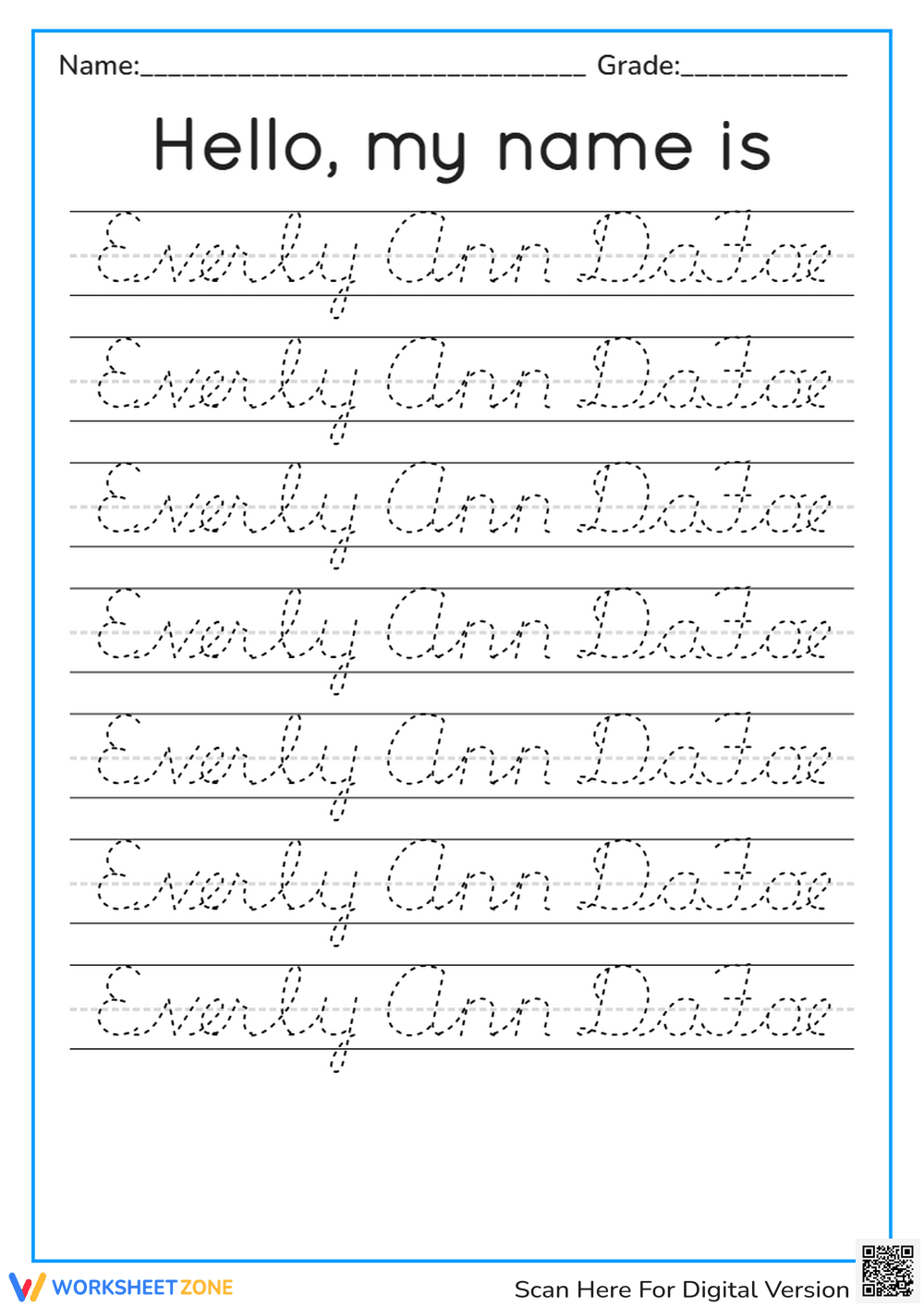

Cursive Name Tracing Worksheet | Grade 1 Printable
Paste this activity's link or code into your existing LMS (Google Classroom, Canvas, Teams, Schoology, Moodle, etc.).
Students can open and work on the activity right away, with no student login required.
You'll still be able to track student progress and results from your teacher account.
This Grade 1 cursive name tracing worksheet provides students with structured practice to master the specific letter connections in the name "Everly Ann Dafoe." By focusing on repetitive tracing, learners develop the muscle memory required for fluid cursive writing and proper letter formation. This resource ensures students gain confidence in their personal signature and general handwriting legibility.
At a Glance
- Grade: 1 · Subject: Handwriting
- Standard:
CCSS.ELA-LITERACY.L.1.1.A— Print or write all upper- and lowercase letters legibly- Skill Focus: Cursive name tracing
- Format: 1 page · 7 problems · Answer key included · PDF
- Best For: Morning work or handwriting centers
- Time: 5–10 minutes
This single-page PDF features seven identical rows of the name "Everly Ann Dafoe" in a dotted cursive font. The layout includes a standard three-line primary grid with a dashed midline to guide letter height and slant. The top of the page includes space for the student's name and grade, making it easy to organize within a classroom portfolio or take-home folder.
The workflow for this resource is designed for maximum efficiency in busy classrooms. First, print the single-page PDF (30 seconds). Next, distribute the sheets to students during morning arrival or a dedicated handwriting block (1 minute). Finally, review the student's letter connections and slant as they complete the seven rows (1 minute). Total teacher preparation time is under 2 minutes, making it an ideal sub-plan or transition activity.
The primary standard addressed is CCSS.ELA-LITERACY.L.1.1.A, which requires students to demonstrate command of the conventions of standard English grammar and usage when writing, specifically printing all upper- and lowercase letters. While this worksheet focuses on cursive, it supports the foundational goal of legible letter production and name recognition. Both standard codes can be copied directly into lesson plans, IEP goals, or district curriculum mapping tools.
Use this worksheet during the independent practice phase of a handwriting lesson after demonstrating the specific cursive strokes for the letters E, v, and l. It serves as an excellent formative assessment tool; teachers should observe the student's grip and stroke direction to identify if they are starting letters from the baseline correctly. Expect completion within 5 to 10 minutes depending on the student's fine motor development.
This resource is tailored for first-grade students who are beginning their transition from manuscript to cursive writing. It is particularly helpful for students named Everly or those practicing specific letter combinations found in the name. Pair this worksheet with a cursive alphabet anchor chart or a tactile tracing tray to provide a multi-sensory learning experience for struggling writers.
This Grade 1 handwriting resource aligns with CCSS.ELA-LITERACY.L.1.1.A by providing targeted practice in letter formation and name writing. According to Fisher & Frey (2014), the gradual release of responsibility model is most effective when students have opportunities for repetitive, low-stakes practice to build automaticity. This worksheet facilitates that automaticity by offering 7 rows of tracing, allowing students to focus on the fluid motion of cursive without the cognitive load of spelling. Research from the NAEP suggests that students who develop strong handwriting skills early are better able to focus on higher-order composition tasks in later grades. By mastering their own name in cursive, students build a personal connection to the writing process, which increases engagement and persistence. This printable PDF serves as a foundational tool for developing the fine motor control and spatial awareness necessary for academic success in literacy and beyond.


