


























Views
Downloads
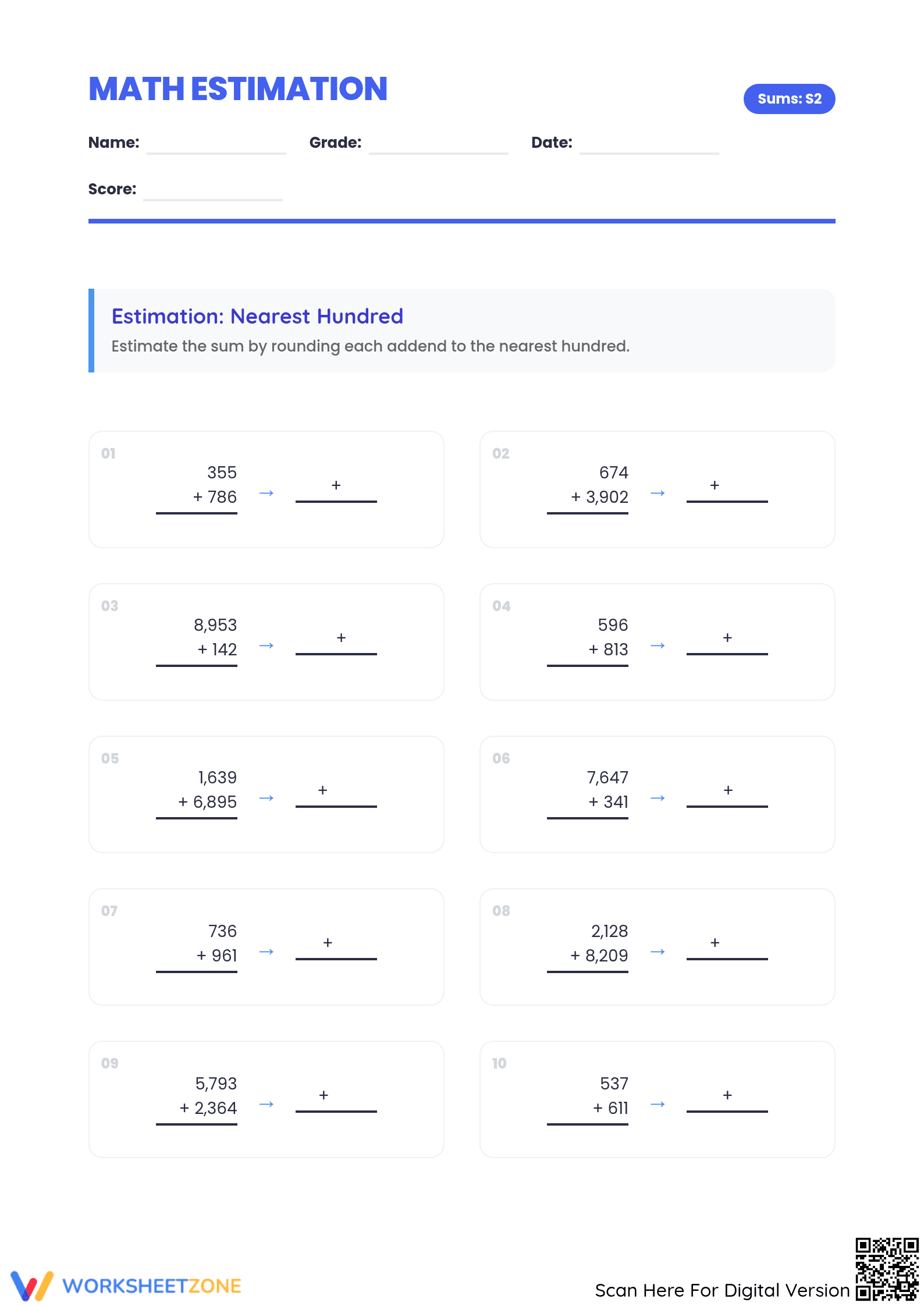


Printable Estimating Sums to Nearest Hundred | Grade 3-4
Paste this activity's link or code into your existing LMS (Google Classroom, Canvas, Teams, Schoology, Moodle, etc.).
Students can open and work on the activity right away, with no student login required.
You'll still be able to track student progress and results from your teacher account.
1. Educational Objective
Help students master mental math with this estimation worksheet. Students round three-digit and four-digit addends to the nearest hundred before calculating the approximate sum. This essential practice builds place value fluency and numerical reasoning. By predicting results before exact calculation, learners develop a stronger mathematical intuition for real-world arithmetic.
2. At a Glance
At a Glance
- Grade: 3 · Subject: Math
- Standard:
CCSS.MATH.CONTENT.3.NBT.A.1— Round whole numbers to the nearest 10 or 100 for estimation- Skill Focus: Sum Estimation via Rounding
- Format: 2 pages · 12 problems · Answer key included · PDF
- Best For: Daily warm-ups or independent practice
- Time: 15–20 minutes
3. What's Inside
This resource contains twelve vertical addition problems distributed across two clear pages. Each problem provides dedicated space for students to write the rounded addends and the final estimated sum. The layout features wide margins and a clean font to reduce cognitive load, making it accessible for diverse learners. A comprehensive answer key is provided for rapid grading and student self-assessment.
4. Zero-Prep Workflow
Follow these three simple steps for a seamless classroom experience. First, print the two-page PDF (30 seconds). Second, distribute the copies to your class for independent work (1 minute). Third, use the included answer key to review results or allow for self-correction (2 minutes). The total teacher preparation time is under two minutes, making this an ideal resource for sub plans or last-minute review sessions.
5. Standards Alignment
This worksheet is strictly aligned to `CCSS.MATH.CONTENT.3.NBT.A.1`, which requires students to use place value understanding to round whole numbers to the nearest 10 or 100. It also supports `CCSS.MATH.CONTENT.3.NBT.A.2` by requiring fluent addition within 1,000. Both standard codes can be copied directly into lesson plans, IEP goals, or district curriculum mapping tools to track student mastery.
6. How to Use It
Assign this worksheet during the independent practice phase of a lesson to verify that students can round accurately before summing. It also serves as an excellent formative assessment exit ticket; observe whether students round both numbers correctly before adding. Most students will complete the twelve problems within fifteen to twenty minutes. Use the results to identify students needing intervention with place value boundaries.
7. Who It's For
This resource is designed for third-grade students initially learning rounding, as well as fourth and fifth graders who require remedial fluency practice. The structured format specifically assists students with dyscalculia by providing clear visual cues for where to place rounded digits. Pair this with a place value anchor chart or number line for maximum instructional impact during small group rotations.
According to the RAND AIRS 2024 analysis of elementary mathematics instruction, providing students with structured estimation tasks significantly improves their ability to detect errors in calculations. This worksheet directly addresses the cognitive demand of CCSS.MATH.CONTENT.3.NBT.A.1 by isolating the rounding skill within an addition context. Research indicates that when students regularly engage in sum estimation, they develop a more robust internal number line, which is a key predictor of success in algebra. The twelve problems presented here offer the repetition necessary for procedural fluency without causing fatigue. By focusing specifically on the nearest hundred, the resource ensures that learners solidify their understanding of three-digit and four-digit place value boundaries. This targeted approach is consistent with high-quality instructional materials that prioritize conceptual depth. Teachers can use this tool to provide evidence of student growth in numerical reasoning.


