


























Views
Downloads


Essential Mixed Percent Problems Worksheet | Grade 7 Math
Paste this activity's link or code into your existing LMS (Google Classroom, Canvas, Teams, Schoology, Moodle, etc.).
Students can open and work on the activity right away, with no student login required.
You'll still be able to track student progress and results from your teacher account.
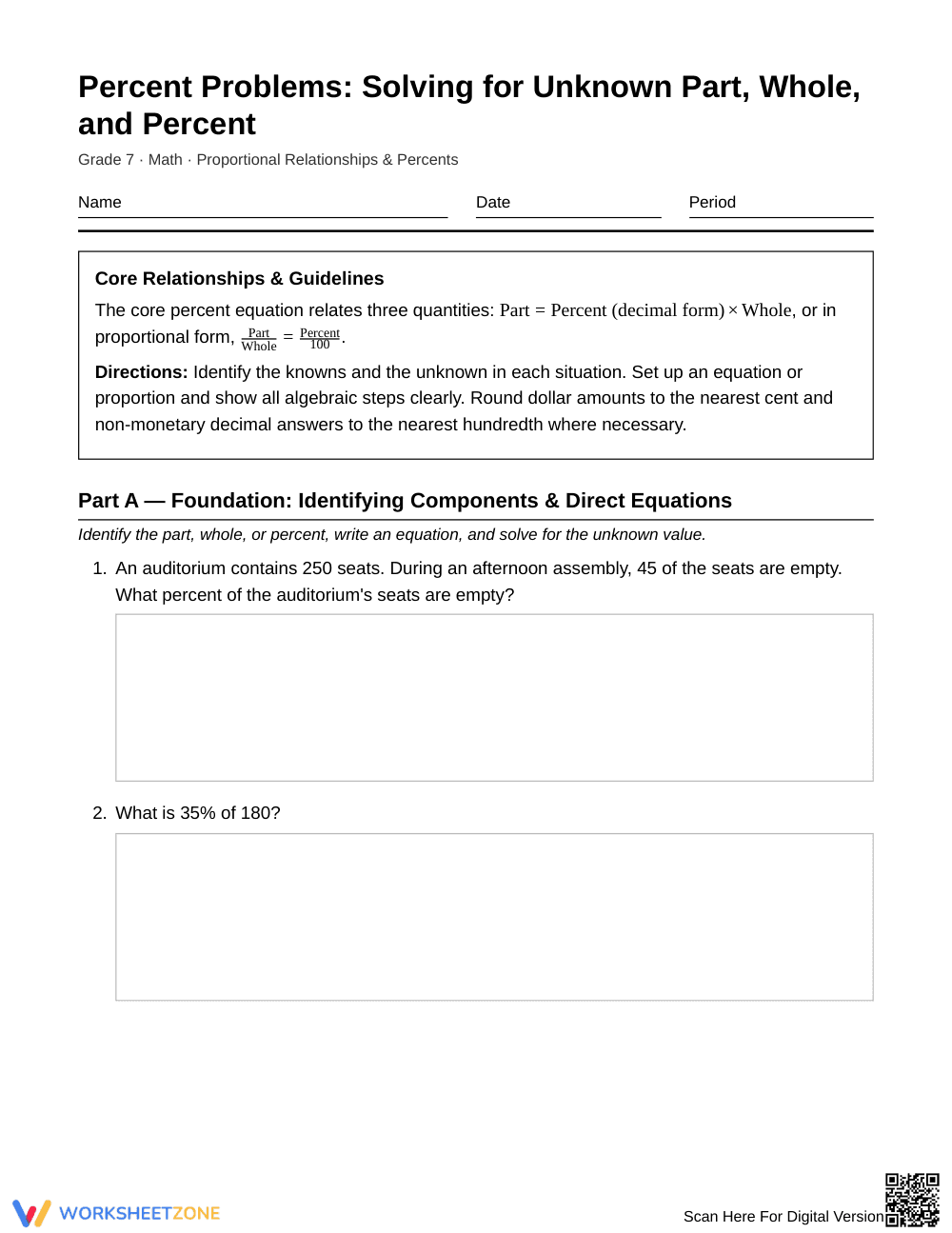
Mastering proportional reasoning requires students to flexibly identify whether a given problem requires finding the part, the whole, or the percent. This targeted worksheet provides structured practice solving for unknown quantities across single-step and multi-step real-world scenarios, building essential algebraic fluency for Grade 7 mathematics learners.
At a Glance
- Grade: 7 · Subject: Math
- Standard:
7.RP.A.3— Solve real-world multistep ratio and percent problems using proportional relationships- Skill Focus: Mix Unknown Part, Whole, and Percent
- Format: 5 pages · 16 problems · Answer key included · PDF
- Best For: Independent classwork, small group review, or homework
- Time: 40–50 minutes
This 5-page printable resource includes a student reference box defining the core percent equation alongside 16 scaffolded problems distributed across three sections. Students work with direct equations, decimal and fractional percentages, rational values, and multi-step word problems involving markups, discounts, simple interest, and successive proportions. A complete 3-page answer key provides step-by-step solutions.
Skill Progression
- Guided Practice (Part A, Problems 1–4): Direct calculation tasks establish foundational mechanics, prompting students to define variables and solve for basic unknown parts, wholes, or percentages.
- Supported Practice (Part B, Problems 5–12): Contextual scenarios incorporate rational values, decimal percentages, and equation modeling to develop strategic method selection.
- Independent Practice (Part C, Problems 13–16): Complex multi-step applications challenge students to integrate simple interest formulas, successive discounts with sales tax, and wholesale markups.
This sequence mirrors the gradual-release model, shifting students smoothly from structural recognition to autonomous problem solving.
Standards Alignment
This resource aligns directly to 7.RP.A.3: "Use proportional relationships to solve multistep ratio and percent problems." It also reinforces foundational work under 7.EE.B.4 by requiring students to construct and solve algebraic equations from verbal descriptions. Both standard codes can be copied directly into lesson plans, IEP goals, or district curriculum mapping tools.
How to Use It
Use this worksheet after direct instruction on the core percent equation or proportions. Assign Parts A and B as mid-unit guided classwork (20–25 minutes), then transition students to Part C for collaborative small-group problem solving. During work time, observe whether students correctly convert percentages to decimals before computing. Expect total completion within 40 to 50 minutes.
Who It's For
This worksheet is designed for general education Grade 7 math classes, accelerated Grade 6 students, and Grade 8 intervention groups needing remediation in proportional relationships. Pair this activity with an anchor chart illustrating part-whole visual bar models or a direct instruction mini-lesson on setting up algebraic percent proportions.
Proportional reasoning represents a foundational cognitive milestone in middle grades mathematics, serving as the primary bridge between elementary arithmetic and high school algebra. According to research from Fisher & Frey (2014) on scaffolded instructional design, student mastery of abstract algebraic concepts improves significantly when direct modeling transitions systematically into contextualized problem solving. Standard 7.RP.A.3 tasks students with applying proportional relationships to solve multistep ratio and percent problems, including tax, markups, discounts, and simple interest. By providing structured practice that interweaves unknown parts, wholes, and percentages, this instructional resource directly addresses common student misconceptions regarding base values and operational selection. Regular exposure to varied problem structures strengthens variable identification, algorithmic efficiency, and relational thinking across diverse mathematical applications, ensuring learners develop enduring competence in middle school algebraic reasoning.


