




























Views
Downloads




Essential Missing Percent Worksheet | Grade 7 Math

Paste this activity's link or code into your existing LMS (Google Classroom, Canvas, Teams, Schoology, Moodle, etc.).
Students can open and work on the activity right away, with no student login required.
You'll still be able to track student progress and results from your teacher account.
This Grade 7 math resource teaches students how to solve for an unknown percent using proportion and equation models. Designed for proportional reasoning mastery, this printable resource equips middle school learners to identify parts and wholes accurately, set up mathematical relationships, and convert decimal quotients into final percentages across varied contextual applications.
At a Glance
- Grade: 7 · Subject: Math
- Standard:
7.RP.A.3— Use proportional relationships to solve multistep ratio and percent problems- Skill Focus: Solve for a Missing Percent
- Format: 5 pages · 12 problems · Answer key included · PDF
- Best For: Guided instruction, targeted intervention, and independent practice
- Time: 40–50 minutes
What's Inside
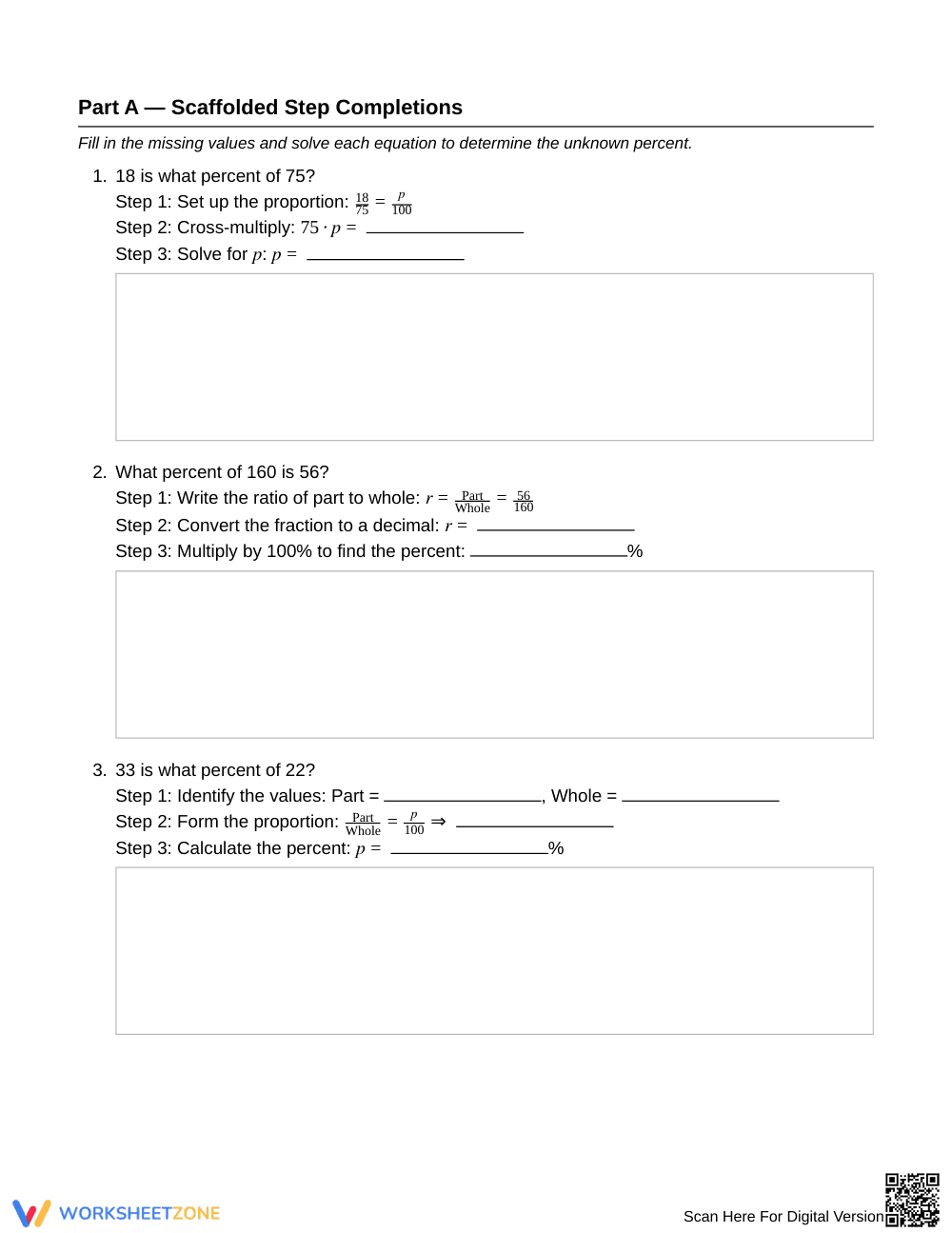
Spanning 5 total pages with a thorough 3-page answer key, this resource provides 12 rigorous problems organized across three structured sections. Students benefit from dual problem-solving reference models, guided step completions, a part-to-whole conversion table, multi-step real-world word problems, and written error analysis prompts targeting common conceptual misconceptions.
Skill Progression
- Guided practice: Two fully worked models introduce proportion and equation strategies alongside four scaffolded step-completion prompts and table calculations.
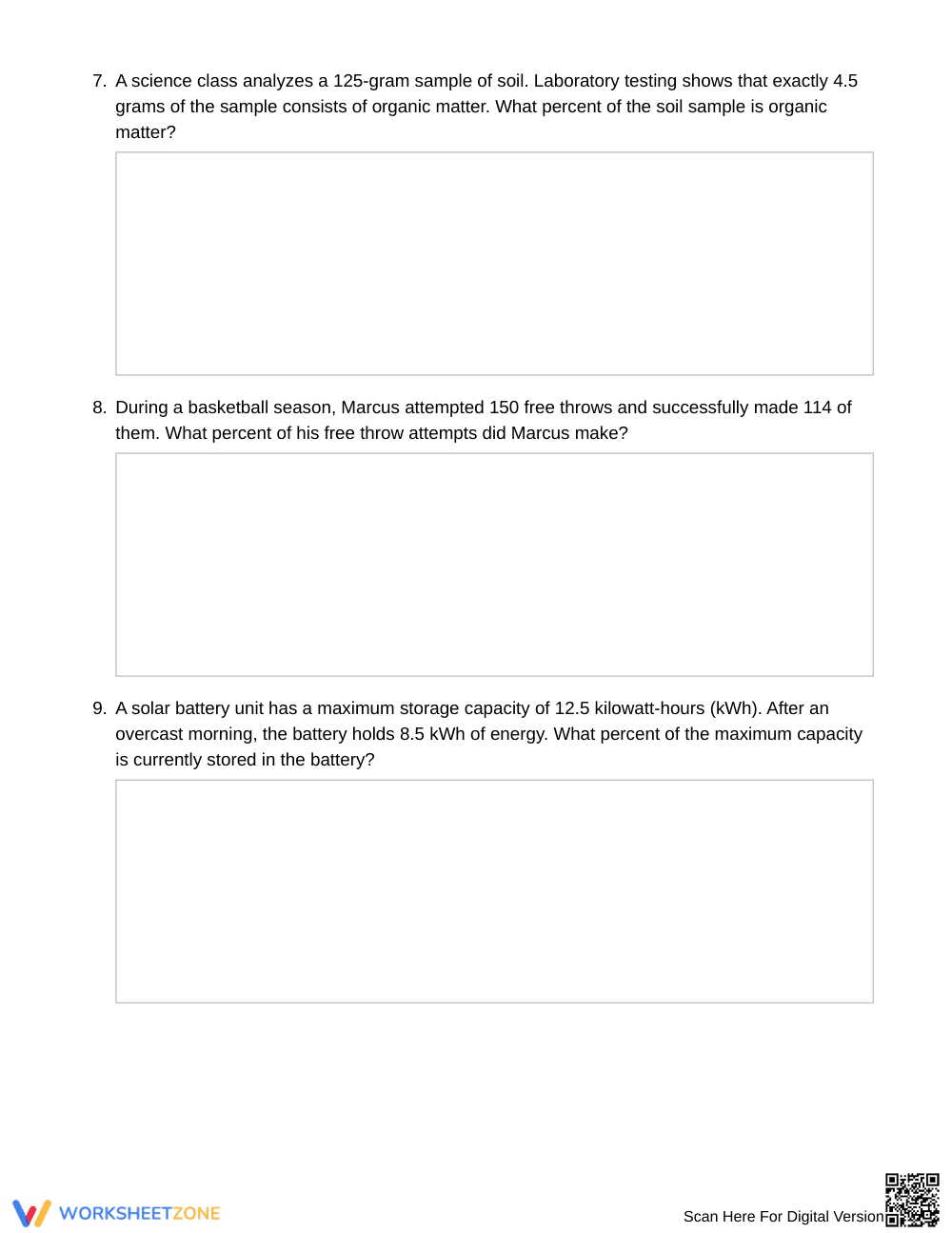
- Supported practice: Six multi-step application problems challenge learners to isolate unknown percents in realistic scientific, athletic, and agricultural contexts.
- Independent practice: Two open-ended reasoning prompts require students to critique incorrect setups, evaluate proportional claims, and articulate written justifications.
This structured progression reflects the gradual release of responsibility model, guiding students systematically from explicit modeling to independent mathematical reasoning.
Standards Alignment
This worksheet directly supports primary standard `7.RP.A.3`: Use proportional relationships to solve multistep ratio and percent problems. It also reinforces supporting standard `7.EE.B.4` by prompting students to construct and solve algebraic equations with rational numbers. Both standard codes can be copied directly into lesson plans, IEP goals, or district curriculum mapping tools.
How to Use It
Deploy this worksheet during core instruction immediately following your mini-lesson on percent proportions, or assign it during targeted small-group intervention. During independent work, observe whether students mistakenly invert the part and whole when the comparison value exceeds 100%. Expect completion within 40 to 50 minutes of instructional time.
Who It's For
This resource serves general education Grade 7 math classes, Tier 2 math intervention groups, and accelerated Grade 6 cohorts. It includes structured scaffolds for emerging multilingual learners and pairs naturally with an interactive anchor chart illustrating percent proportion formulas.
According to Fisher & Frey (2014), structured instructional frameworks that bridge modeled demonstrations with scaffolded practice significantly increase student autonomy in complex mathematical problem-solving. This Grade 7 resource aligns with standard 7.RP.A.3 by guiding students to solve for an unknown percent using proportional relationships and algebraic equations. By combining worked visual models, structured ratio tables, and contextual word problems, the worksheet provides systematic practice calculating missing percentages from diverse rational quantities. Students progress from guided cross-multiplication to rigorous mathematical reasoning, evaluating common student calculation errors and justifying proportional properties. The inclusion of multi-step real-world scenarios ensures middle school learners connect abstract fraction-to-decimal conversions to meaningful contexts such as laboratory data and athletic statistics. This comprehensive design ensures measurable mastery of proportional reasoning standards across general education and targeted intervention settings alike.


