




























Views
Downloads



Essential Idioms in Context Worksheet | Grade 6 ELA

Paste this activity's link or code into your existing LMS (Google Classroom, Canvas, Teams, Schoology, Moodle, etc.).
Students can open and work on the activity right away, with no student login required.
You'll still be able to track student progress and results from your teacher account.
This Grade 6 ELA worksheet helps students analyze and decode figurative language in authentic peer conversations. Learners use context clues across eight realistic school scenarios to distinguish between literal statements and common idiomatic expressions, building essential reading comprehension and conversational vocabulary skills.
At a Glance
- Grade: 6 · Subject: ELA
- Standard:
L.6.5.a— Interpret figures of speech in context- Skill Focus: Decode Idioms in School Conversations
- Format: 5 pages · 10 problems · Answer key included · PDF
- Best For: Targeted practice or small-group remediation
- Time: 35–45 minutes
What's Inside
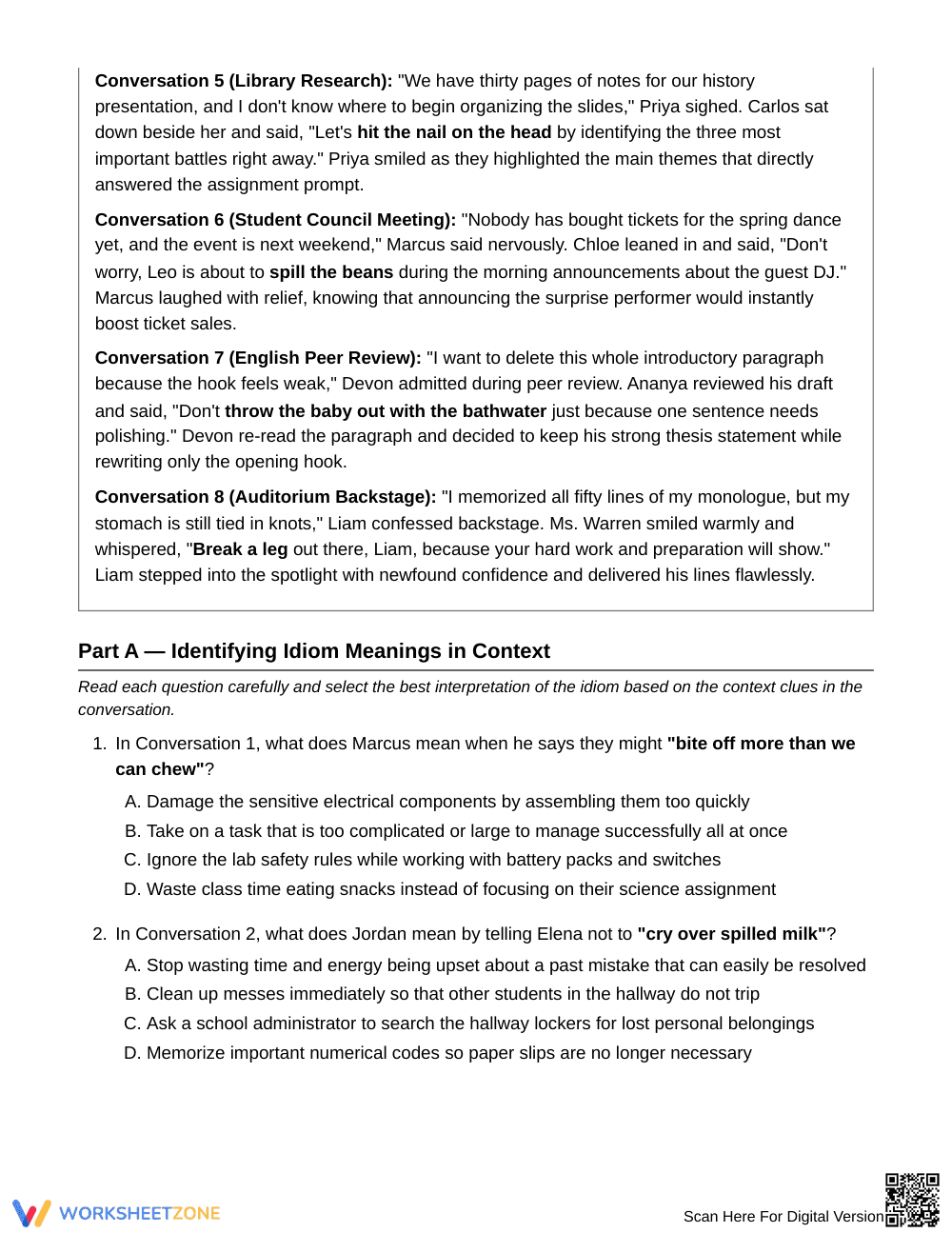
The 5-page printable resource features an introductory reference guide defining literal versus figurative meanings, followed by eight detailed dialogue vignettes set in relatable school environments like science labs and art studios. Students tackle 10 focused tasks divided across three distinct sections, supported by a complete 2-page answer key that includes model literal rewrites and sample explanatory rationales.
Skill Progression
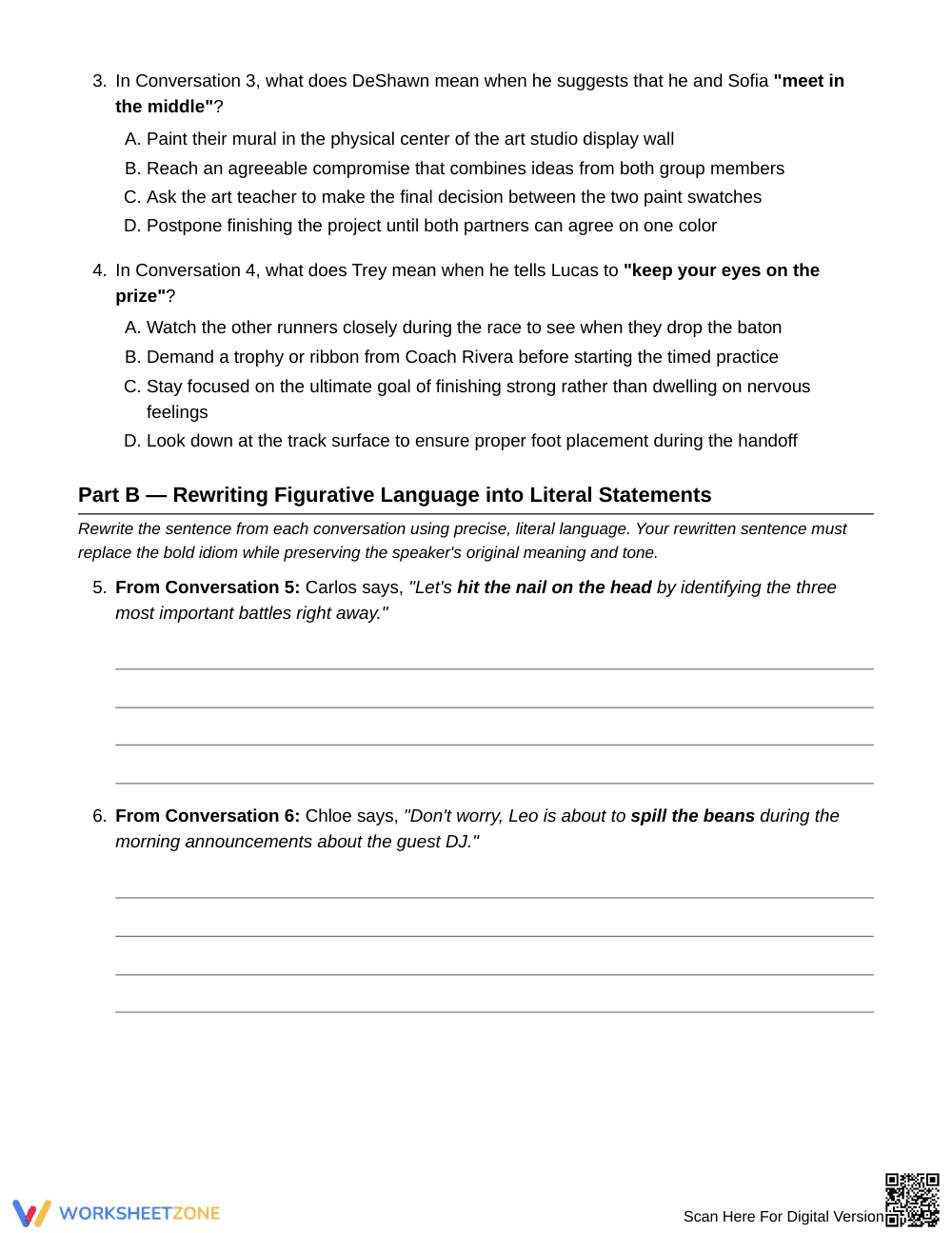
- Guided practice (Part A, Problems 1–4): Students read conversations 1 through 4 and complete four multiple-choice items identifying the precise nonliteral meaning of expressions like "bite off more than we can chew."
- Supported practice (Part B, Problems 5–8): Students rewrite four dialogue sentences from conversations 5 through 8 into precise, literal language while preserving speaker intent.
- Independent practice (Part C, Problems 9–10): Students write short-answer explanations analyzing tone, cultural relevance, and why specific idioms convey nuanced ideas better than literal phrasing.
This structured progression reflects the gradual release of responsibility model, shifting students smoothly from scaffolded identification to independent analysis.
Standards Alignment
The primary focus aligns to `L.6.5.a`: "Interpret figures of speech (e.g., personification) in context." Supporting instruction connects to `RL.6.4`, requiring students to determine the meaning of words and phrases as they are used in a text, including figurative and connotative meanings. Both standard codes can be copied directly into lesson plans, IEP goals, or district curriculum mapping tools.
How to Use It
Assign this activity immediately after direct instruction on nonliteral language, or utilize it during tier-two intervention stations. While students work through Part B, circulate to observe whether learners retain the emotional tone of the speaker when substituting literal phrasing for idioms. The entire worksheet takes approximately 35 to 45 minutes to complete.
Who It's For
This activity is designed for sixth-grade general education students, English language learners acquiring cultural idioms, and students receiving speech-language or special education support. Pair this worksheet directly with a figurative language anchor chart or a collaborative read-aloud focusing on character dialogue.
According to Fisher & Frey (2014), purposeful figurative language instruction relies on contextual dialogue analysis rather than rote memorization of definitions. By anchoring idioms to common middle school interactions, this resource enables Grade 6 students to master standard L.6.5.a through systematic context evaluation. Learners evaluate how figurative expressions function pragmatically, determining underlying speaker motivation and emotional intent across varied social scenarios. The multi-tiered sequence of multiple-choice identification, literal sentence restructuring, and tone justification ensures students internalize nonliteral phrases effectively. As demonstrated in contemporary literacy research, connecting abstract idioms to familiar situational context significantly accelerates expressive vocabulary development and improves reading comprehension outcomes for adolescent learners. Consequently, educators gain actionable formative data regarding student ability to decipher subtle nuances in spoken and written academic texts.


