


























Views
Downloads



Essential Homeostatic Loops Worksheet | Grade 10 Biology
Paste this activity's link or code into your existing LMS (Google Classroom, Canvas, Teams, Schoology, Moodle, etc.).
Students can open and work on the activity right away, with no student login required.
You'll still be able to track student progress and results from your teacher account.
This Grade 10 biology worksheet equips students to master homeostatic feedback systems through targeted analysis of stimulus, sensor, control center, and effector pathways. High school learners analyze physiological models, interpret synthetic clinical data, and evaluate pathway disruptions to develop an enduring mechanistic understanding of negative feedback loops.
At a Glance
- Grade: 10 · Subject: Biology
- Standard: Model how feedback mechanisms maintain homeostasis in human physiological systems
- Skill Focus: Stimulus, Sensor, Control, and Response
- Format: 5 pages · 12 problems · Answer key included · PDF
- Best For: High school biology core physiology instruction
- Time: 45–60 minutes
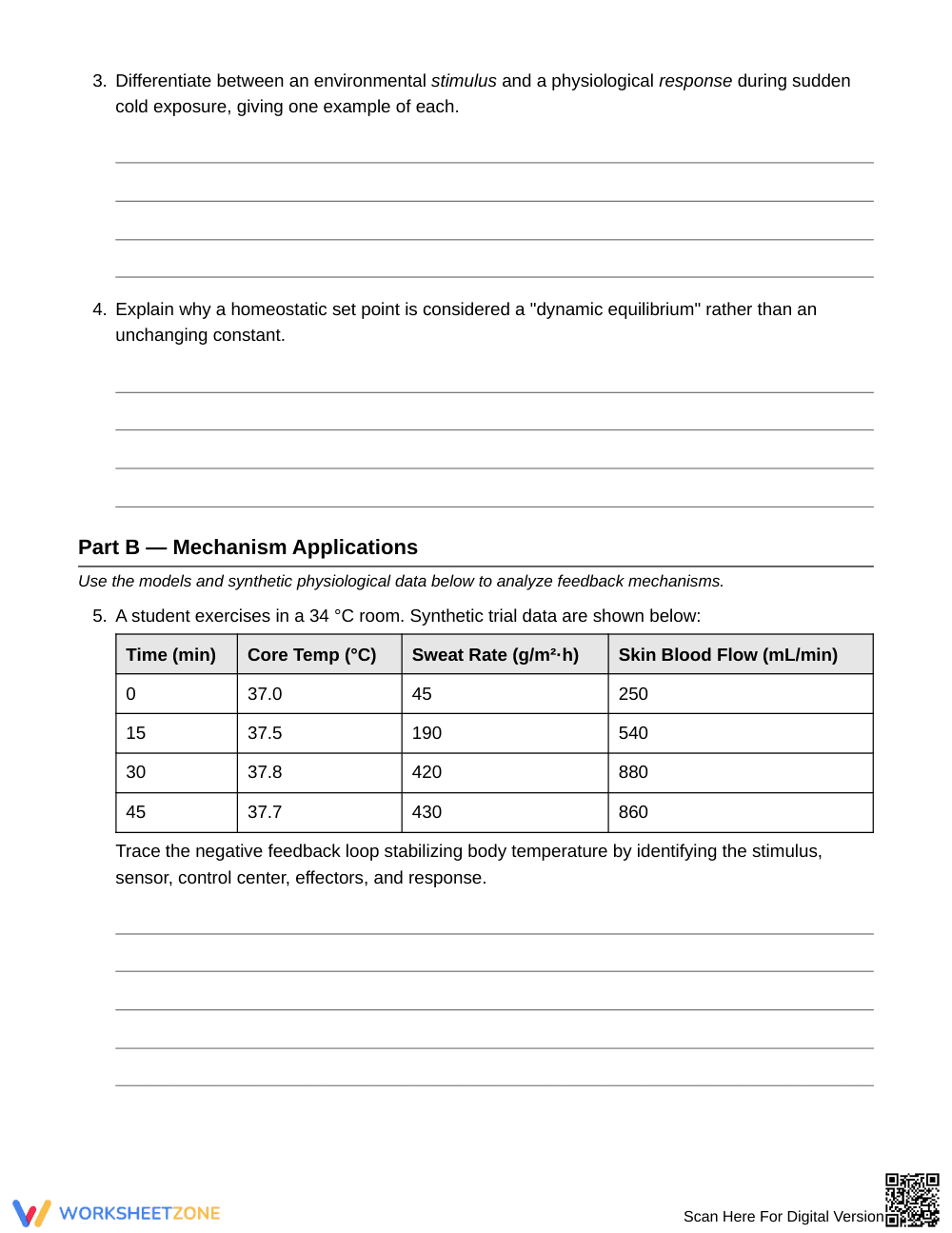
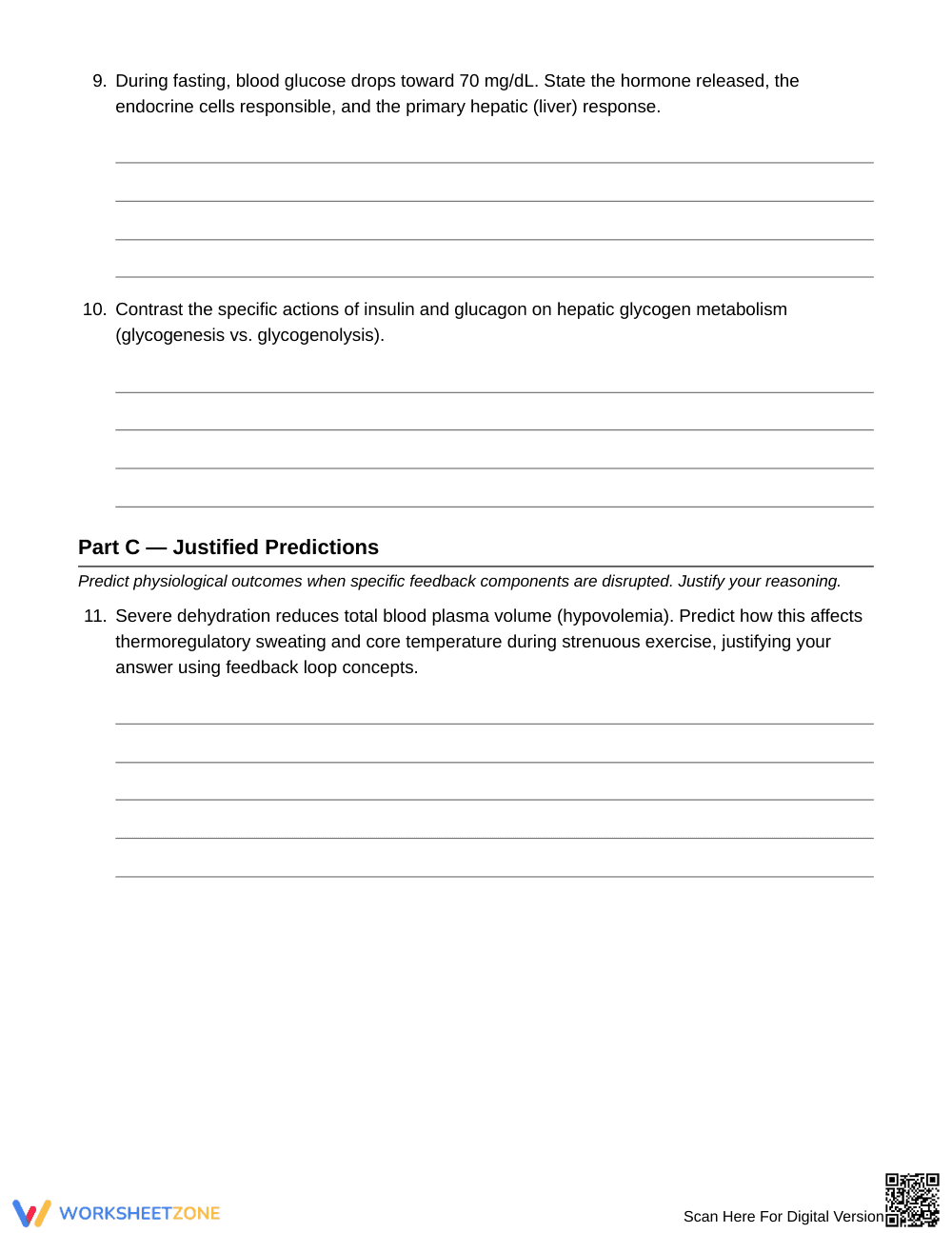
This 5-page student packet features 12 analytical items supported by an introductory reference box of core physiological principles. Students evaluate conceptual distinctions, complete short-answer mechanism explanations, interpret multi-timepoint synthetic data tables for core temperature and blood glucose, and construct reasoned predictions for physiological system failures. A complete 3-page answer key provides expected responses and explanatory rationales.
Skill Progression
- Guided practice (Part A, 4 tasks): Foundational conceptual prompts anchored by a top-of-page reference summary allow students to distinguish negative from positive feedback, categorize sensors versus effectors, and define dynamic equilibrium.
- Supported practice (Part B, 6 tasks): Data-supported application questions require students to examine synthetic clinical trials of exercise-induced sweating and oral glucose intake, tracing operational pathways through specific endocrine and neural components.
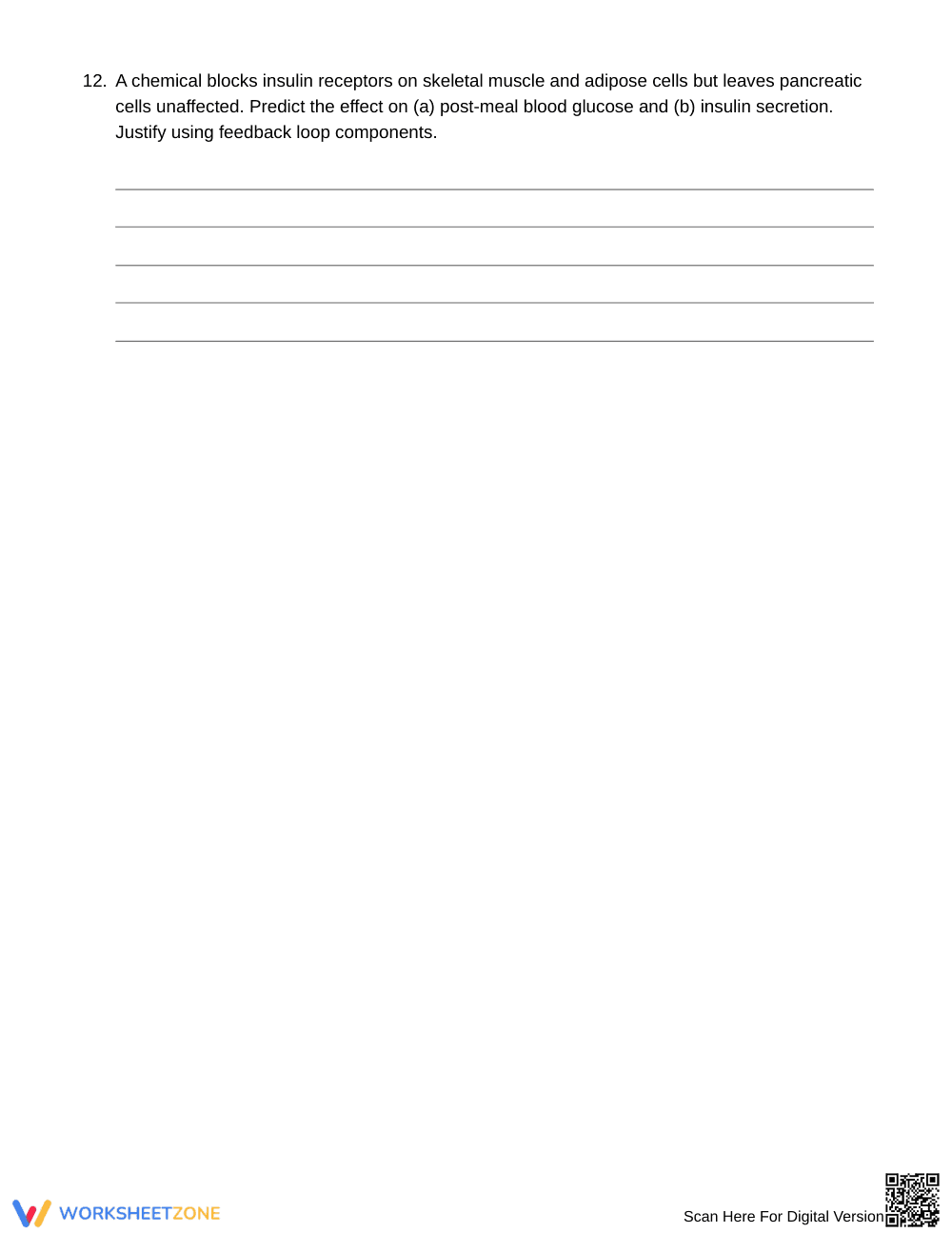
- Independent practice (Part C, 2 tasks): Unscaffolded scenario-based predictive items challenge students to deduce systemic outcomes when hypovolemia or receptor-blocking chemicals disrupt critical feedback components.
This structured sequence reflects the gradual-release framework, advancing students deliberately from component identification to rigorous physiological problem solving.
Standards Alignment
This resource aligns with high school life science standards governing how organisms maintain dynamic internal stability. Students investigate feedback loops to explain how human organ systems detect stimuli, route signals to control centers, and coordinate responses. Curricular benchmarks emphasize homeostatic feedback mechanisms, thermoregulation, and endocrine regulation. Both standard codes can be copied directly into lesson plans, IEP goals, or district curriculum mapping tools.
How to Use It
Deploy this worksheet after direct instruction on the endocrine and nervous systems to consolidate feedback concepts. During small-group practice, prompt students to trace anatomical information flow on the data interpretation tasks. For formative assessment, inspect Part C predictions to verify whether students attribute physiological changes to specific receptor and effector breakdowns rather than vague generalities. Expected completion time is 45 to 60 minutes.
Who It's For
This activity is designed for tenth-grade biology students encountering human anatomy and physiology units. Scaffolded data tables support emerging science readers, while disruption analysis provides rigorous extension for advanced learners. Pair this printable with a whole-class human endocrine pathway anchor chart or direct lecture slides on negative feedback loops.
High school biology students must master the functional components of homeostatic loops, including stimulus detection, sensor input, control center integration, and effector responses, to comprehend human biological systems. According to Fisher & Frey (2014), structured progression across guided, supported, and independent practice phases significantly accelerates analytical mastery when secondary learners confront complex scientific feedback mechanisms. By examining multi-timepoint quantitative data from human thermoregulation and oral glucose tolerance trials, students transition from simply memorizing biological vocabulary to actively evaluating dynamic cause-and-effect relationships within physiological networks. This 5-page curricular resource delivers 12 aligned tasks that systematically develop student competency in identifying regulatory structures and predicting the systemic consequences of component failure. The included 3-page answer key supports immediate instructional feedback, enabling classroom educators to diagnose misconceptions regarding dynamic equilibrium and receptor inhibition rapidly during high school biology instruction.


