




























Views
Downloads



Essential Domain Vocabulary Worksheet | Grade 8 ELA

Paste this activity's link or code into your existing LMS (Google Classroom, Canvas, Teams, Schoology, Moodle, etc.).
Students can open and work on the activity right away, with no student login required.
You'll still be able to track student progress and results from your teacher account.
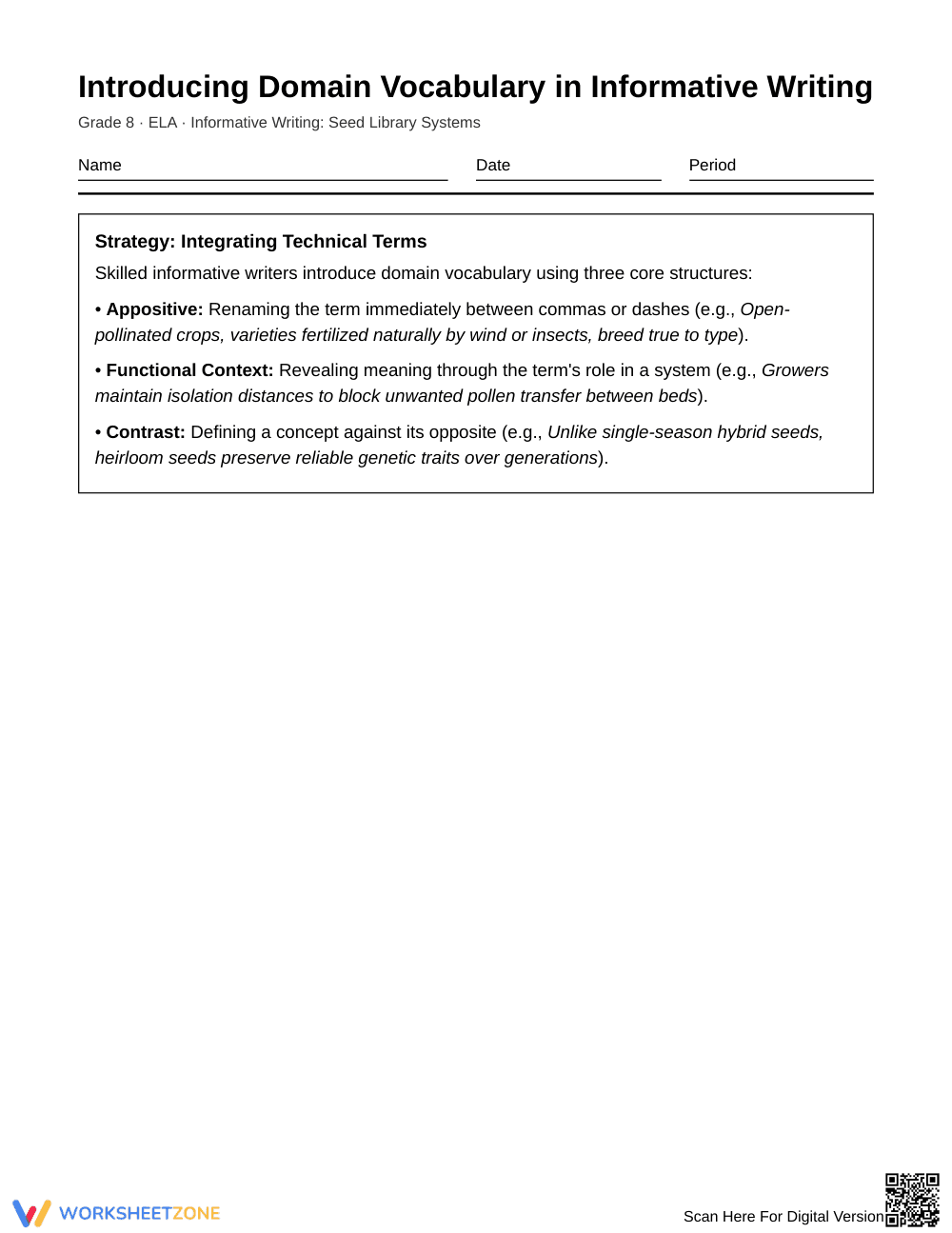
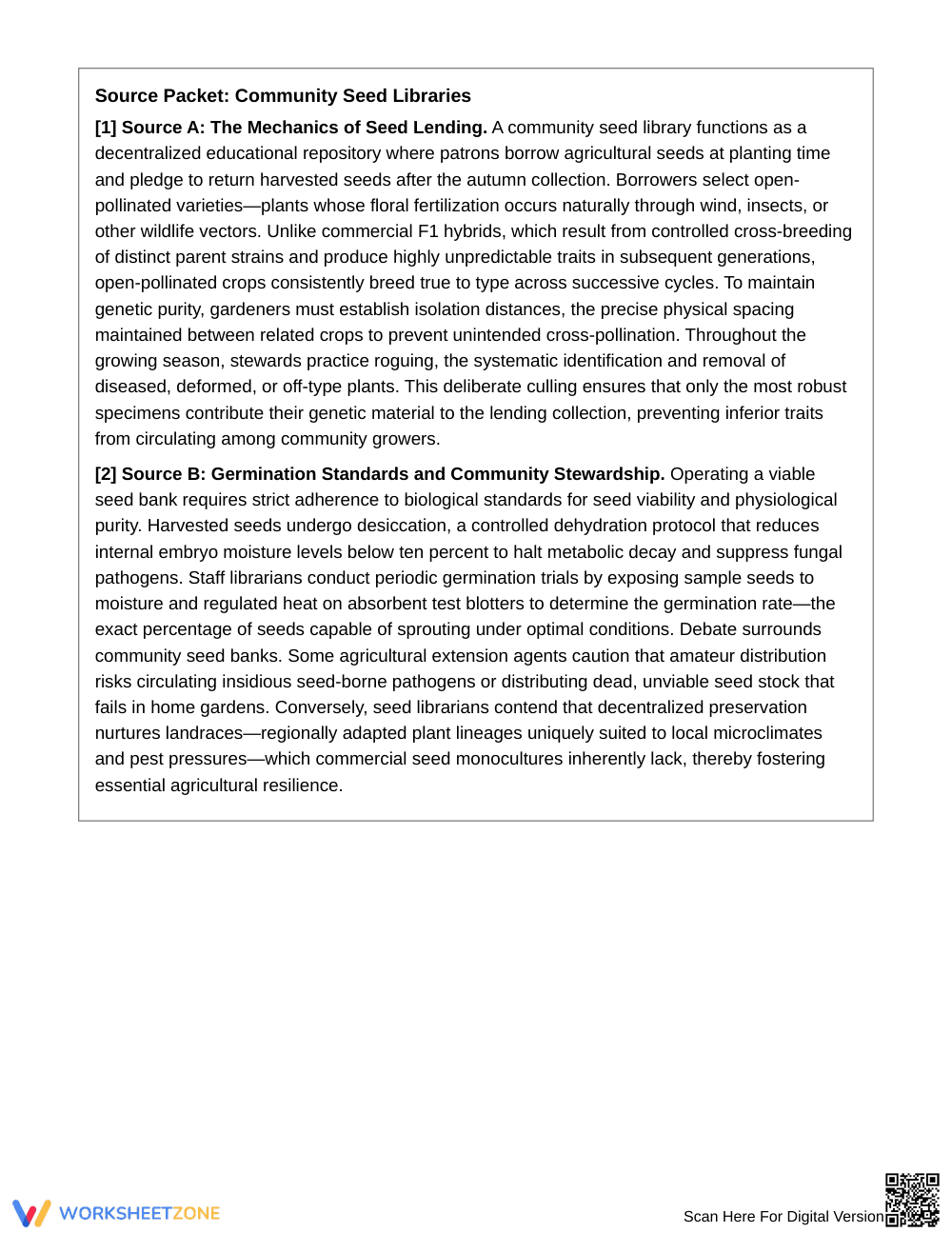
This informative writing worksheet equips middle school writers to define and integrate complex technical language within non-fiction prose. Students analyze informational texts about agricultural seed libraries, observe professional syntax models, and practice embedding subject-specific terminology naturally through appositives, contrast, and functional context to produce an evidence-based informational draft.
At a Glance
- Grade: 8 · Subject: ELA
- Standard:
W.8.2.d— Use precise words and domain-specific vocabulary to inform or explain- Skill Focus: Introduce Domain Vocabulary in Context
- Format: 5 pages · 8 problems · Answer key included · PDF
- Best For: Informative essay vocabulary drafting and revision
- Time: 45–60 minutes
What's Inside
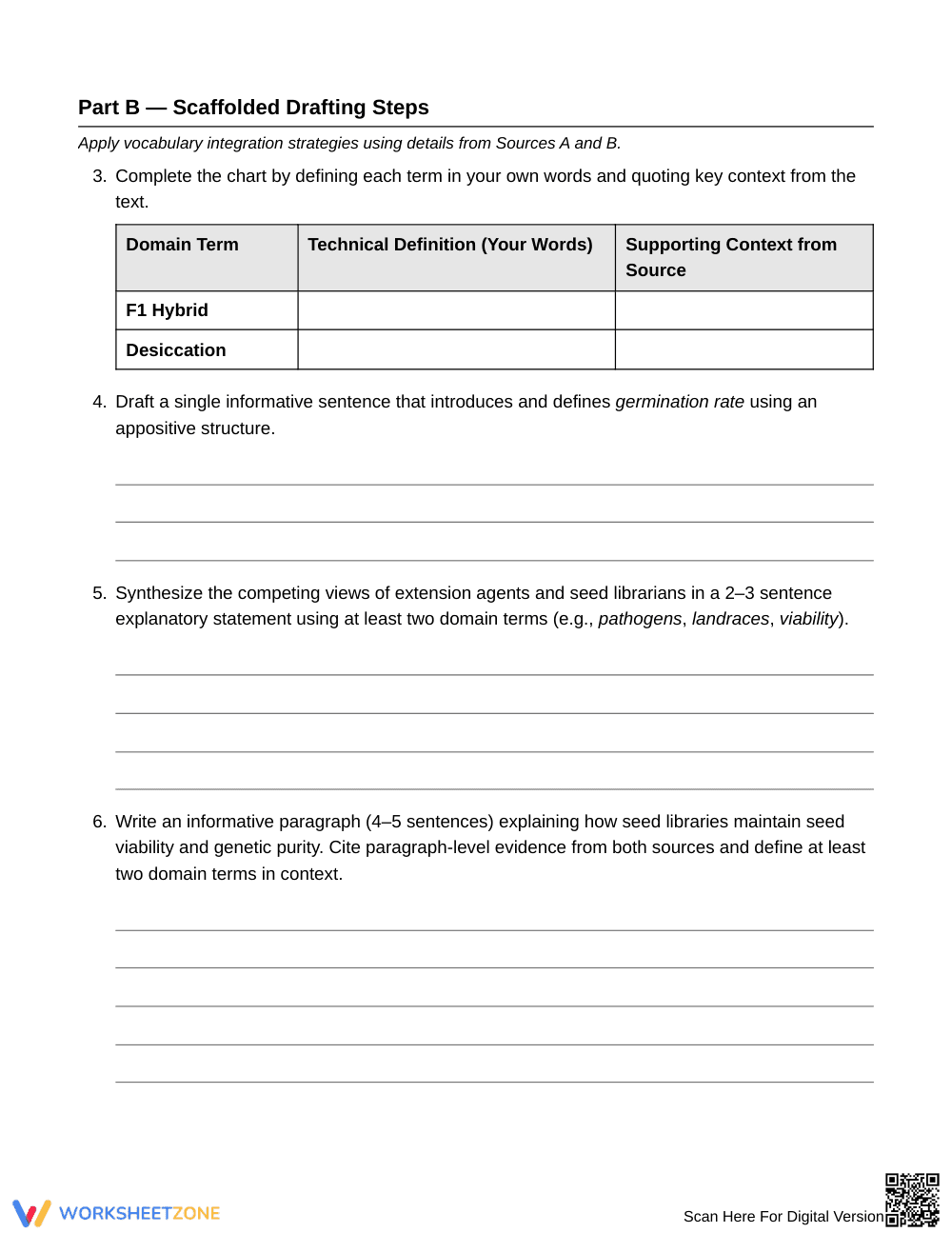
This 5-page instructional resource contains two informational source texts, a side-by-side mentor model, and 8 scaffolded student tasks. It includes a definition-in-context graphic organizer, sentence-combining drills, a colloquial-to-formal paragraph rewrite task, and an extended 250- to 350-word drafting prompt, supported by a thorough 4-page answer key.
Skill Progression
- Guided practice (Tasks 1–2): Students deconstruct mentor texts to identify how authors embed technical terms like roguing and landraces using appositives and punctuation-based context clues.
- Supported practice (Tasks 3–6): Writers complete a vocabulary extraction chart, draft single-sentence appositive definitions, synthesize opposing viewpoints, and construct a 4-to-5-sentence informational paragraph using domain terms.
- Independent practice (Tasks 7–8): Students revise informal, colloquial prose into formal academic language and independently write a complete multi-paragraph informational essay integrating at least four domain terms.
This structured sequence uses the gradual-release framework (I Do, We Do, You Do) to move students from passive text analysis to active, sophisticated technical writing.
Standards Alignment
This activity aligns directly to `W.8.2.d`: Use precise language and domain-specific vocabulary to inform about or explain the topic. It additionally reinforces `RI.8.4` by requiring students to determine the meaning of technical words in context. Both standard codes can be copied directly into lesson plans, IEP goals, or district curriculum mapping tools.
How to Use It
Use this resource during the drafting phase of an informative writing unit, immediately following direct instruction on appositives and context clues. For formative assessment, examine student responses in Part B to verify that learners embed definitions within narrative flow rather than tacking on rigid, dictionary-style sentences. Students typically complete the reading and structured drafting tasks within 45 to 60 minutes.
Who It's For
Designed for Grade 8 general education ELA classes, this worksheet also supports English language learners and developing writers through explicit sentence frames and mentor models. Pair this packet with an anchor chart on appositive punctuation or a lesson on informative essay structures.
According to Fisher & Frey (2014), explicit instruction in domain-specific vocabulary integration within content-area reading and writing accelerates informational text comprehension and academic writing fluency for adolescent learners. This resource targets standard W.8.2.d by providing deliberate practice in embedding technical terms such as desiccation and isolation distances directly into explanatory sentences. Through structured text analysis, sentence synthesis, and targeted revision, middle school writers transition from relying on vague, conversational phrasing to deploying precise, discipline-specific vocabulary in analytical drafts. The 8 scaffolded tasks establish rigorous expectations for informational clarity, providing educators with concrete artifacts of student vocabulary mastery and synthetic writing ability.


