




























Views
Downloads




Essential Developing Details Worksheet | Grade 6 ELA

Paste this activity's link or code into your existing LMS (Google Classroom, Canvas, Teams, Schoology, Moodle, etc.).
Students can open and work on the activity right away, with no student login required.
You'll still be able to track student progress and results from your teacher account.
This Grade 6 ELA worksheet teaches students to move beyond listing facts and instead develop details that explain how, why, and to what purpose—an essential informative-writing skill anchored to standard W.6.2.b. Across 8 structured tasks, students analyze an informational passage, expand undeveloped facts using fading scaffolds, and revise a choppy draft into a cohesive explanatory paragraph.
At a Glance
- Grade: 6 · Subject: ELA
- Standard:
W.6.2.b— Develop a topic with relevant facts, definitions, details, and quotations- Skill Focus: Developing details instead of listing them
- Format: 5 pages · 8 problems · Answer key included · PDF
- Best For: Guided practice during writing workshop
- Time: 30–45 minutes
What's Inside
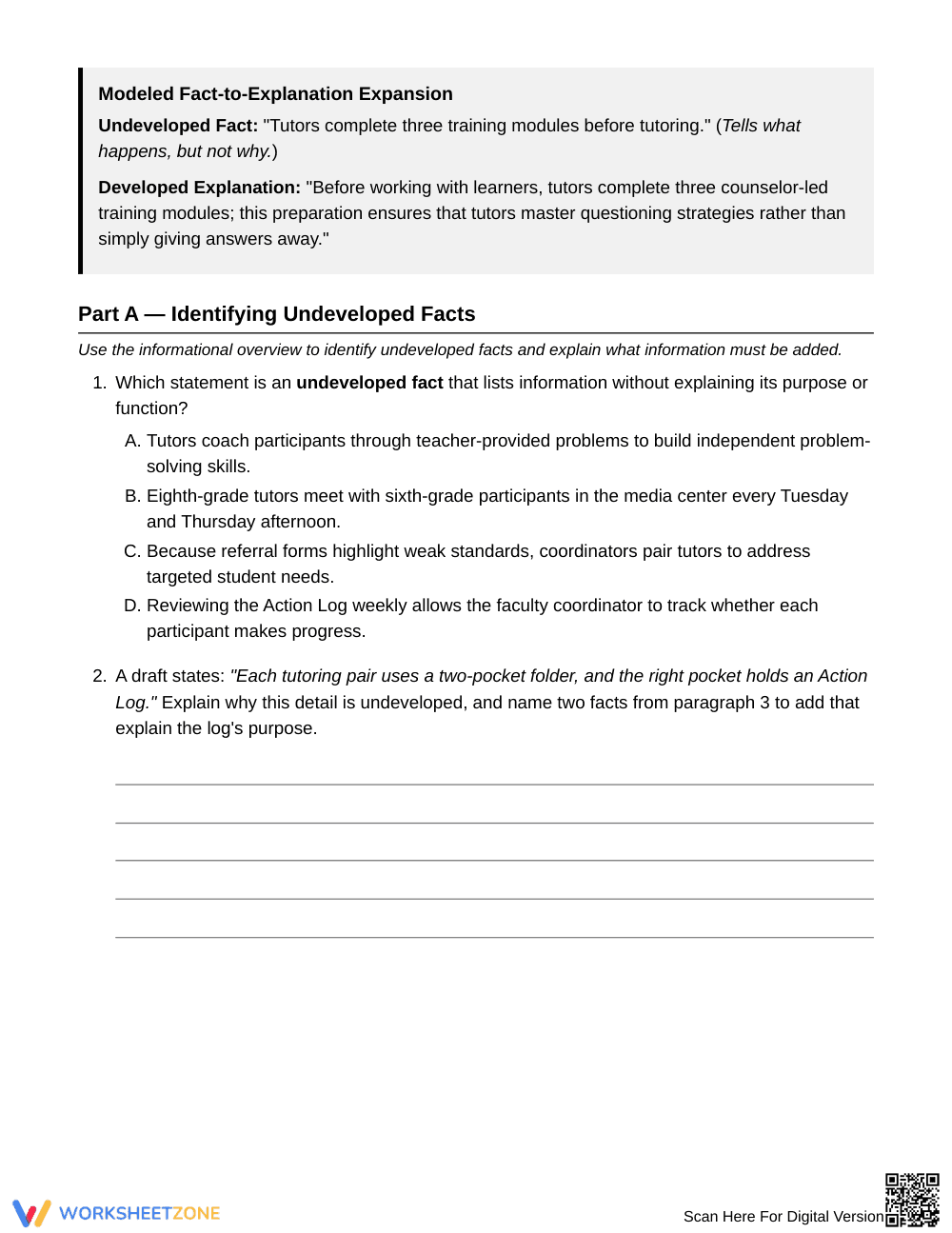
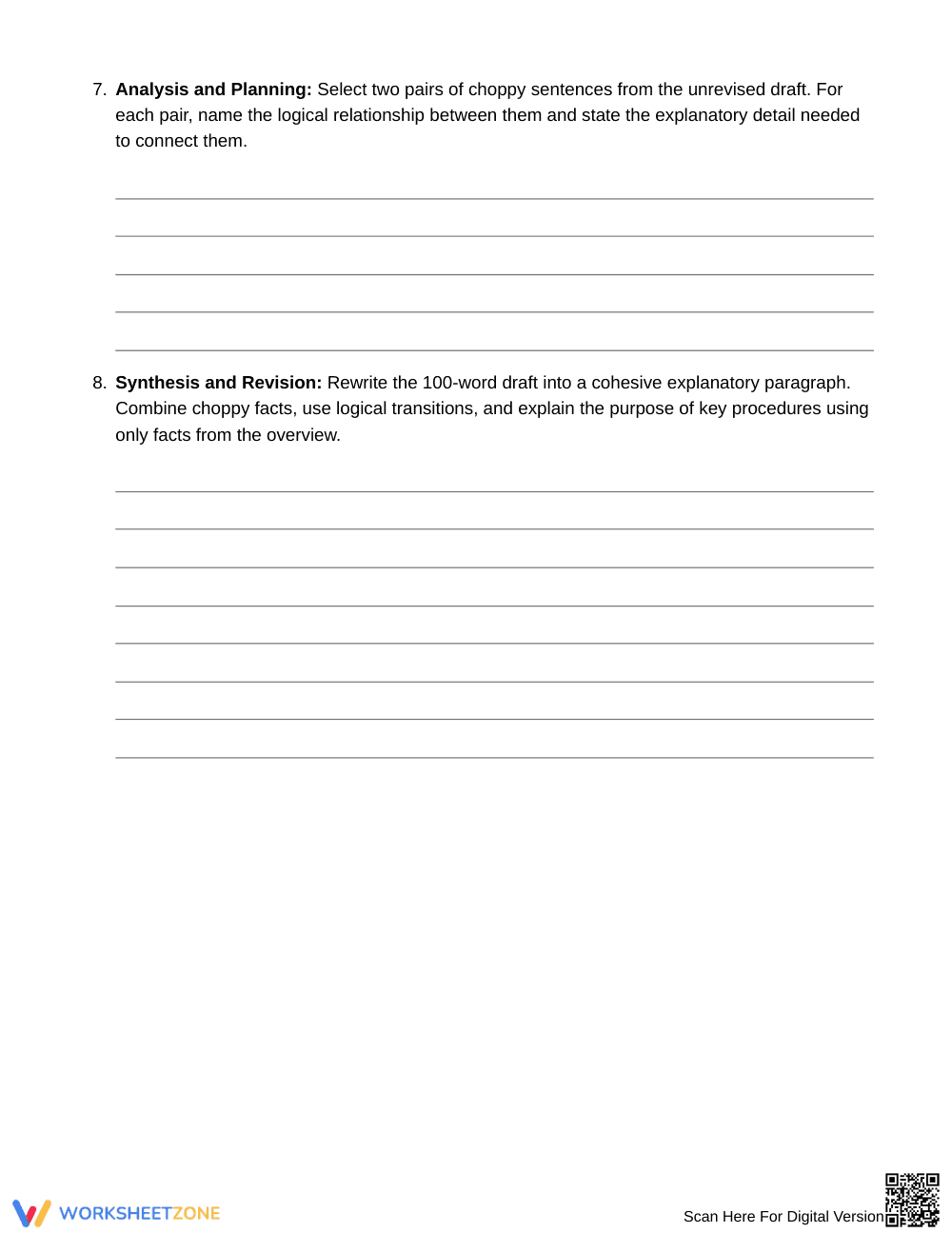
The worksheet opens with a concept box distinguishing listed details from developed details, complete with a modeled fact-to-explanation expansion. Students then work through a three-paragraph informational overview about a fictional peer-tutoring program. Part A (2 items) asks students to identify undeveloped facts and explain what explanatory information is missing. Part B (4 items) uses a gradual-release scaffold—heavy sentence frame, transitional prompt, light prompt, and fully independent response—to guide students through expanding supplied details. Part C (2 items) presents a 100-word unrevised draft and asks students to rewrite it as a cohesive paragraph. A full answer key is included.
Skill Progression
- Guided practice (Items 1–2): Students identify undeveloped facts in a multiple-choice item and a short-response prompt, building recognition of what "listing" looks like versus genuine explanation.
- Supported practice (Items 3–6): Four expansion tasks use fading scaffolds so students internalize the pattern of adding purpose, mechanism, or outcome to a bare fact.
- Independent practice (Items 7–8): Students analyze sentence-level relationships in a draft, then rewrite the full paragraph with logical transitions and developed explanations drawn from text evidence.
How to Use It
Assign the worksheet after direct instruction on elaboration strategies during a writing workshop block. As students work through Part B, circulate and note which scaffold level each student needs—this observation doubles as a formative check on readiness for independent drafting. Expected completion time is 30–45 minutes for the full worksheet; Parts A and B alone take roughly 20 minutes.
Who It's For
Designed for Grade 6 writers who can state facts but struggle to explain their significance. Students receiving writing intervention benefit from the heavy-scaffold frame in Item 3, while on-level writers can start at Item 5. Pair this worksheet with an anchor chart of elaboration sentence starters for additional support.
This five-page, 8-task worksheet targets W.6.2.b, the Common Core standard requiring students to develop a topic with relevant facts, concrete details, and examples rather than merely listing information. The specific skill—transforming undeveloped facts into explanations of purpose, mechanism, or outcome—addresses a gap identified by NAEP data showing that only 27 percent of eighth graders perform at or above the proficient level in writing. By using a gradual-release scaffold that moves from sentence frames to independent paragraph revision, the resource reflects the structured literacy framework endorsed by Fisher & Frey (2014), which demonstrates that fading scaffolds produce stronger transfer to independent writing tasks. Teachers can print the PDF, distribute it with zero prep, and use the included answer key to provide immediate feedback—making it practical for whole-class instruction, small-group intervention, or substitute-teacher plans.


