


























Views
Downloads



Essential Complex Unit Rates Worksheet | Grade 7 Math
Paste this activity's link or code into your existing LMS (Google Classroom, Canvas, Teams, Schoology, Moodle, etc.).
Students can open and work on the activity right away, with no student login required.
You'll still be able to track student progress and results from your teacher account.
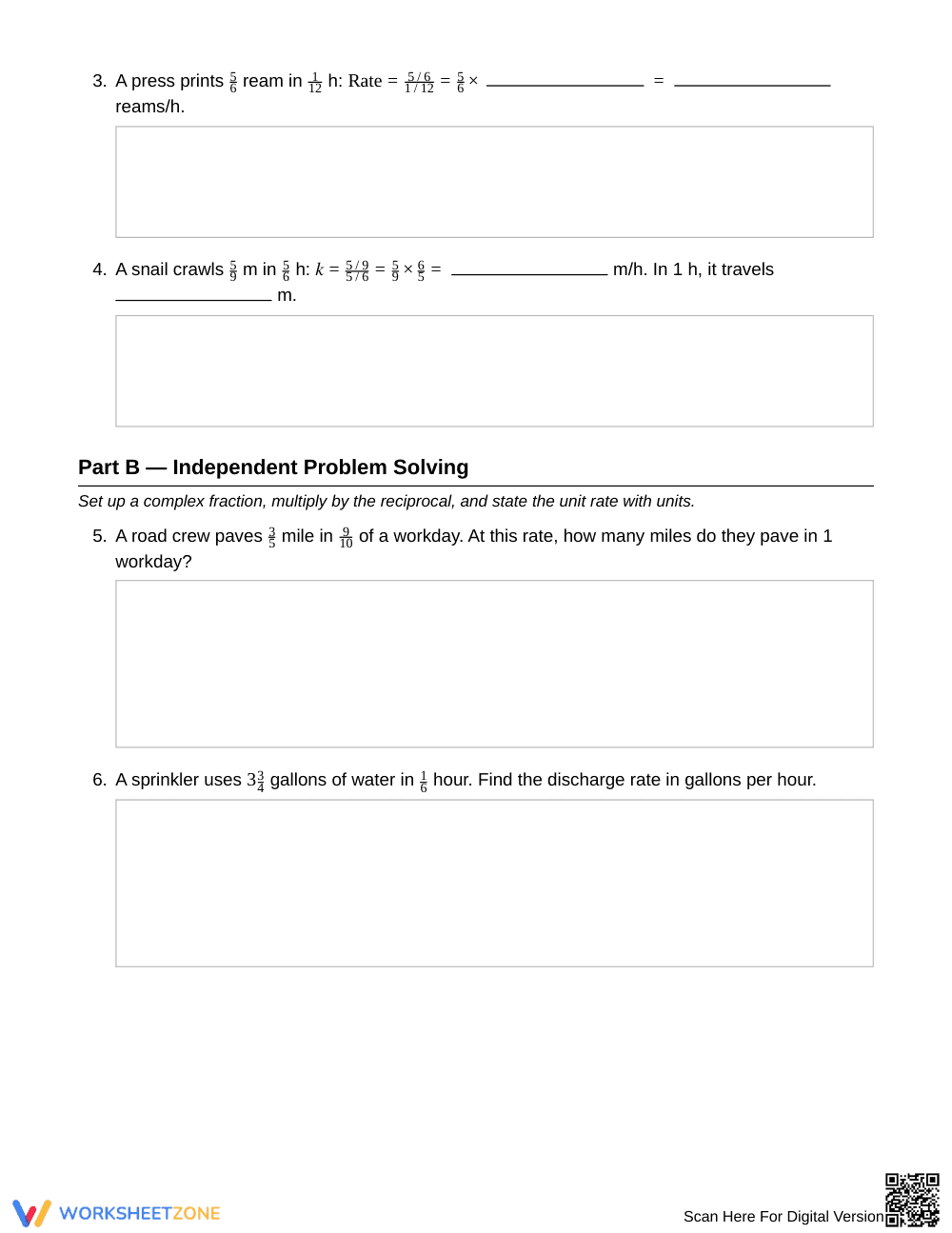
This Grade 7 math worksheet equips middle school students to calculate complex unit rates involving ratios of fractions, mixed numbers, and real-world rates of change. Through 12 multi-step problems, learners simplify complex fractions by multiplying by the reciprocal, derive unit rates with correct measurement units, and analyze proportional relationships in practical contexts.
At a Glance
- Grade: 7 · Subject: Math
- Standard:
7.RP.A.1— Compute unit rates associated with ratios of fractions and mixed quantities.- Skill Focus: Complex Unit Rates & Fraction Division
- Format: 4 pages · 12 problems · Answer key included · PDF
- Best For: Core practice or small-group intervention
- Time: 35–45 minutes
What's Inside
The 4-page resource includes a structured reference box with division rules, 2 modeled examples, 4 scaffolded completion problems, 6 independent rate tasks, and 2 reasoning challenges. A complete 2-page answer key provides step-by-step reciprocal multiplication solutions, labeled dimensional units, and conceptual justifications for immediate grading and feedback.
Skill Progression
- Guided practice (Reference Box & Models): Breaks down fraction division into reciprocal multiplication through 2 fully solved distance and area models.
- Supported practice (Part A, Problems 1–4): Provides missing-step blanks so students practice inverting divisors and simplifying resulting fractions.
- Independent practice (Parts B & C, Problems 5–12): Demands autonomous setup of complex fractions, table analysis, unit comparisons, and written error corrections.
This systematic structure mirrors the gradual release of responsibility model, moving students from guided calculation to independent critical analysis.
Standards Alignment
This resource aligns with `7.RP.A.1`, focusing on computing unit rates associated with ratios of fractions, including quantities measured in like or different units. It also supports `7.NS.A.2.B` by reinforcing division of signed rational numbers through reciprocal multiplication. Both standard codes can be copied directly into lesson plans, IEP goals, or district curriculum mapping tools.
How to Use It
Deploy this worksheet after direct instruction on fraction division as mid-unit guided practice, or assign Parts B and C for targeted partner problem-solving. During instruction, observe whether students correctly invert the denominator rather than the numerator when calculating rates. Most students complete all 12 tasks in 35 to 45 minutes.
Who It's For
Designed for Grade 7 general math classrooms, Tier 2 intervention groups, and accelerated Grade 6 learners mastering proportional reasoning. Pair this resource with a visual tape diagram anchor chart or rate tables before transitioning into constant of proportionality graphs.
According to Fisher & Frey (2014), structured instructional progressions that transition systematically from modeled demonstrations to partially scaffolded tasks and independent problem-solving significantly increase procedural fluency and conceptual retention in middle school mathematics. This worksheet operationalizes that evidence-based architecture for standard 7.RP.A.1, targeting the plain-English skill of calculating complex unit rates involving ratios of fractions and mixed numbers. By beginning with explicit reciprocal multiplication rules and structured fill-in steps before advancing to open-ended rate comparisons and student error analysis, the activity ensures learners build durable mastery of proportional relationships. Educational practitioners can directly integrate these 12 calibrated tasks into formative assessment routines to track individual student readiness for linear equations, slope concepts, and constant of proportionality benchmarks across Grade 7 mathematics curricula.


