




























Views
Downloads




Essential Circulatory Demand Worksheet | Grade 8 Science

Paste this activity's link or code into your existing LMS (Google Classroom, Canvas, Teams, Schoology, Moodle, etc.).
Students can open and work on the activity right away, with no student login required.
You'll still be able to track student progress and results from your teacher account.
This Grade 8 science worksheet equips middle school students to analyze how physical exercise alters cardiovascular output and blood flow distribution. Through realistic physiological datasets, learners connect cellular respiration demands in working muscle tissue to whole-body responses, including cardiac output adjustments, vasoconstriction, vasodilation, and post-exercise recovery requirements.
At a Glance
- Grade: 8 · Subject: Science
- Standard: Relate muscular energy demands to circulatory output, blood flow distribution, and oxygen extraction
- Skill Focus: Circulatory response to exercise
- Format: 5 pages · 10 problems · Answer key included · PDF
- Best For: Middle school body systems unit practice
- Time: 40–50 minutes
What's Inside
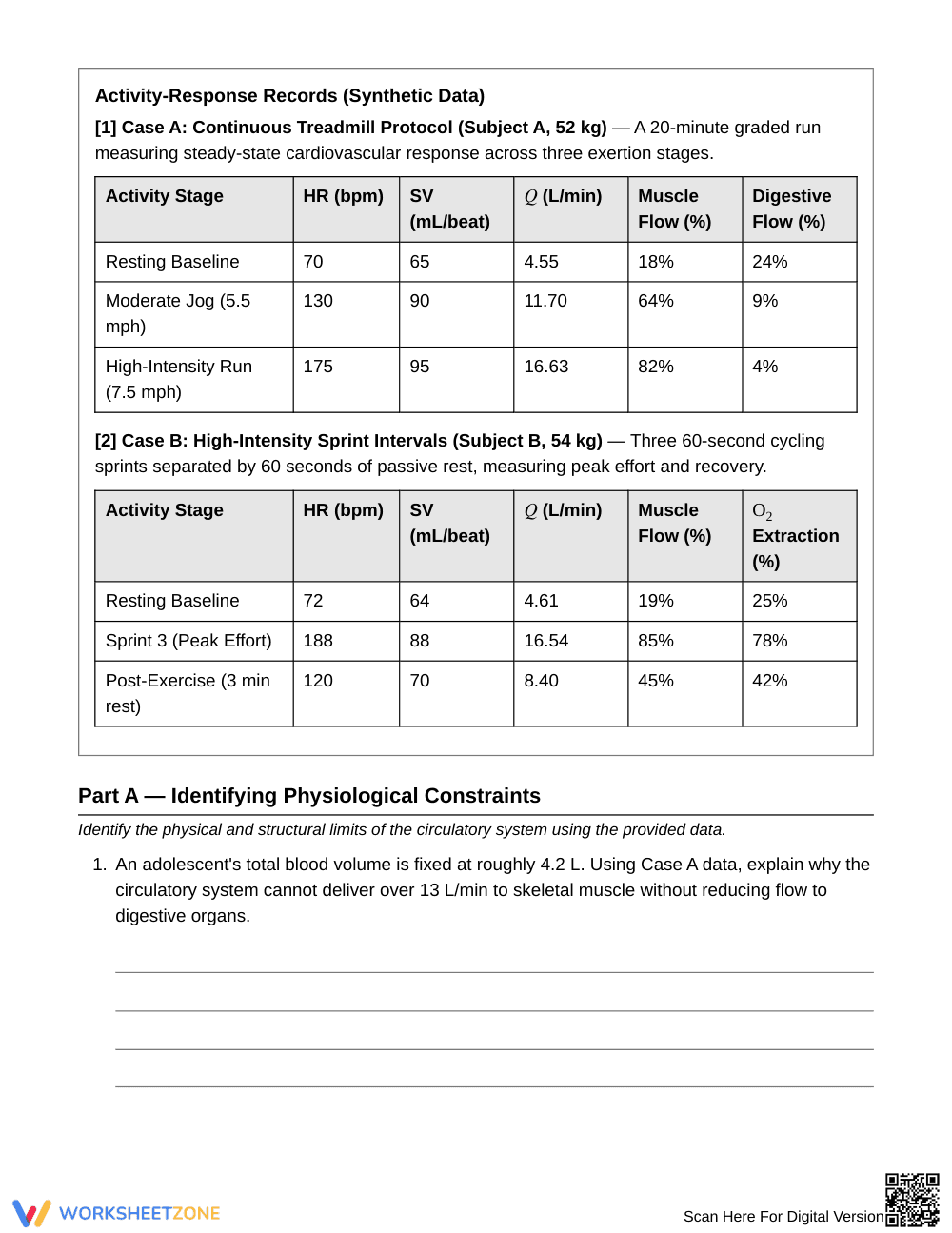
This 5-page resource provides a comprehensive physiological data set featuring two synthetic exercise cases: a continuous treadmill protocol and a high-intensity sprint interval series. Students evaluate key metrics such as heart rate, stroke volume, cardiac output, oxygen extraction, and regional blood flow percentages across 10 analytical prompts. A complete 2-page answer key provides worked calculations and sample explanations for immediate instructional feedback.
Skill Progression
- Guided Practice (Part A, 2 tasks): Students identify structural and volume constraints of the human cardiovascular system by interpreting resting versus peak blood volume allocations.
- Supported Practice (Part B, 6 tasks): Learners calculate cardiac output using the standard formula, describe arteriole constriction and dilation mechanisms, and explain post-exercise oxygen debt.
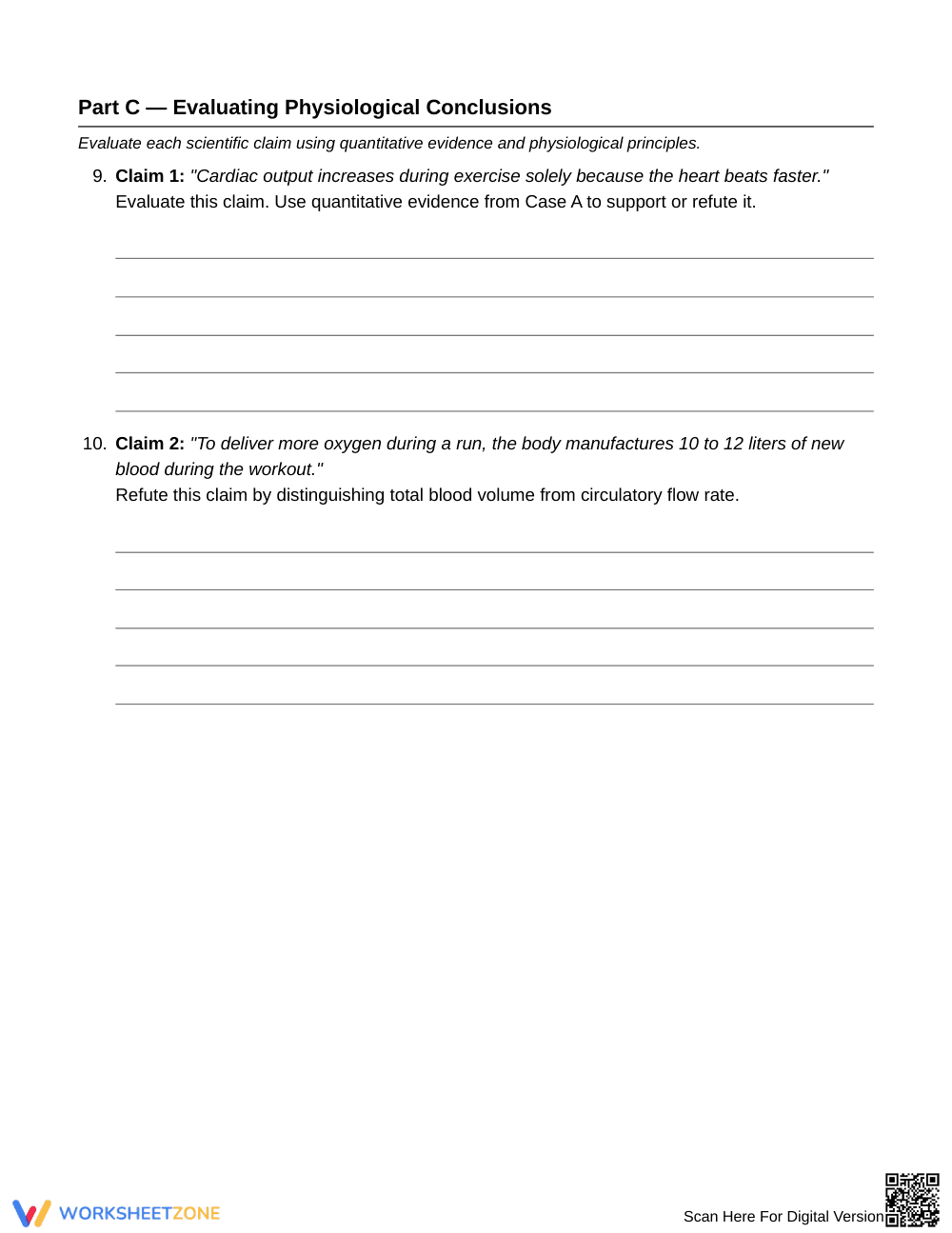
- Independent Practice (Part C, 2 tasks): Students evaluate and refute common physiological misconceptions by synthesizing multi-variable data and constructing evidence-based scientific arguments.
This structured sequence follows a gradual-release model, moving students from basic data comprehension to advanced physiological reasoning.
Standards Alignment
This lesson aligns directly with middle school life science standards addressing human body systems and cellular energy release. Students develop models demonstrating how organ systems interact to support cellular respiration under varying physical workloads. These learning targets integrate into standard middle school life science curriculum maps and unit pacing guides.
How to Use It
Deploy this worksheet after direct instruction on the circulatory system and aerobic cellular respiration. For formative assessment, examine student responses on Part B to ensure they differentiate between cardiac output changes and regional vascular redirection. The complete activity takes approximately 40 to 50 minutes of instructional time.
Who It's For
This resource is designed for Grade 8 general science, honors life science, or introductory biology classrooms. It serves as an effective extension after a laboratory investigation measuring student pulse rates or as an analytical follow-up to an anchor lesson on cellular respiration.
According to Fisher & Frey (2014), structured data analysis paired with guided scientific argumentation accelerates conceptual mastery in middle school science classrooms. When students evaluate quantitative physiological models rather than memorizing organ names in isolation, they build durable cross-system understanding. This Grade 8 circulatory demand worksheet translates abstract physiological mechanics into concrete mathematical relationships by asking students to calculate cardiac output, model capillary gas exchange, and explain arteriole constriction during exercise. Working through authentic datasets bridges the conceptual gap between microscopic cellular respiration and macroscopic cardiovascular adaptation. Teachers can directly measure analytical growth as students refute flawed physiological claims using empirical evidence from provided exercise protocols.


