




























Views
Downloads



Essential Circulation Models Worksheet | Grade 8 Science

Paste this activity's link or code into your existing LMS (Google Classroom, Canvas, Teams, Schoology, Moodle, etc.).
Students can open and work on the activity right away, with no student login required.
You'll still be able to track student progress and results from your teacher account.
This middle school science worksheet helps eighth-grade students evaluate competing scientific models of blood transport and capillary gas exchange. Through quantitative data analysis and structural comparisons, learners contrast continuous bulk-flow and regulated dual-circuit models to understand how vessel morphology enables systemic nutrient delivery.
At a Glance
- Grade: 8 · Subject: Science
- Standard: Compare scientific models of human body systems and microvascular transport
- Skill Focus: Compare Models of Circulation and Exchange
- Format: 5 pages · 10 problems · Answer key included · PDF
- Best For: Quantitative model evaluation and microvascular analysis
- Time: 40–50 minutes
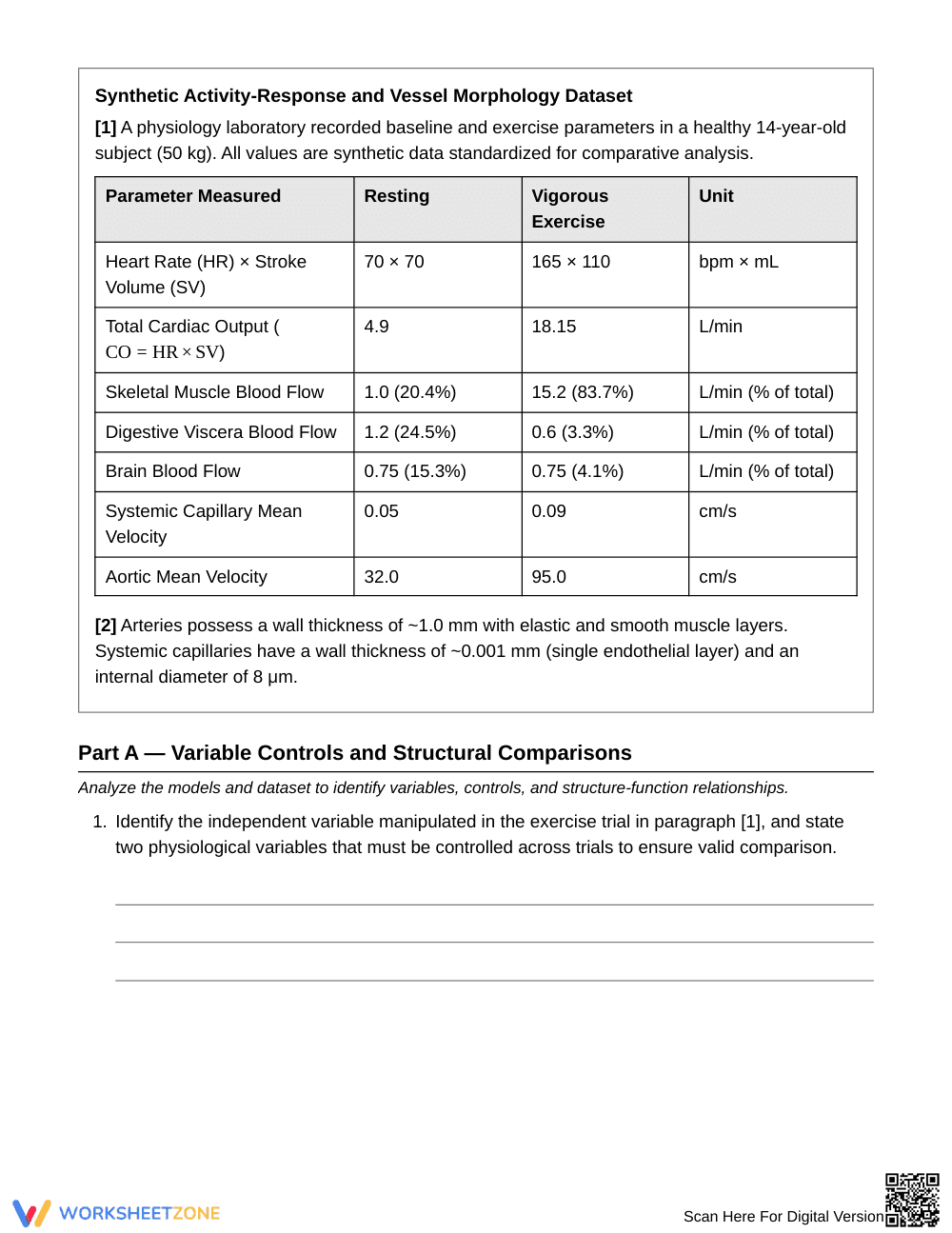
This 5-page worksheet presents 10 analytical problems divided across structural, predictive, and evaluative sections. Students examine synthetic hemodynamic datasets, including resting versus exercise cardiac output, vessel cross-sectional area, and capillary wall thickness (~0.001 mm versus ~1.0 mm arterial walls). A comprehensive 2-page answer key provides complete rationales, calculation breakdowns, and model evaluations.
Skill Progression
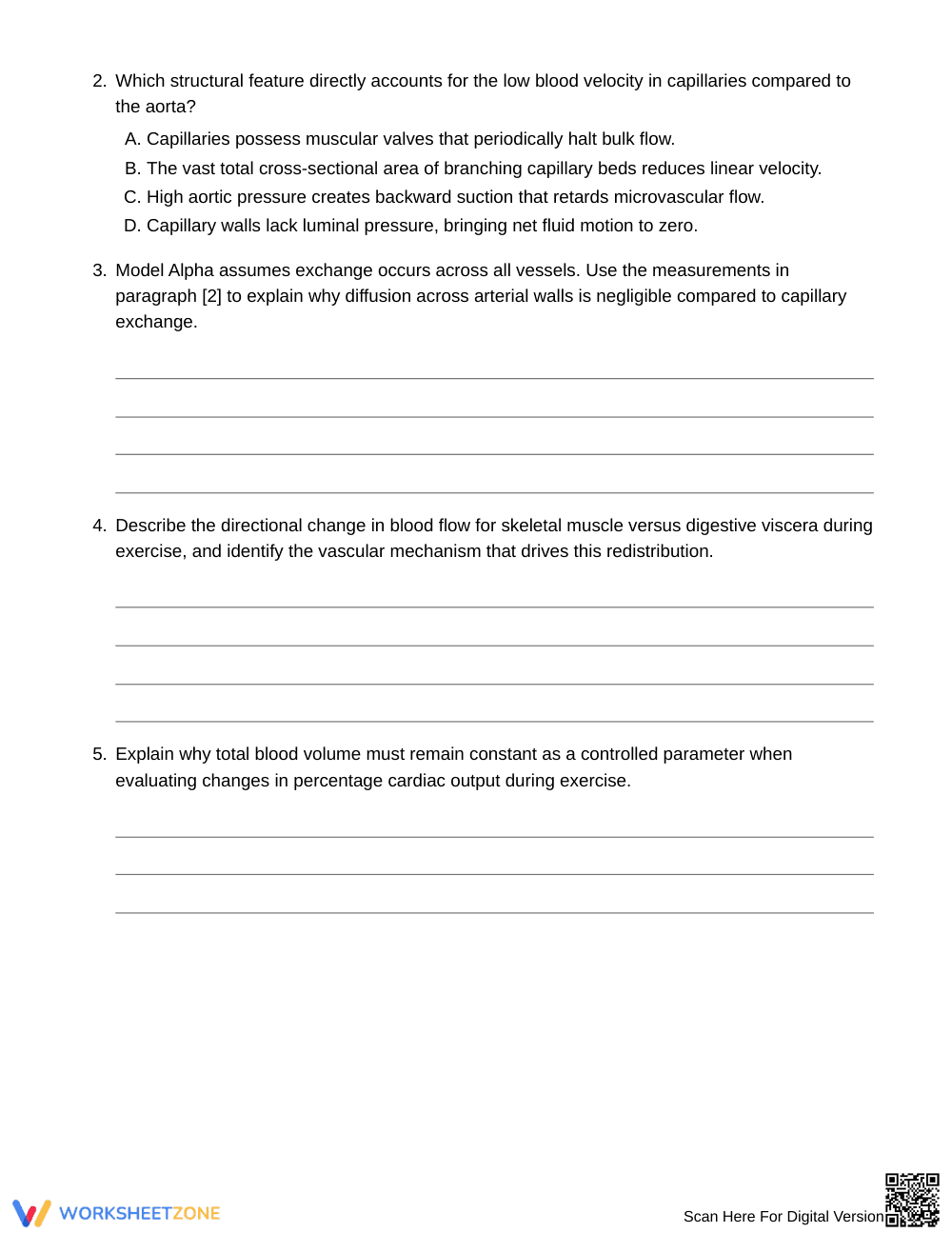
- Guided practice (Part A): Students examine controlled experimental variables and correlate vessel morphology, such as endothelial wall thickness, directly to diffusion efficiency across six structured prompts.
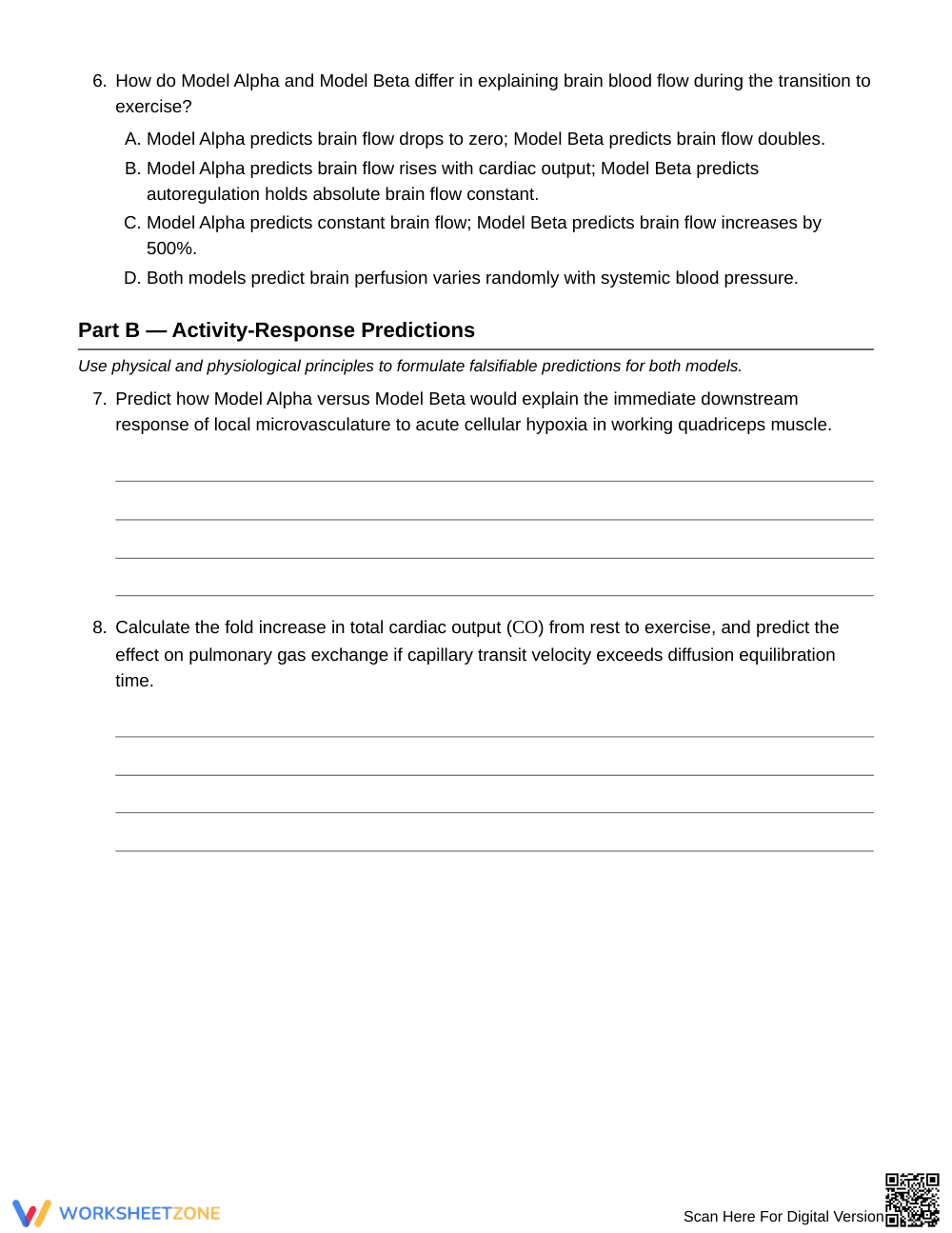
- Supported practice (Part B): Learners formulate falsifiable predictions regarding microvascular vasodilation and calculate fold changes in cardiac output during vigorous exertion across two multi-step tasks.
- Independent practice (Part C): Students independently evaluate empirical evidence to refute the uniform bulk-flow model and validate regulated capillary exchange across two rigorous synthesis questions.
This progression mirrors the gradual release of responsibility framework, transitioning students from foundational data interpretation to independent evidence-based argumentation.
Standards Alignment
This resource aligns with middle school life science standards requiring students to develop and use models to describe the function of a system and its interacting subsystems. Students investigate how specialized tissues and organ structures facilitate vital material transport. Standard descriptions can be copied directly into lesson plans, IEP goals, or district curriculum mapping tools.
How to Use It
Deploy this worksheet after direct instruction on the circulatory system to deepen analytical reasoning. In small groups, students can dissect the synthetic hemodynamic table to justify vascular redistribution between digestive viscera and skeletal muscle. For formative assessment, observe whether students correctly identify total capillary cross-sectional area as the primary factor reducing flow velocity. Completion typically requires 40 to 50 minutes of instructional time.
Who It's For
This activity serves general Grade 8 science students, advanced life science learners, and introductory biology classes requiring quantitative reasoning. Pair this assignment with a circulatory system anatomical diagram or a microvascular blood flow animation to reinforce the physical mechanisms of solute diffusion.
Middle school students often harbor persistent misconceptions regarding internal transport, commonly assuming that blood freely leaks from all blood vessels or moves at uniform velocity throughout the body. According to research on model-based inquiry by Fisher & Frey (2014), engaging students in contrasting flawed conceptual models against evidence-based mechanistic frameworks significantly strengthens conceptual retention and scientific argumentation. By systematically analyzing synthetic resting and exercise data across 10 structured tasks, eighth-grade learners directly contrast continuous bulk-flow with regulated capillary exchange. Students evaluate empirical hemodynamic shifts, such as the redistribution of cardiac output from 20.4% to 83.7% in active skeletal muscle, while observing how anatomical adaptations like single-cell endothelial capillary walls enable gas exchange. This structured data analysis grounds biological systems instruction in verifiable quantitative evidence.


