


























Views
Downloads



Essential Cellular Energy Flow Worksheet | Grade 10 Biology
Paste this activity's link or code into your existing LMS (Google Classroom, Canvas, Teams, Schoology, Moodle, etc.).
Students can open and work on the activity right away, with no student login required.
You'll still be able to track student progress and results from your teacher account.
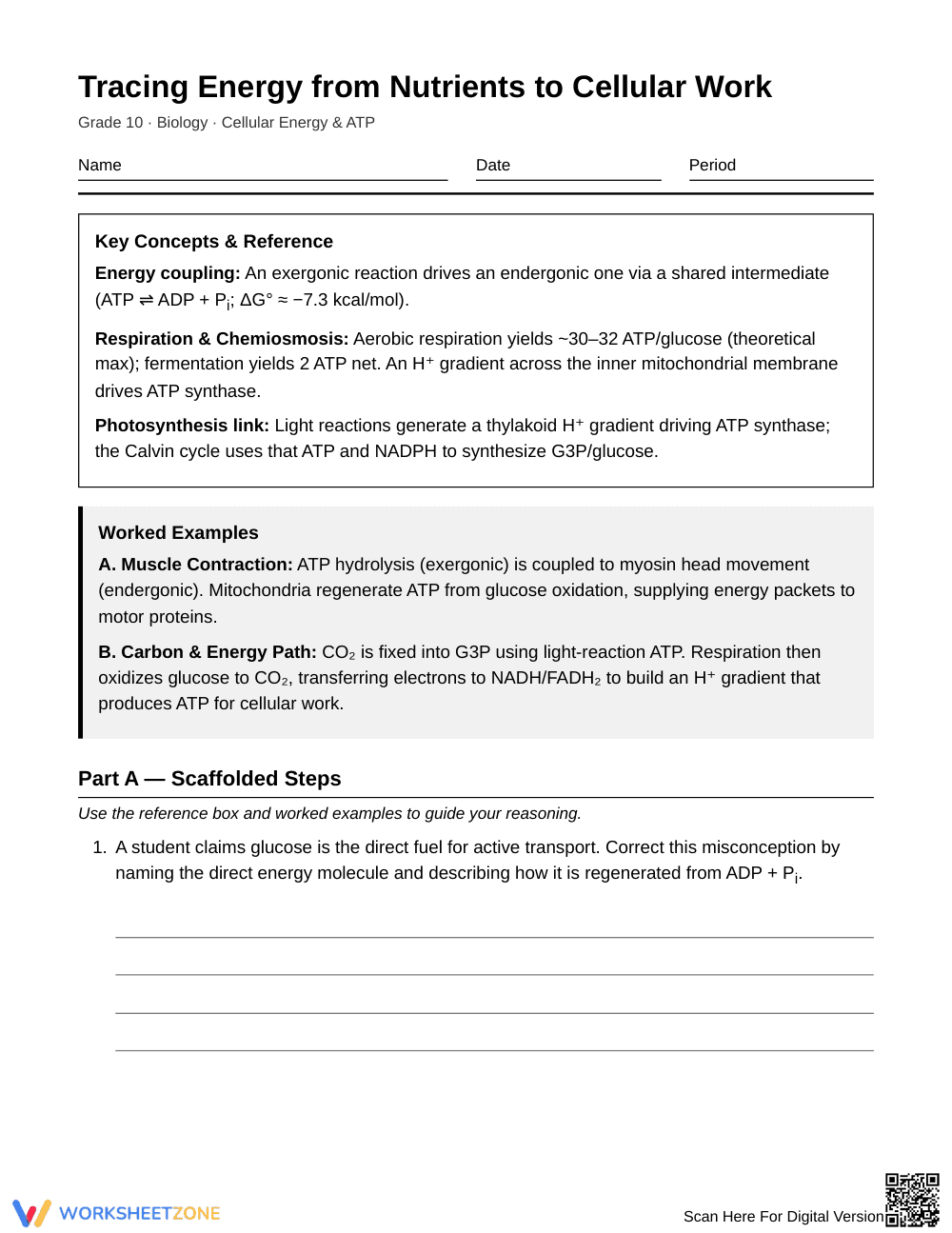
This biology worksheet guides tenth-grade students through tracing energy transfer from nutrients to cellular work. Students analyze biochemical reactions, interpret mitochondrial respiration data, and explain how ATP hydrolysis powers active transport. Through structured inquiry and quantitative reasoning, learners build deep conceptual mastery of energy coupling and metabolic pathways.
At a Glance
- Grade: 10 · Subject: Biology
- Standard: High School Life Science — Trace biochemical energy flow from organic nutrient molecules to cellular work
- Skill Focus: Trace Energy from Nutrients to Cellular Work
- Format: 5 pages · 10 problems · Answer key included · PDF
- Best For: High school cellular respiration review
- Time: 45–60 minutes
What's Inside
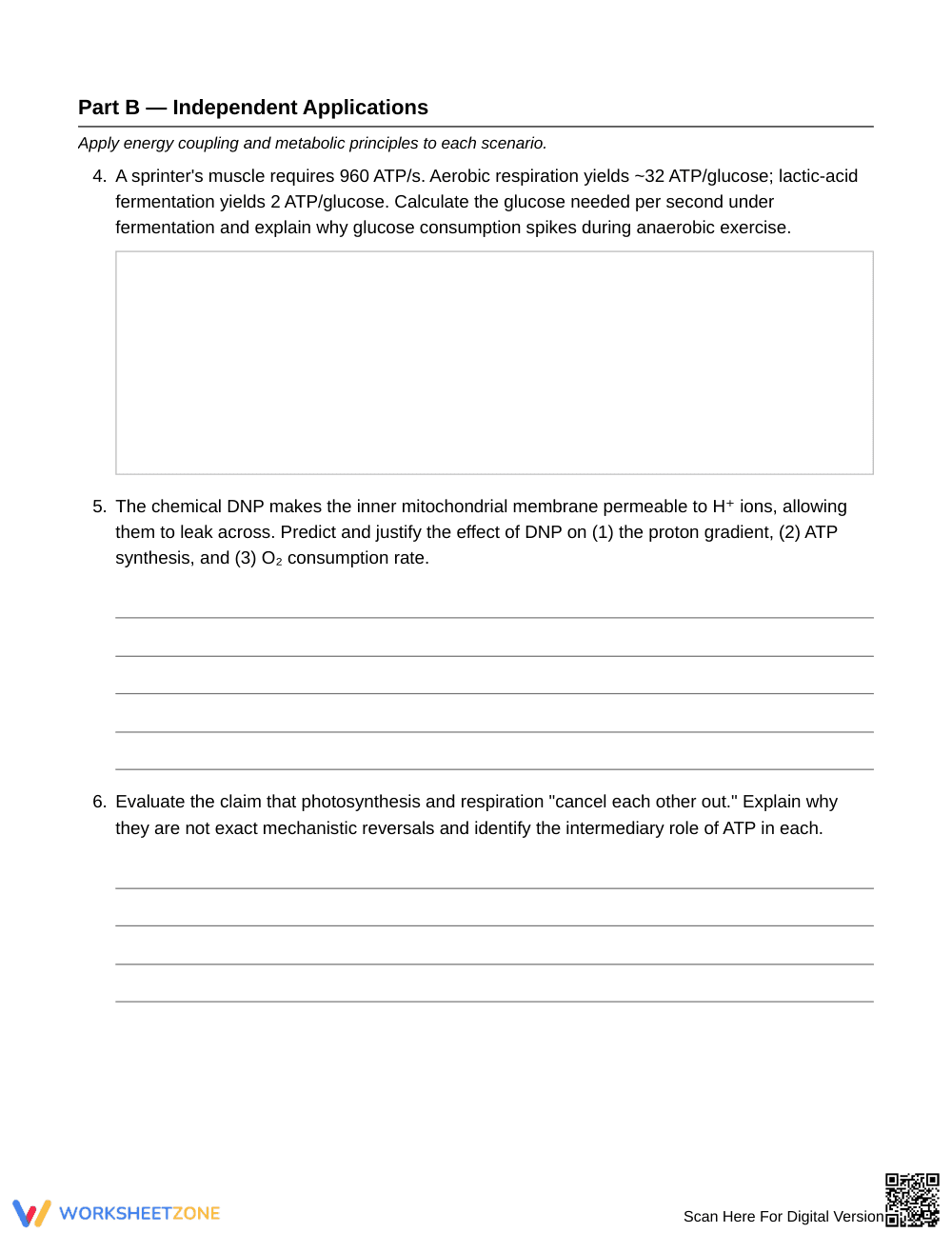
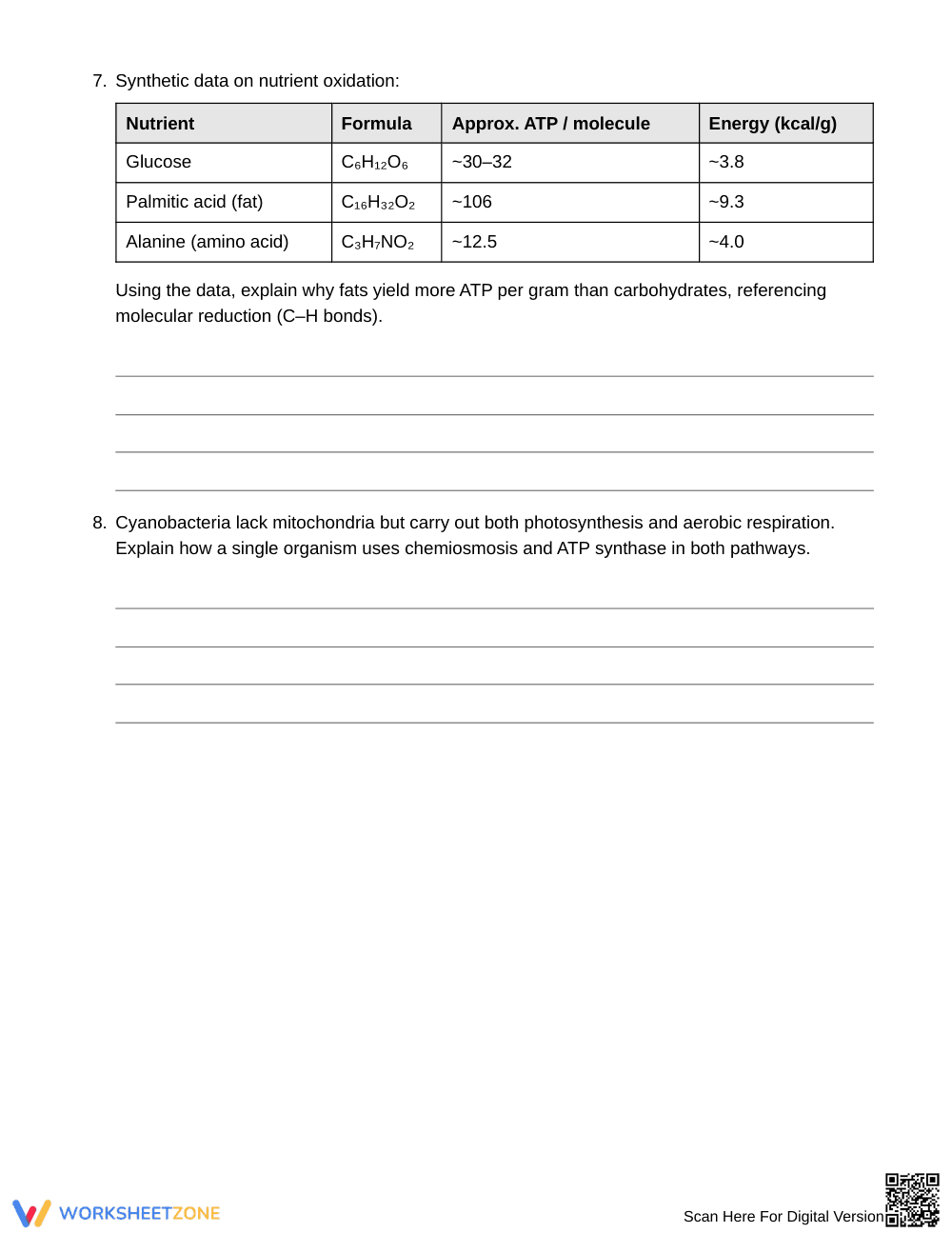
This 5-page resource features 10 biology tasks arranged in three pedagogical tiers. It includes reference boxes on chemiosmosis and coupling, two worked examples, synthetic mitochondrial respiration data, a 5-step energy organizer, and comparative nutrient oxidation tables. A complete 2-page answer key provides full explanations for every item.
Skill Progression
- Guided practice (Problems 1–3): High scaffolds with reference formulas, worked examples, mitochondrial data analysis, and a guided pathway organizer.
- Supported practice (Problems 4–8): Moderate scaffolds requiring students to calculate anaerobic yields, predict DNP effects, analyze fat oxidation data, and evaluate chemiosmosis.
- Independent practice (Problems 9–10): Low scaffolds prompting complete written explanations of ATP currency and oxidative phosphorylation mechanics.
This sequence mirrors the gradual-release model, transitioning learners smoothly from teacher guidance to independent mastery.
Standards Alignment
This worksheet aligns with high school biology curriculum standards requiring students to explain how cellular respiration breaks down organic molecules to power cellular work. A supporting standard focuses on modeling energy flow across cellular respiration and photosynthesis. Both standard codes can be copied directly into lesson plans, IEP goals, or district curriculum mapping tools.
How to Use It
Use this worksheet immediately after direct instruction on cellular respiration as guided practice, or deploy it before unit exams as a paired review station. Formatively observe student responses on Part A, Problem 2 to spot misconceptions regarding how oxygen deprivation halts ATP synthase. Expected completion time is 45 to 60 minutes.
Who It's For
This worksheet serves Grade 10 general and honors biology students studying cellular energy. Support struggling learners by providing an annotated membrane diagram alongside the respiration data, while challenging advanced students to calculate free energy yields. Pair this resource with an ATP cycle anchor chart.
According to Fisher & Frey (2014), structured cognitive scaffolding enables secondary science students to transition successfully from conceptual acquisition to complex biological problem solving. This tenth-grade biology worksheet operationalizes that pedagogical framework by guiding students through tracing energy from nutrients to cellular work across ten rigorous tasks. High school life science standards emphasize that students must trace how organic macromolecules undergo catabolic breakdown to regenerate ATP through chemiosmosis and energy coupling. By systematically pairing reference principles, worked examples, and synthetic respiration data sets, this resource ensures students master both biochemical mechanisms and quantitative metabolic reasoning. Independent explanation checks further reinforce conceptual retention by requiring learners to articulate the physiological importance of proton gradients and high-energy phosphate bonds in sustaining cellular life. The structured gradual-release architecture provides verifiable evidence of standard mastery, making this five-page instructional resource an essential asset for rigorous high school biology classrooms.


