


























Views
Downloads


Essential Equivalent Ratios Worksheet | Grades 4-6 Math
Paste this activity's link or code into your existing LMS (Google Classroom, Canvas, Teams, Schoology, Moodle, etc.).
Students can open and work on the activity right away, with no student login required.
You'll still be able to track student progress and results from your teacher account.
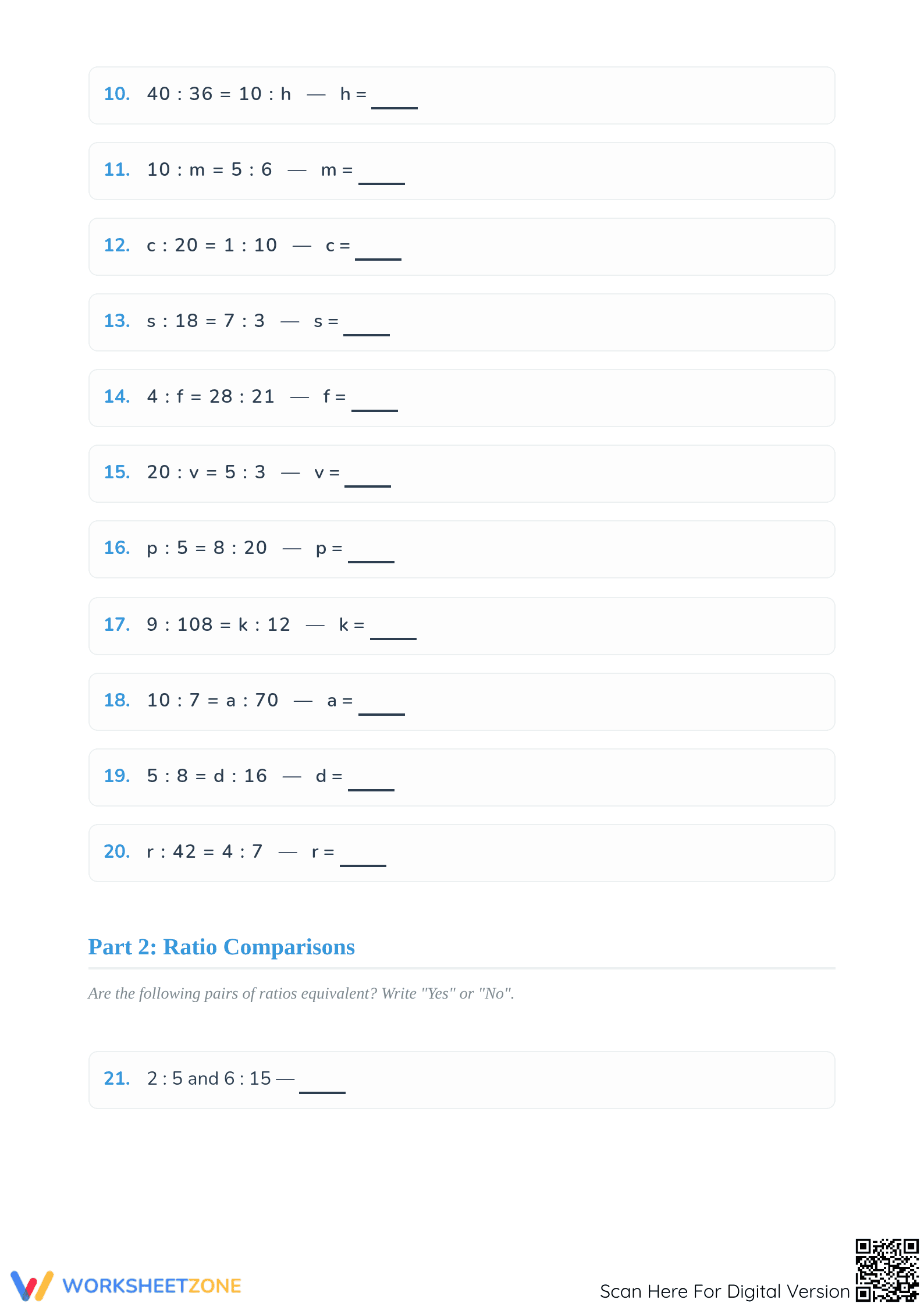
This comprehensive Math worksheet provides students with intensive practice in identifying and calculating equivalent ratios. By solving for unknown variables and applying proportional reasoning to real-world scenarios, learners build the foundational skills necessary for success in middle school algebra. This resource ensures students can confidently manipulate ratios across various mathematical contexts.
At a Glance
- Grade: 5 · Subject: Math (Ratios & Proportions)
- Standard:
6.RP.A.3— Use ratio and rate reasoning to solve real-world and mathematical problems- Skill Focus: Identifying equivalent ratios and finding unknown values
- Format: 5 pages · 46 problems · Answer key included · PDF
- Best For: Mastery-based practice and homework reinforcement
- Time: 35–50 minutes
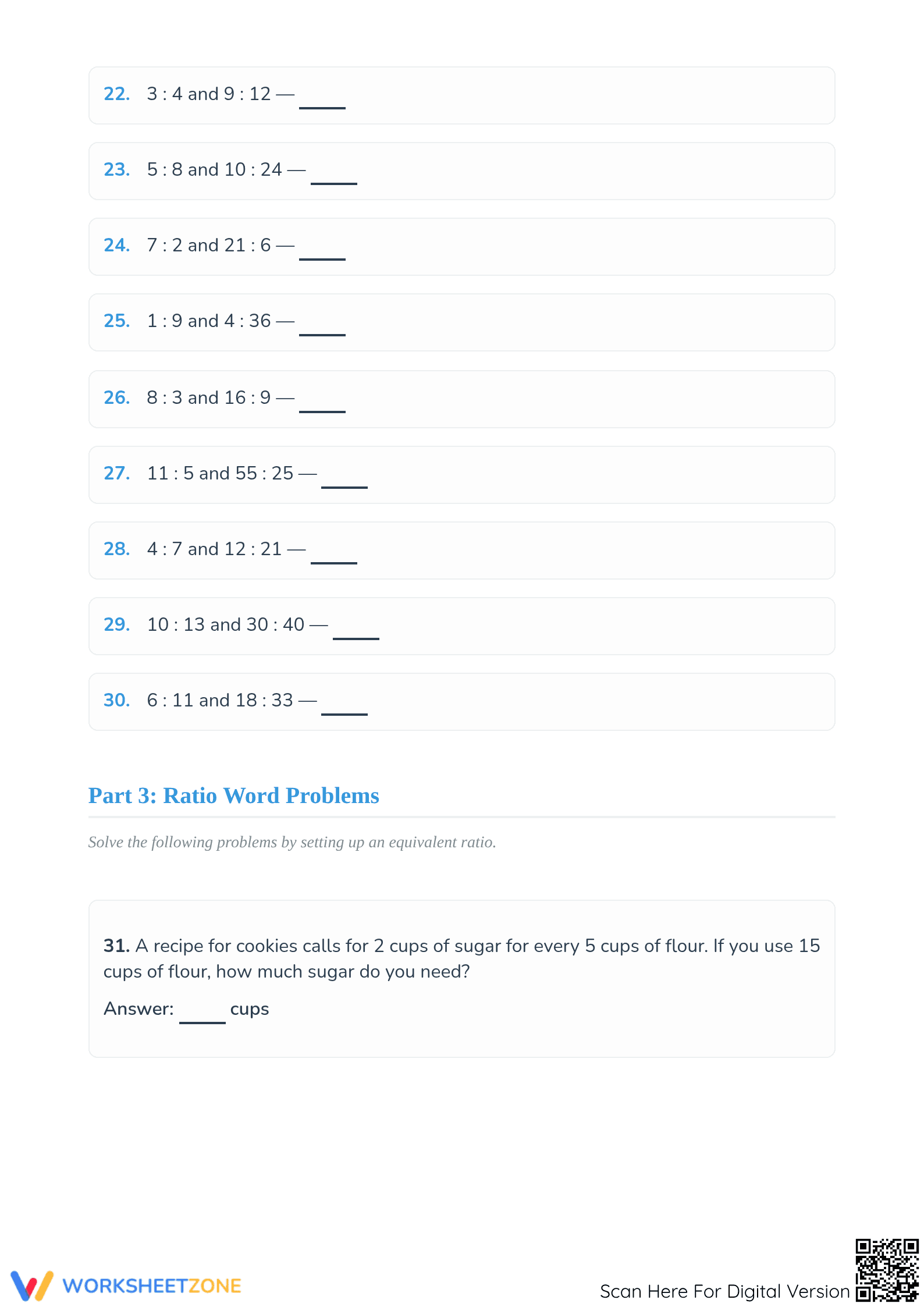
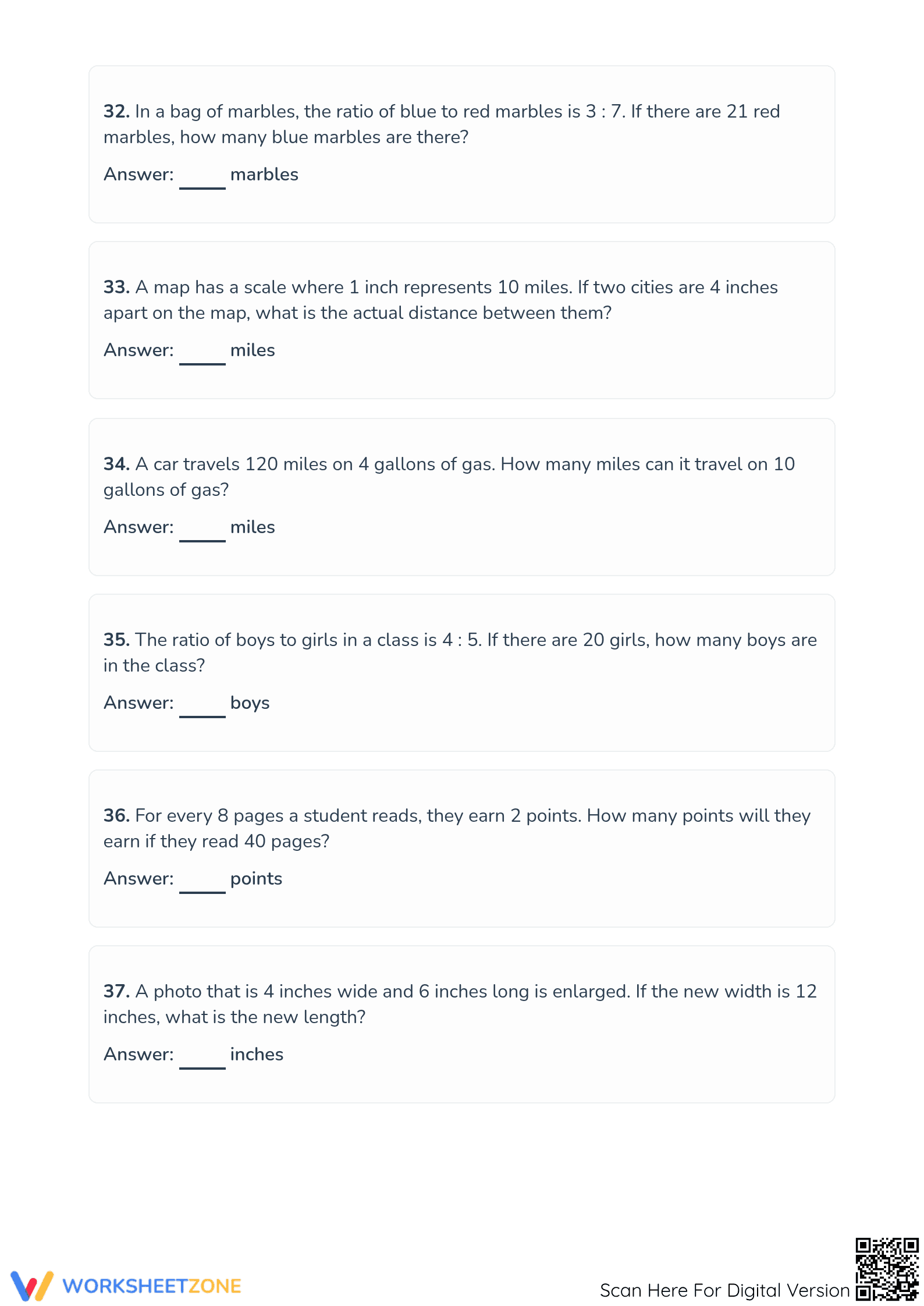
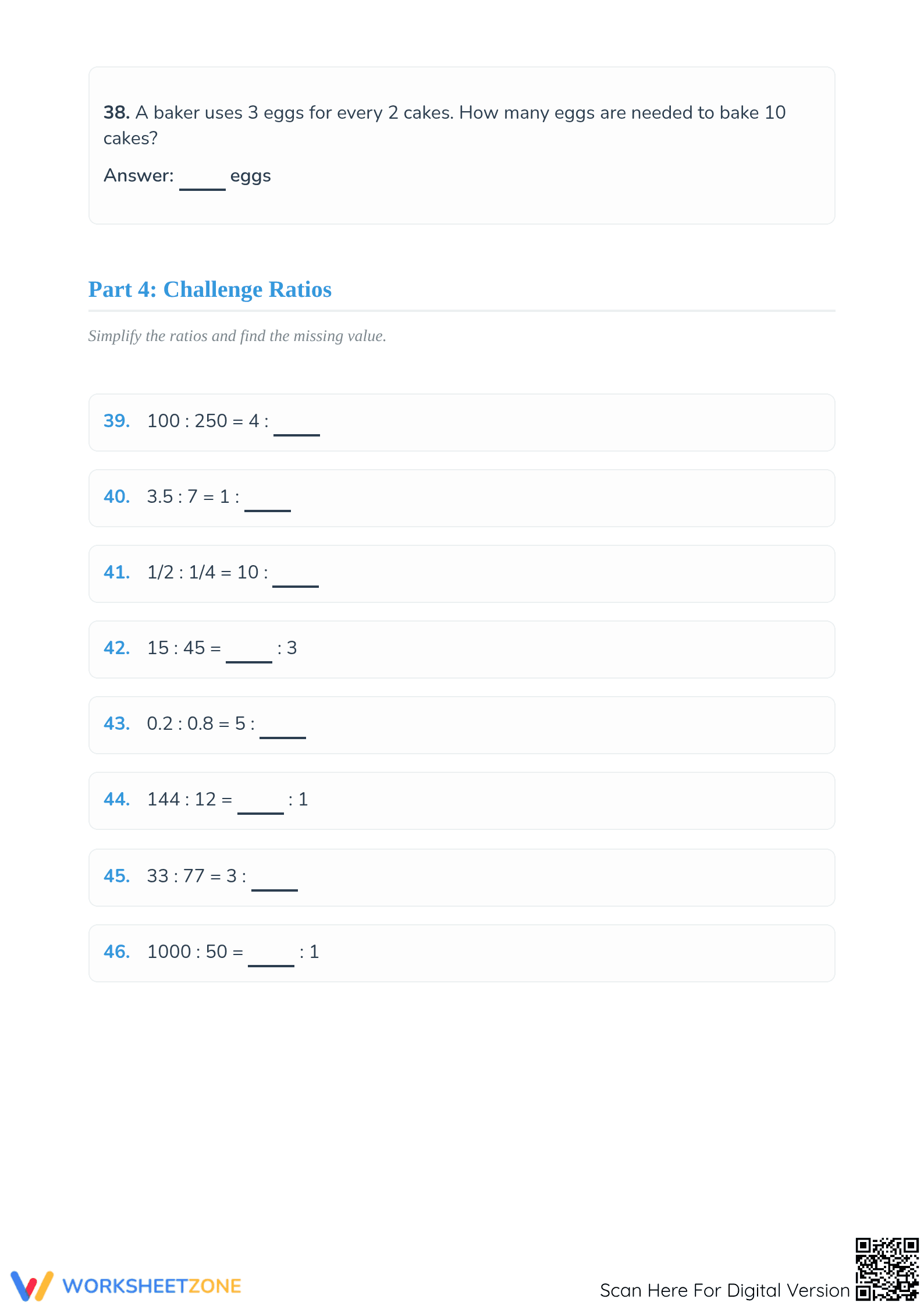
Inside this 5-page collection, you will find 46 structured tasks designed to lead students toward total proficiency. The packet includes four distinct parts: solving for unknown variables in ratio equations, comparing ratio pairs for equivalence, applying ratios to multifaceted word problems, and a final set of challenge ratios for simplification. A complete answer key is provided for every problem, allowing for rapid grading or student self-correction.
- Guided Practice (Part 1): 20 problems focused on finding unknown variable values (q, t, x, etc.) in straightforward ratio equations to establish calculation accuracy.
- Supported Application (Parts 2-3): 18 problems involving direct ratio comparisons (Yes/No) and word problems that translate textual information into equivalent ratio formats.
- Independent Mastery (Part 4): 8 challenge problems requiring students to simplify complex ratios and find missing values without immediate scaffolds.
This resource is strictly aligned to the 6.RP.A.3 standard, which requires students to use ratio and rate reasoning to solve mathematical problems. While designed for upper elementary students transitioning into these concepts, it perfectly bridges the gap between equivalent fractions and proportional relationships. These standard codes can be copied directly into lesson plans, IEP goals, or district curriculum mapping tools.
Use this worksheet as a primary practice set following your direct instruction on proportions. It works exceptionally well as a formative assessment tool; observe how students handle the transition from Part 2 (comparisons) to Part 3 (word problems) to identify who may need additional literacy support in math. Expect a total completion time of approximately 45 minutes for the full set.
This resource is ideal for Grade 5 and Grade 6 students who are mastering proportional reasoning. It provides necessary scaffolding for struggling learners through its clear layout while offering extensions for advanced students in the challenge section. It pairs naturally with an anchor chart on the cross-multiplication method or visual ratio tables.
According to the RAND AIRS 2024 report on mathematics instructional materials, structured practice with proportional reasoning is a critical predictor of success in middle school algebra. This 5-page worksheet provides a comprehensive suite of 46 problems aligned to CCSS.MATH.CONTENT.6.RP.A.3, covering equivalent ratios, unknown variable values, and real-world word problems. By transitioning from abstract algebraic equations to concrete applications like recipe scaling and map distances, students build the cognitive flexibility required for higher-order math. Research by Fisher & Frey (2014) emphasizes that gradual release models—moving from guided calculation to independent problem-solving—maximize student retention of mathematical concepts. This resource facilitates that progression through four distinct sections, including a final challenge component to push proficient learners toward mastery. The inclusion of a complete answer key ensures immediate feedback, a vital component of formative assessment in the modern classroom.


