


























Views
Downloads



Grade 5 Equivalent Ratios — Printable No-Prep Worksheet
Paste this activity's link or code into your existing LMS (Google Classroom, Canvas, Teams, Schoology, Moodle, etc.).
Students can open and work on the activity right away, with no student login required.
You'll still be able to track student progress and results from your teacher account.
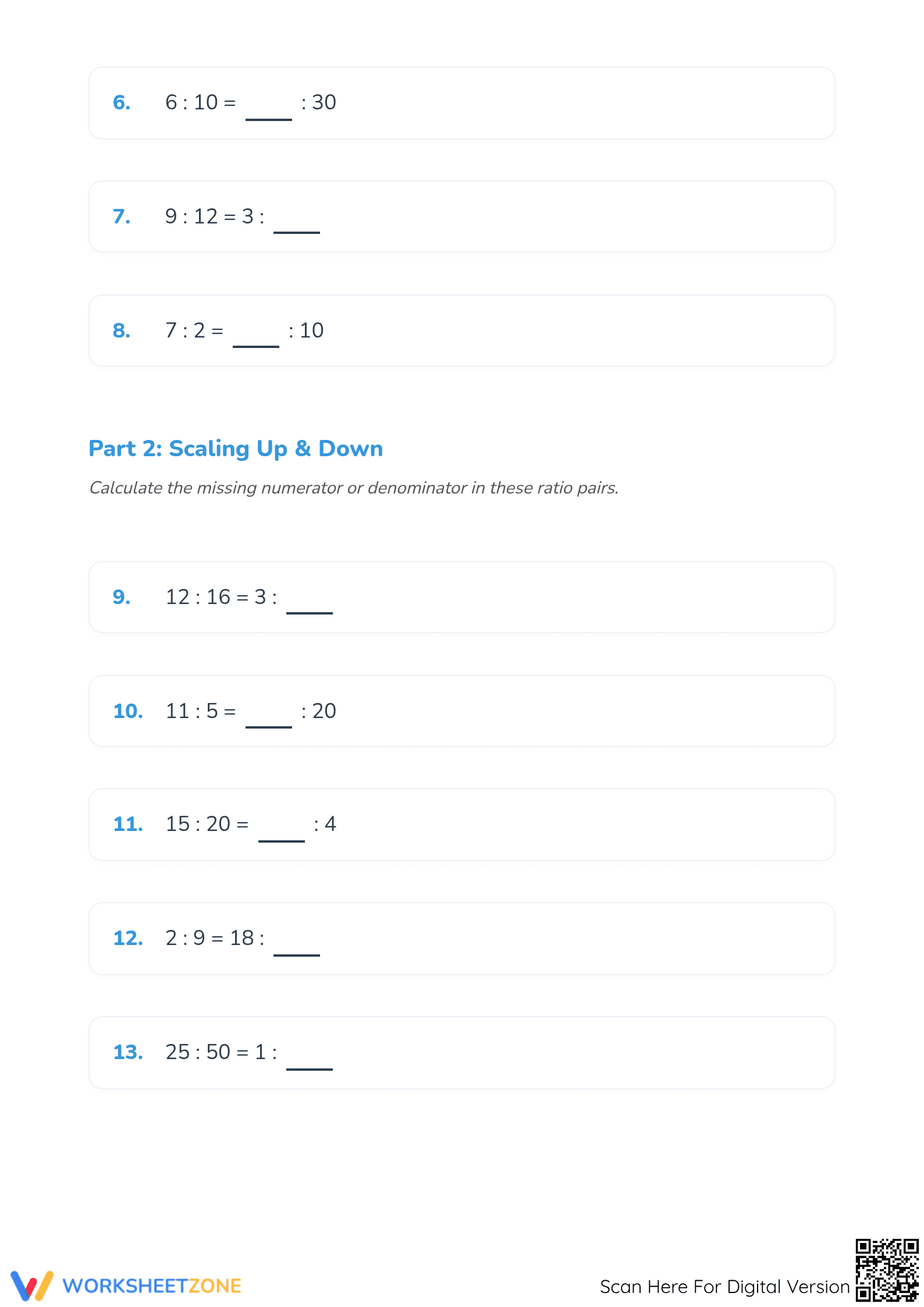
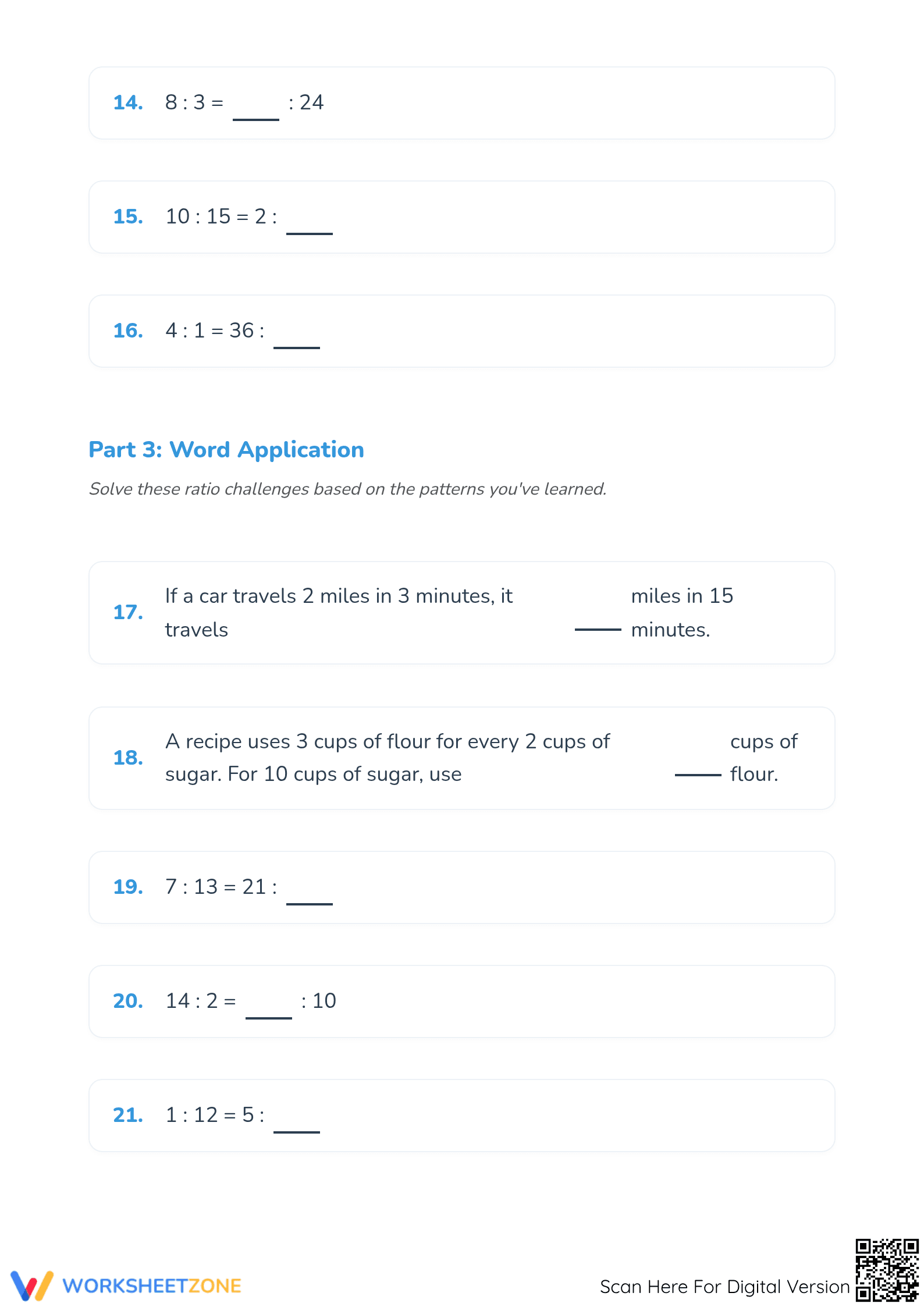
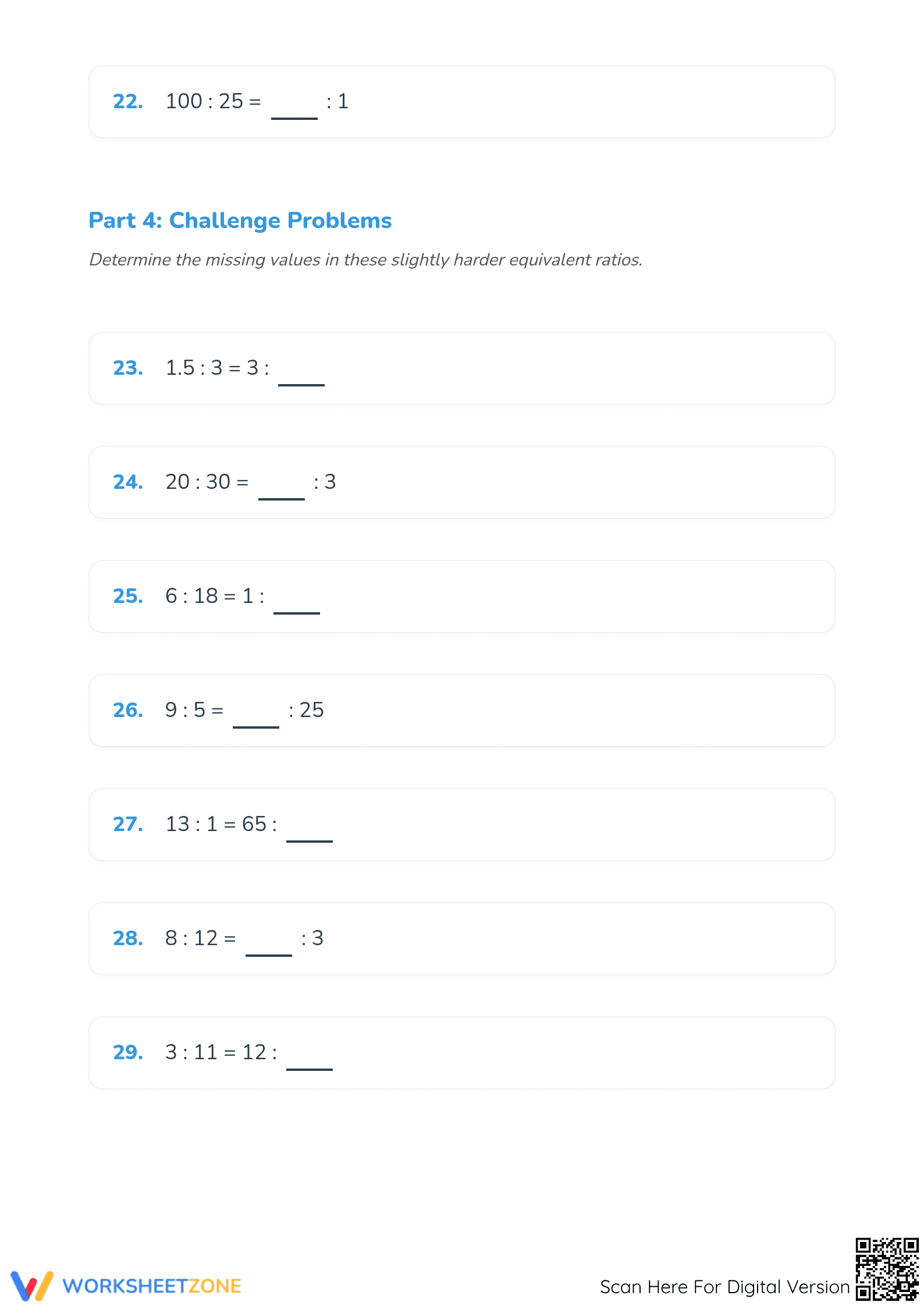
This comprehensive equivalent ratios worksheet provides 30 targeted problems to help students master the foundational skill of solving for unknown values. Students will practice scaling ratios up and down, applying their knowledge to real-world word problems and complex challenge scenarios. This resource ensures a smooth transition from basic multiplication to proportional reasoning.
At a Glance
At a Glance
- Grade: 5 · Subject: Math
- Standard:
CCSS.MATH.CONTENT.6.RP.A.3— Use ratio and rate reasoning to solve real-world and mathematical problems- Skill Focus: Equivalent ratios and unknown values
- Format: 5 pages · 30 problems · Answer key included · PDF
- Best For: Proportional reasoning practice and independent seatwork
- Time: 45–60 minutes
What's Inside
This five-page collection contains 30 distinct problems organized into four scaffolded sections: Basic Ratios, Scaling Up & Down, Word Application, and Challenge Problems. The layout features clear instructions and designated space for student work. A complete answer key is provided for all 30 items, allowing for quick grading or student self-checking without additional teacher overhead.
Zero-Prep Workflow
- Step 1: Print — Send the five-page PDF to your printer in seconds (1 minute).
- Step 2: Distribute — Hand out the packets for immediate student engagement during seatwork or centers (1 minute).
- Step 3: Review — Use the included answer key to check for accuracy during or after the lesson (2 minutes).
The total teacher preparation time is under four minutes, making this a reliable solution for busy instructional days or emergency sub plans.
Standards Alignment
The primary focus is `CCSS.MATH.CONTENT.6.RP.A.3`, which requires students to use ratio and rate reasoning to solve real-world and mathematical problems. Specifically, it aligns with sub-standard `A.3.A` regarding tables of equivalent ratios. This worksheet bridges 5th-grade multiplication patterns with 6th-grade proportional logic. Both standard codes can be copied directly into lesson plans, IEP goals, or district curriculum mapping tools.
How to Use It
Use this packet during independent practice after an introductory lesson on ratios and scaling factors. It works exceptionally well as a formative assessment tool; observe students during Part 3 (Word Application) to identify those struggling with the transition from abstract numbers to contextual logic. The expected completion time for the full 30-problem set is approximately 50 minutes.
Who It's For
Designed for Grade 5 students ready for advanced math or Grade 6 students needing reinforcement of core ratio concepts. It naturally pairs with a visual anchor chart illustrating ratio tables or a direct instruction lesson on cross-multiplication and scaling factors. This resource is ideal for general education classrooms, math intervention blocks, or homeschool settings.
Understanding equivalent ratios is a critical milestone in the development of proportional reasoning, which serves as a gateway to algebra and higher-level mathematics. This resource leverages the gradual release of responsibility model, moving from basic computation to contextual application, as supported by Fisher & Frey (2014). By providing 30 varied problems, the worksheet offers the high-dosage practice necessary to move skills from short-term memory to long-term fluency. Research from EdReports 2024 emphasizes that materials aligned to `CCSS.MATH.CONTENT.6.RP.A.3` must integrate both mathematical procedures and real-world applications to be truly effective. This worksheet achieves that balance by incorporating word problems and challenge scenarios that force students to generalize their scaling strategies. The included answer key supports immediate feedback, a practice shown to significantly reduce the solidification of misconceptions during the early stages of ratio acquisition.


