


























Views
Downloads




Printable Equivalent Ratios Worksheet | Grades 4-6 Ready
Paste this activity's link or code into your existing LMS (Google Classroom, Canvas, Teams, Schoology, Moodle, etc.).
Students can open and work on the activity right away, with no student login required.
You'll still be able to track student progress and results from your teacher account.
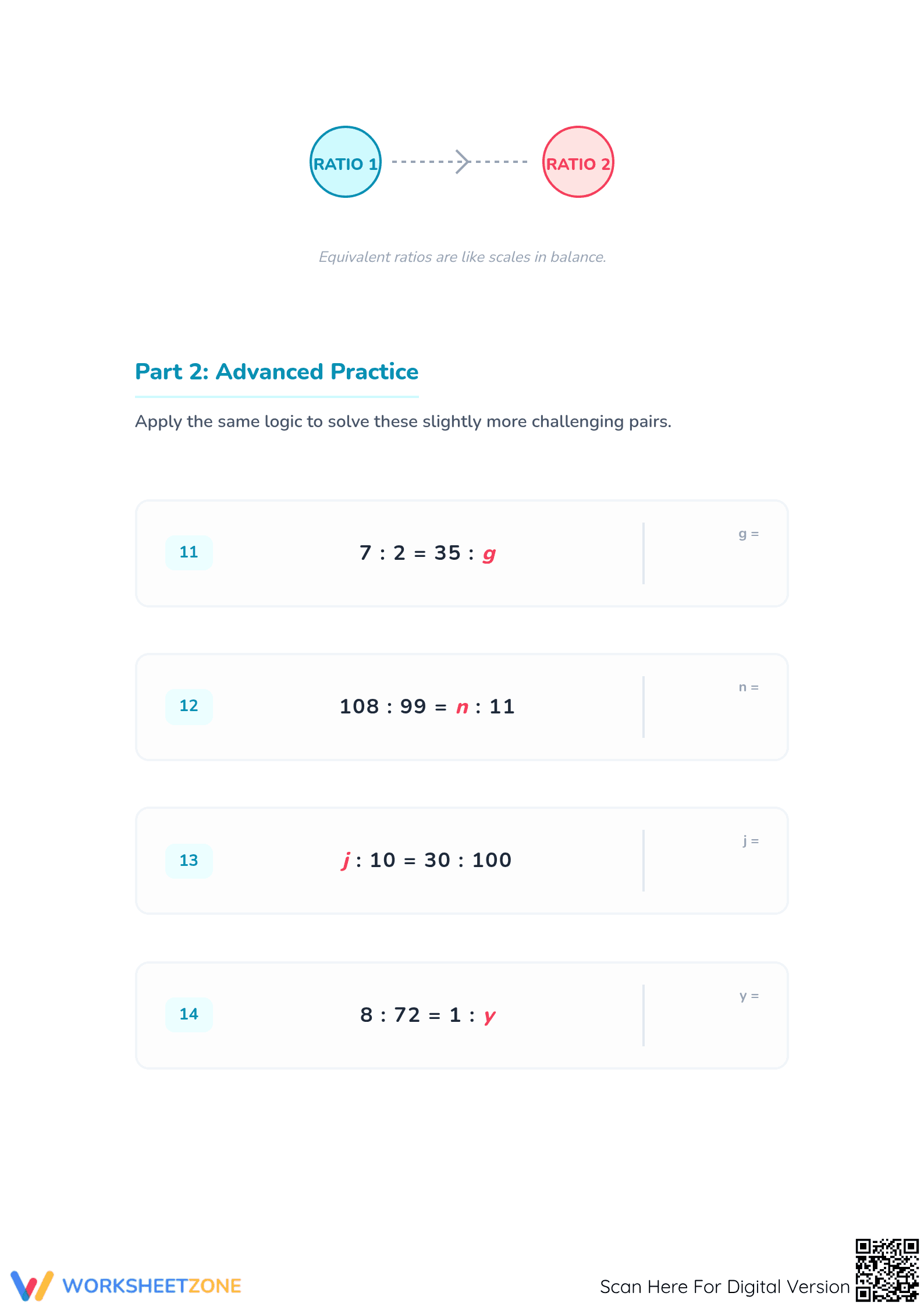
Master the fundamental concept of proportional reasoning with this comprehensive 5-page practice packet. Students will solve for unknown variables in equivalent ratio pairs, moving from basic computational steps to advanced problem-solving applications. This resource ensures students understand the mathematical relationships that maintain consistency across different ratio forms before applying them to complex scenarios.
At a Glance
- Grade: 4–6 · Subject: Math (Fractions/Ratios)
- Standard:
6.RP.A.3— Use ratio and rate reasoning to solve real-world and mathematical problems- Skill Focus: Solving equivalent ratios for unknown values
- Format: 5 pages · 21 problems · Answer key included · PDF
- Best For: Independent practice, homework, or sub plans
- Time: 30–45 minutes
This 5-page collection is designed for structural clarity and student independence. It includes two distinct sections of practice problems that progress in difficulty, followed by a dedicated critical thinking prompt that requires students to articulate their mathematical process. The layout provides ample workspace for calculations, making it an ideal choice for formative assessment or independent skill reinforcement without the need for additional teacher scaffolding.
The zero-prep workflow is optimized for busy educators seeking high-quality instructional materials. Print the 5-page PDF in 1 minute for your entire class. Distribute the packets for a 40-minute independent work block, allowing you to rotate for small-group intervention. Review the answers using the provided key during the final 5 minutes of class for immediate student feedback. This streamlined process requires less than 2 minutes of teacher preparation time.
This worksheet is aligned to the primary standard `CCSS.MATH.CONTENT.6.RP.A.3`, which focuses on using ratio and rate reasoning to solve mathematical problems. It also supports 4th and 5th-grade standards related to equivalent fractions, specifically `4.NF.A.1`. These standard codes can be copied directly into lesson plans, IEP goals, or district curriculum mapping tools to ensure rigorous alignment with state and national mathematics frameworks.
Use this resource as a bridge between direct instruction on proportions and summative unit assessments. It works exceptionally well as a mid-unit check-in to identify students who struggle with the cross-multiplication or scaling methods. Teachers should observe whether students prefer additive or multiplicative strategies during Part 1, as this provides a valuable data point for future differentiation and targeted re-teaching sessions during the instructional cycle.
This packet is for upper elementary and middle school students developing their proportional reasoning skills. It is particularly beneficial for students who require structured practice to master the transition from simple fractions to formal ratio notation. Pair this resource with a visual anchor chart or a short introductory video on ratio scaling to provide a multi-modal learning experience that supports diverse learner needs in the general education classroom.
According to the NAEP 2024 mathematics framework analysis, mastering proportional reasoning is a critical milestone for success in middle school algebra and beyond. This worksheet targets the specific sub-skill of identifying equivalent ratios, a foundational competency that allows students to solve complex rate problems and understand geometric similarity. By providing a structured progression from basic to advanced practice, this resource aligns with best practices for cognitive load management in mathematics instruction. The inclusion of a critical thinking prompt mirrors the demands of high-stakes assessments, encouraging students to develop metacognitive awareness of their problem-solving strategies. Fisher & Frey (2014) shows articulating mathematical logic significantly increases long-term retention. Educators can use these tasks to build the fluency required for the CCSS.MATH.CONTENT.6.RP.A.3 standard while providing the necessary scaffolds for learners at different stages of conceptual development.


