


























Views
Downloads

Printable Equivalent Expressions Worksheet | Grade 8-10 Math
Paste this activity's link or code into your existing LMS (Google Classroom, Canvas, Teams, Schoology, Moodle, etc.).
Students can open and work on the activity right away, with no student login required.
You'll still be able to track student progress and results from your teacher account.
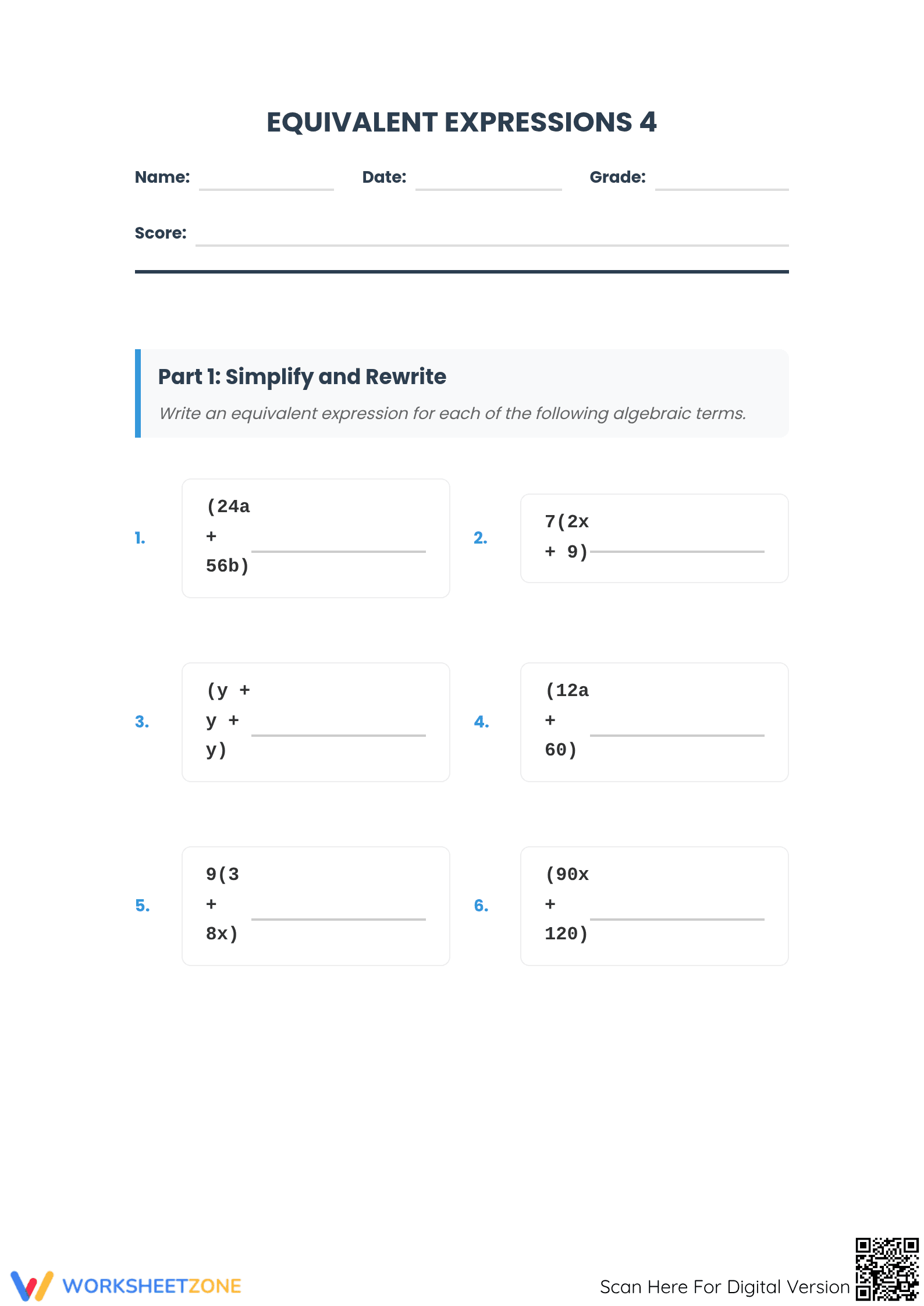
This algebraic expressions worksheet helps students master the art of identifying and creating equivalent mathematical statements. By working through 16 structured problems, learners develop a deep understanding of how to simplify terms, distribute factors, and combine like variables to reach equivalent forms. The activities move from basic simplification to real-world word problem applications, ensuring a robust outcome for middle and high school students.
At a Glance
- Grade: 8–10 · Subject: Algebra
- Standard:
6.EE.A.3— Apply properties of operations to generate equivalent expressions accurately- Skill Focus: Algebraic Simplification
- Format: 3 pages · 16 problems · Answer key included · PDF
- Best For: Independent practice or homework reinforcement
- Time: 30–45 minutes
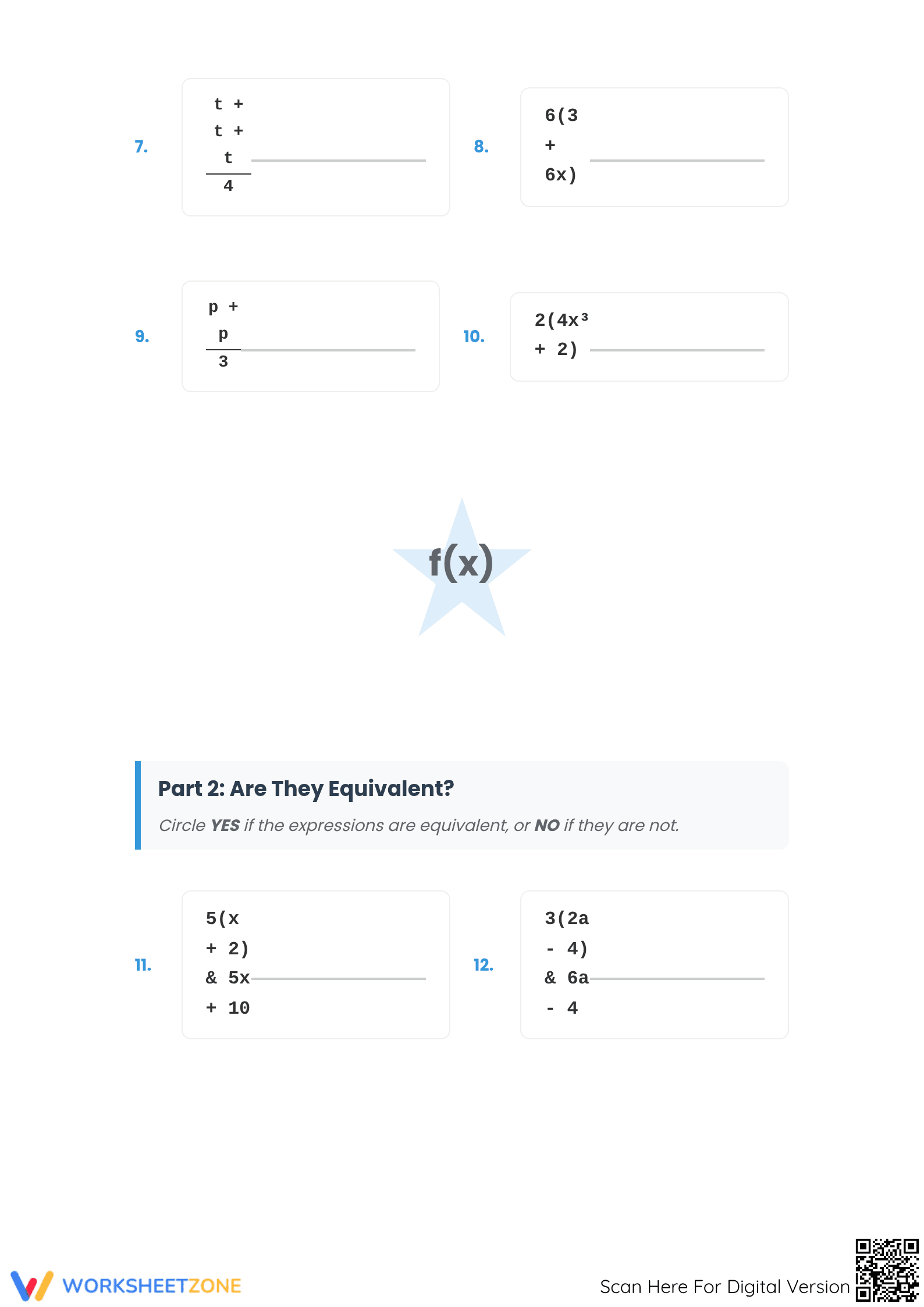
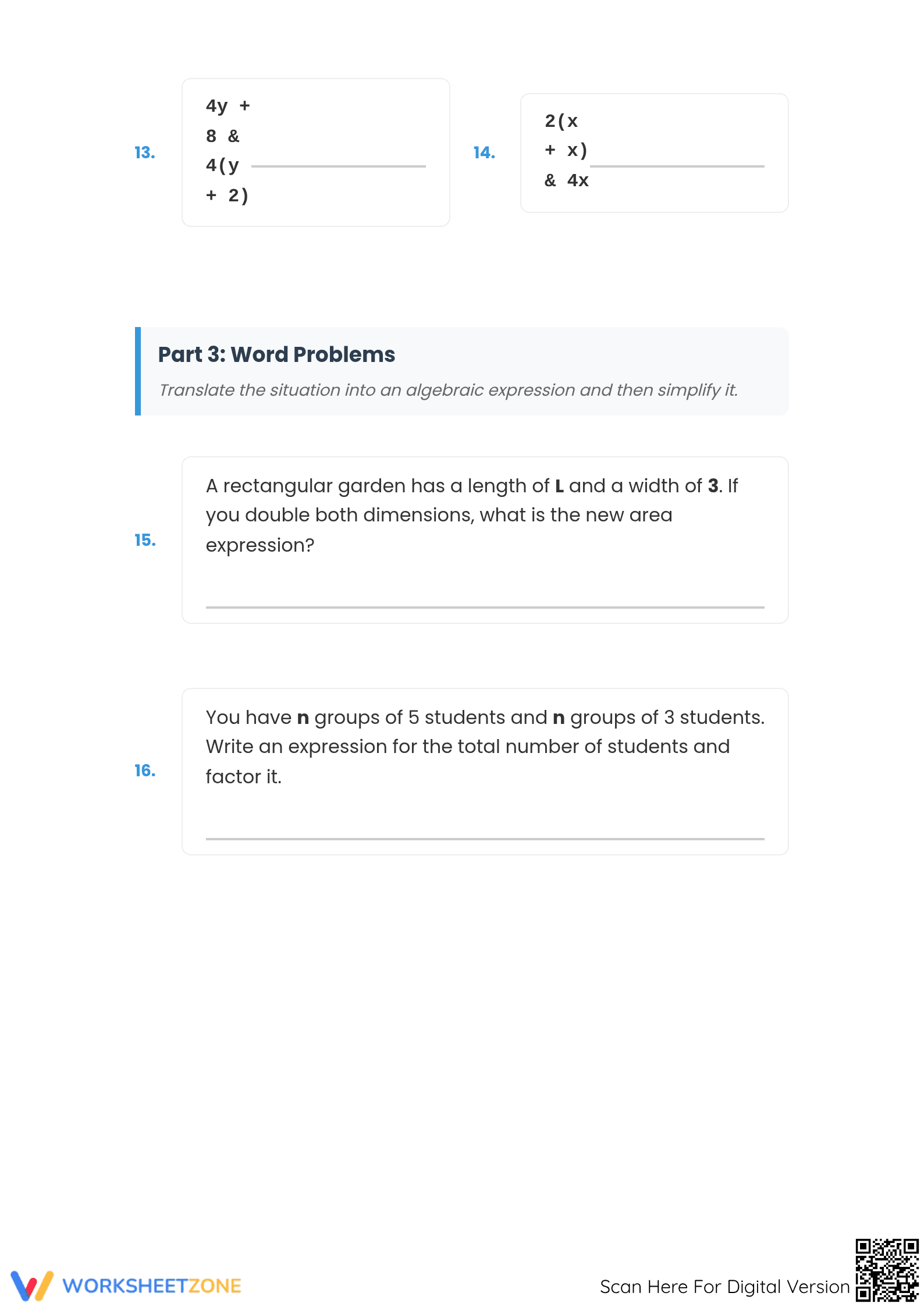
What's Inside: The resource consists of three distinct pages featuring sixteen unique tasks. Part one focuses on simplifying and rewriting terms, part two challenges students to verify equivalence between two given expressions, and part three introduces word problems requiring translation into algebraic language. A comprehensive answer key is provided to facilitate quick grading and immediate student feedback.
Skill Progression
- Guided Practice: The first six problems provide clear prompts to rewrite terms using the distributive property or combining like variables, with 6 targeted exercises.
- Supported Practice: Problems 7 through 14 require students to compare expressions and determine equivalence, building critical thinking skills over 8 structured tasks.
- Independent Practice: The final two word problems challenge students to apply their knowledge to geometric and grouping scenarios without visual scaffolds.
This sequence follows a gradual-release model, moving from technical computation to higher-order application.
Standards Alignment
The primary alignment is to `CCSS.MATH.CONTENT.6.EE.A.3`: "Apply the properties of operations to generate equivalent expressions." Students must utilize the distributive property and combine like terms to demonstrate mastery. This resource also supports `CCSS.MATH.CONTENT.7.EE.A.1` by focusing on linear expressions with rational coefficients. Both standard codes can be copied directly into lesson plans, IEP goals, or district curriculum mapping tools.
How to Use It
Use this worksheet as a secondary practice set during or after direct instruction on algebraic properties. For a formative assessment tip, observe students during Part 2; if they struggle to identify non-equivalence, it often indicates a misconception in applying the distributive property to negative terms or constants. Expected completion time ranges from 30 minutes for advanced learners to 45 minutes for those requiring more processing time.
Who It's For
This is designed for Grade 8, 9, and 10 students enrolled in Pre-Algebra or Algebra 1 courses. It provides excellent differentiation for students who need focused, repetitive practice with variable manipulation. It pairs naturally with an anchor chart detailing the Distributive Property and the Commutative Property of Addition.
The `6.EE.A.3` standard requires students to generate equivalent expressions through the strategic application of mathematical properties. According to research from ScienceDirect TpT Analysis, structured algebraic practice that bridges the gap between abstract symbols and word-based scenarios significantly improves long-term retention of variable relationships. This worksheet addresses that need by providing sixteen varied tasks that require students to simplify, compare, and translate algebraic terms. By mastering these equivalent forms, students build the foundational fluency required for solving complex multi-step equations in higher-level mathematics. The inclusion of a clear answer key supports self-directed learning and allows for immediate correction of procedural errors, which is a key component of effective math pedagogy.


