


























Views
Downloads


Enzyme Structure and Function Worksheet | Grade 9-12 Ready
Paste this activity's link or code into your existing LMS (Google Classroom, Canvas, Teams, Schoology, Moodle, etc.).
Students can open and work on the activity right away, with no student login required.
You'll still be able to track student progress and results from your teacher account.
High school biology students master enzyme mechanics with this comprehensive 3-page resource. It guides learners through activation energy, substrate specificity, and denaturation. By synthesizing informational text with visual diagrams, students develop a clear understanding of how protein structure dictates biological function in living systems.
At a Glance
- Grade: 9-12 · Subject: Biology
- Standard:
HS-LS1-1— Explain how the structure of proteins like enzymes determines their functional role- Skill Focus: Enzyme-substrate specificity and environmental denaturation
- Format: 3 pages · 6 problems · Answer key included · PDF
- Best For: Introduction to biochemistry or sub plans
- Time: 30–45 minutes
What's Inside
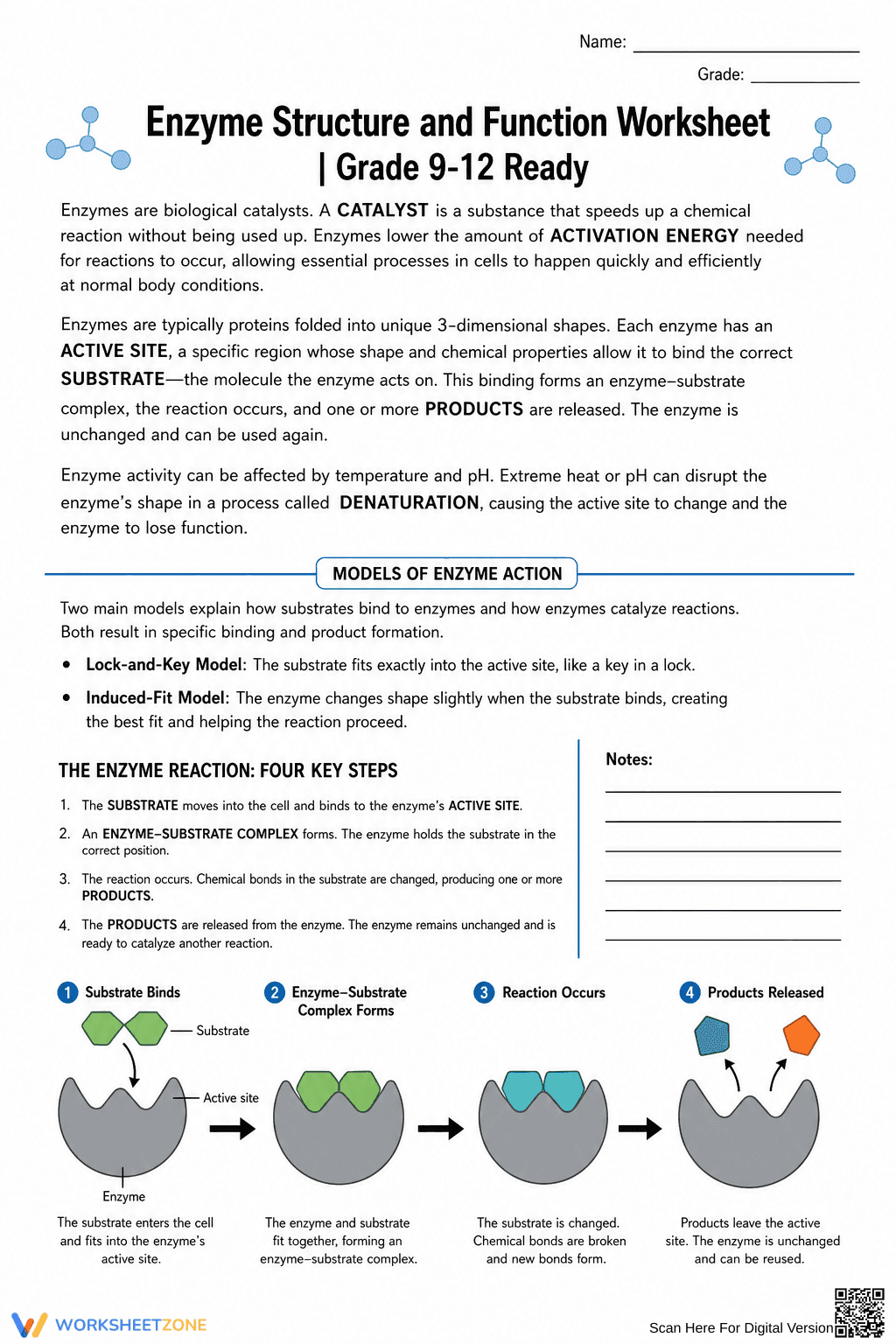
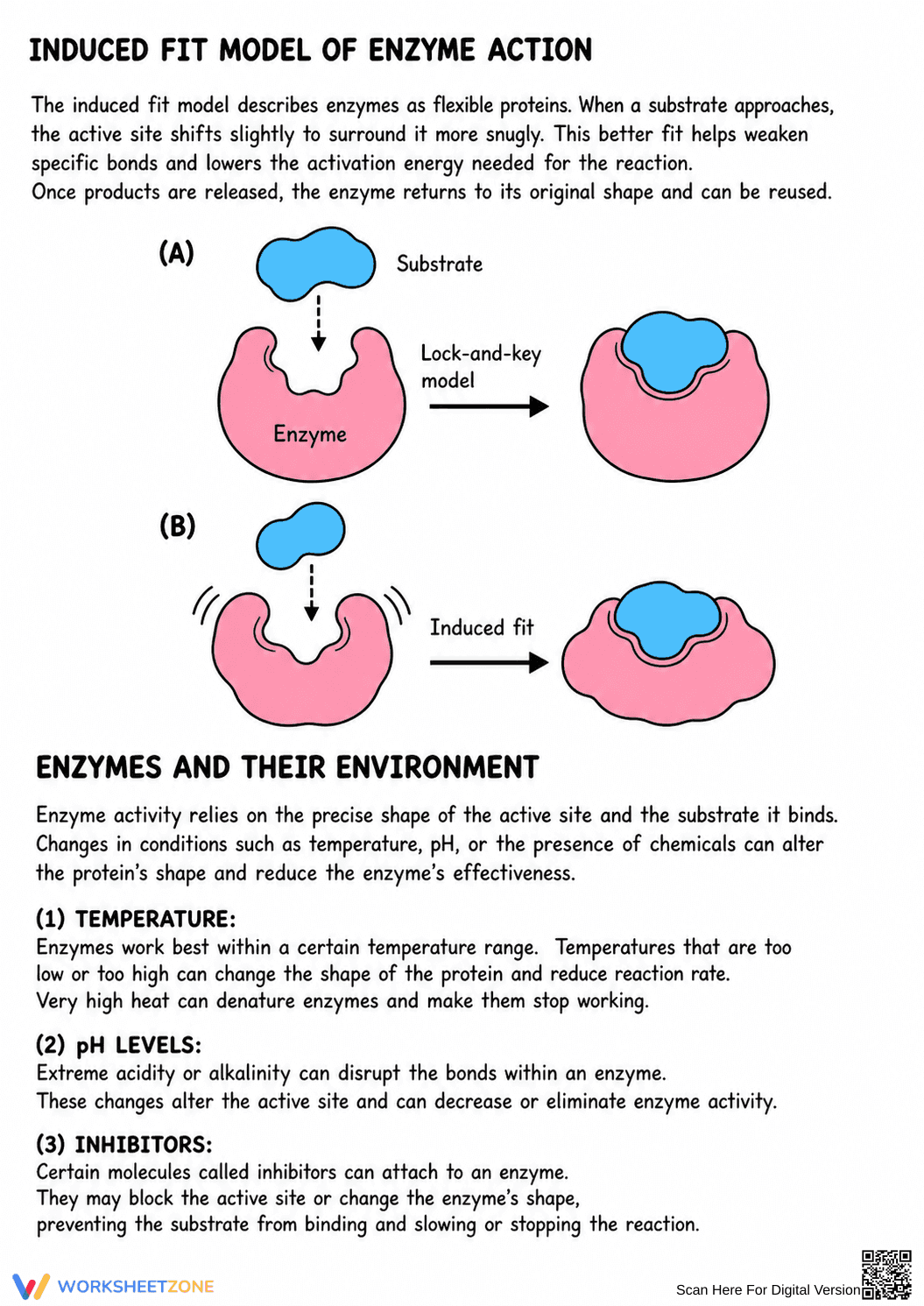
The packet contains two pages of illustrated informational text followed by a one-page assessment. Reading sections define key vocabulary including substrate, active site, and activation energy. Visual diagrams illustrate the four-step process of enzyme action and compare the lock-and-key mechanism with the induced-fit model. The final page features 6 open-ended response questions requiring text synthesis.
Zero-Prep Workflow
- Print: Generate the three-page PDF for your entire class in under 1 minute.
- Distribute: Hand out the self-contained reading and task sheets with zero additional materials required.
- Review: Use the included answer key to grade the 6 synthesis questions in less than 5 minutes.
Total teacher prep time is under 2 minutes, making this an ideal solution for emergency sub plans or independent study blocks.
Standards Alignment
Aligned to `HS-LS1-1`, this worksheet focuses on the relationship between protein structure and function. By examining how inhibitors and temperature changes alter the active site, students gain evidence for how molecular shape dictates biological activity. It also supports `HS-LS1-6` by illustrating the role of carbon-based molecules. Both standard codes can be copied directly into lesson plans, IEP goals, or district curriculum mapping tools.
How to Use It
Use this worksheet during the "Explain" phase of a 5E instructional cycle after students have observed a liver-catalase lab. It serves as a bridge between hands-on observation and academic vocabulary mastery. Formatively assess student understanding by checking question 6, which requires them to explain three distinct environmental factors. Expect students to spend 20 minutes reading and 15 minutes on the written tasks.
Who It's For
This material is tailored for biology students in grades 9 through 12. The inclusion of diagrams makes it particularly effective for visual learners and English Language Learners (ELLs) who benefit from the spatial representation of the active site. It pairs naturally with an enzyme-substrate simulation or a protein-folding anchor chart.
According to the RAND AIRS 2024 report on secondary science literacy, the integration of domain-specific reading passages with targeted comprehension tasks significantly improves the retention of complex biochemical concepts. This worksheet addresses the HS-LS1-1 standard by requiring students to articulate the mechanism of enzyme-substrate specificity, a foundational concept in cellular biology. Research from Fisher & Frey (2014) emphasizes that gradual release through text-dependent questions allows students to move from basic identification of catalysts to complex explanations of denaturation. By providing 6 structured prompts, the resource ensures that learners engage with the text multiple times to extract evidence. This alignment with evidence-based instructional strategies supports mastery of the NGSS framework, ensuring that students can explain how environmental stressors like pH and temperature disrupt the precise molecular fit required for metabolic efficiency.


