




























Views
Downloads

Grade 9 Enzyme Worksheet — Essential No-Prep Printable

Paste this activity's link or code into your existing LMS (Google Classroom, Canvas, Teams, Schoology, Moodle, etc.).
Students can open and work on the activity right away, with no student login required.
You'll still be able to track student progress and results from your teacher account.
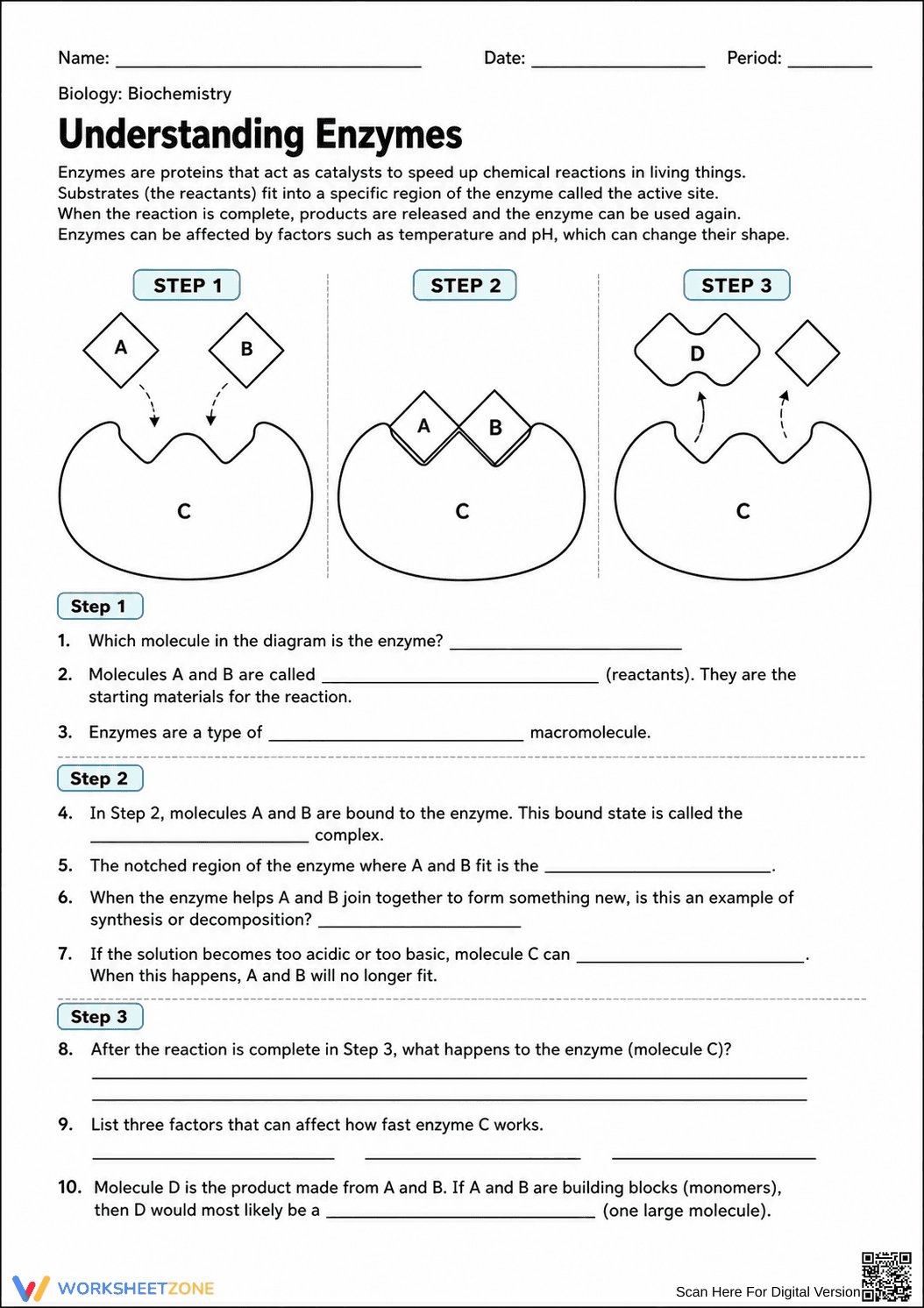
This high school biology worksheet provides students with a clear introduction to enzyme function. By analyzing a three-step diagram of an enzyme-substrate complex, students identify key macromolecules, understand synthesis, and explain how environmental factors affect reaction rates. It bridges the gap between abstract chemical formulas and visible biological processes to ensure student comprehension.
At a Glance
- Grade: 9 · Subject: Biology
- Standard:
HS-LS1-1— Explain how protein structures carry out essential life functions- Skill Focus: Enzyme-substrate interactions
- Format: 1 page · 10 problems · Answer key included · PDF
- Best For: Independent practice or sub plans
- Time: 15–20 minutes
This single-page resource features introductory text explaining enzymes as biological macromolecules. A clear three-step diagram illustrates the lock-and-key model, showing substrates binding to an active site. Students apply this visual information to answer 10 targeted questions, including fill-in-the-blank prompts and short-answer explanations. A complete answer key ensures accurate grading and immediate feedback for learners.
This resource is designed for a zero-prep workflow:
- Print (1 minute): The single-page layout is optimized for standard black-and-white printing.
- Distribute (1 minute): Hand out the worksheet as a standalone assignment; the embedded reading means students need no supplementary texts.
- Review (3 minutes): Use the included answer key to quickly check comprehension or facilitate peer-grading.
With total teacher prep time under two minutes, this is highly suitable for emergency sub plans or last-minute review sessions.
This activity aligns with HS-LS1-1, requiring students to construct an explanation based on evidence for how the structure of DNA determines the structure of proteins which carry out the essential functions of life. By focusing on enzymes as specific proteins that facilitate biochemical reactions, students connect molecular structure to biological function. This standard code can be copied directly into lesson plans or IEP goals.
Teachers can deploy this worksheet immediately after direct instruction on macromolecules to reinforce the specific role of proteins. It also serves as a warm-up before a laboratory experiment on reaction rates. As a formative assessment tip, observe how students answer question seven regarding acidic or basic solutions; this will quickly reveal their understanding of protein denaturation. Expected completion time ranges from 15 to 20 minutes.
This resource is primarily designed for ninth-grade biology students encountering biochemistry concepts for the first time. The visual nature of the diagram provides built-in scaffolding, making abstract concepts more accessible for visual learners and English Language Learners. It pairs with a hands-on lab or direct instruction on biological macromolecules.
Understanding enzyme-substrate interactions is a foundational requirement for high school biology, directly supporting HS-LS1-1 as students explain how protein structures carry out essential life functions. According to a ScienceDirect TpT Analysis, integrating visual models with targeted questioning significantly improves student retention of abstract biochemical processes. When learners can trace the physical changes in molecules through a step-by-step diagram, they develop a more robust mental model of cellular metabolism. This worksheet leverages that pedagogical strategy by requiring students to map vocabulary terms directly onto a visual representation of a chemical reaction. By connecting the structural components of the active site to the broader concept of environmental factors like pH and temperature, educators can ensure a comprehensive grasp of the material. This targeted practice builds the necessary cognitive framework for advanced studies in genetics and cellular respiration.


