


























Views
Downloads

Introduction to Enzymes Worksheet | Essential Biology
Paste this activity's link or code into your existing LMS (Google Classroom, Canvas, Teams, Schoology, Moodle, etc.).
Students can open and work on the activity right away, with no student login required.
You'll still be able to track student progress and results from your teacher account.
This comprehensive biology worksheet provides a structured introduction to the world of biological catalysts. Students will identify the chemical composition of enzymes, analyze how they lower activation energy, and interpret complex data regarding environmental influences like pH and temperature. By the end of these activities, learners will be able to explain the lock-and-key model with scientific precision.
At a Glance
- Grade: 9-12 · Subject: Biology
- Standard:
HS-LS1-1— Explain how the structure of proteins like enzymes facilitates specific biological functions- Skill Focus: Enzyme kinetics and environmental factors
- Format: 2 pages · 20 problems · Answer key included · PDF
- Best For: High school biology introductory units
- Time: 30–45 minutes
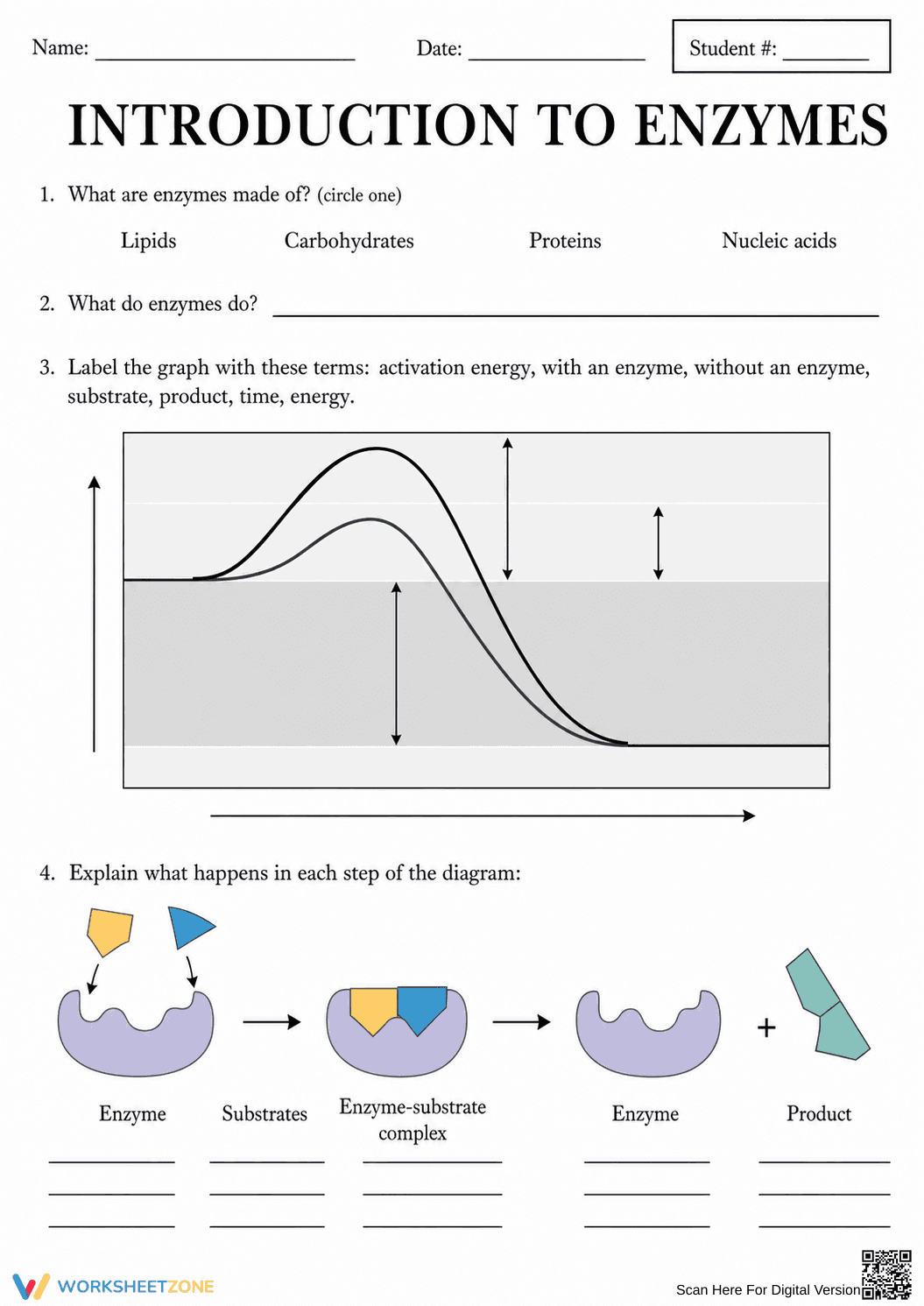
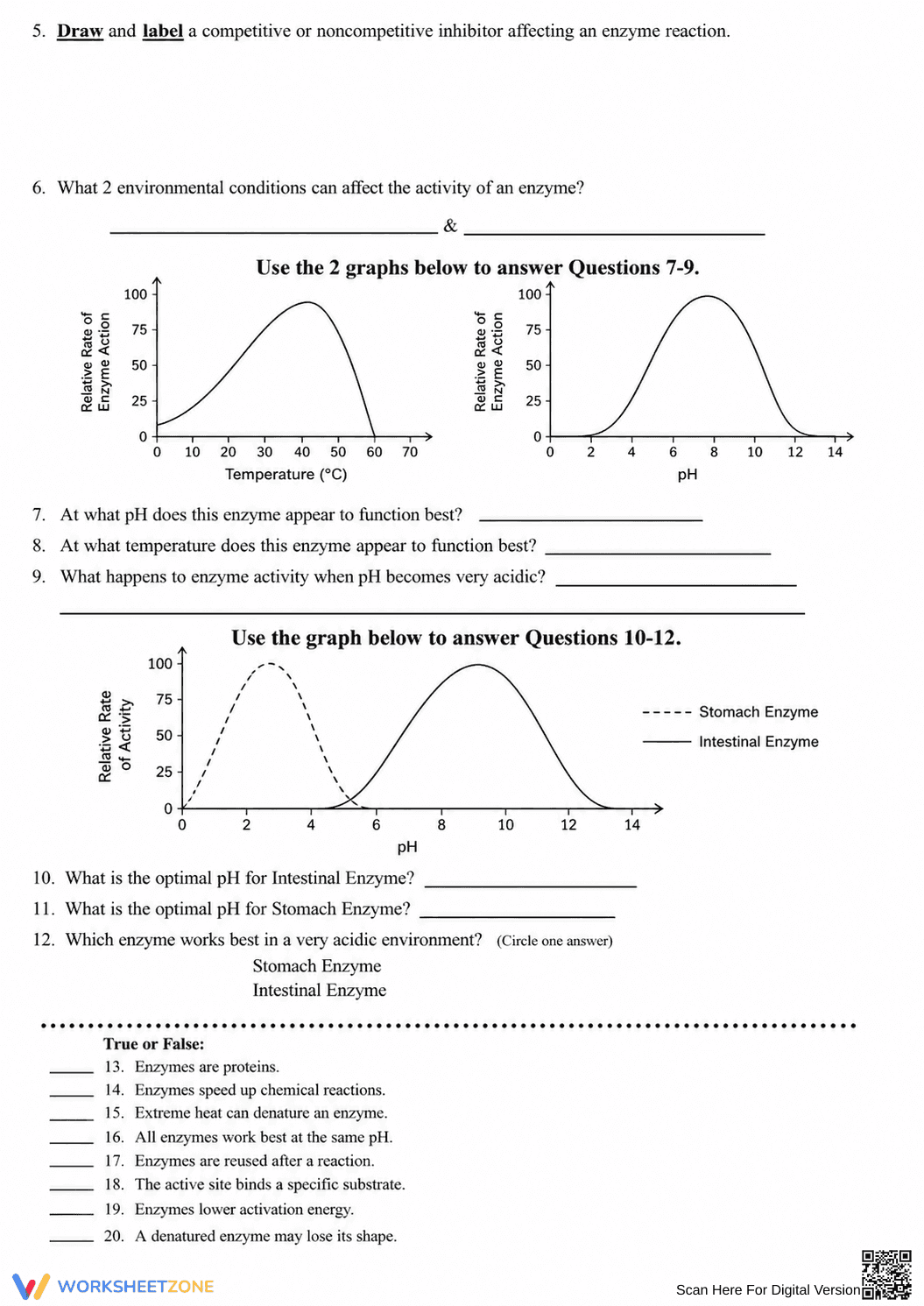
What's Inside: This two-page resource features 20 diverse tasks, including multiple-choice identification, diagram labeling for activation energy graphs, and a multi-step explanation of the enzyme-substrate complex. The second page challenges students with graph analysis of stomach and intestinal enzymes, requiring them to determine optimal pH and temperature ranges. A final true/false section reinforces core vocabulary and conceptual facts.
Zero-Prep Workflow
- Print: Select the 2-page PDF and print enough copies for your class in under 30 seconds.
- Distribute: Hand out the worksheets as a transition from direct instruction to independent practice during your biochemistry unit.
- Review: Use the included answer key to facilitate a rapid peer-grading session or whole-class review in approximately 5 minutes.
This resource is designed as a complete, standalone activity that requires no additional teacher setup, making it an ideal choice for emergency sub plans or formative assessment days.
Standards Alignment
Primary Standard: `HS-LS1-1` — Construct an explanation based on evidence for how the structure of DNA determines the structure of proteins which carry out the essential functions of life through systems of specialized cells. This worksheet focuses on the functional aspect of proteins as catalysts. Both standard codes can be copied directly into lesson plans, IEP goals, or district curriculum mapping tools.
How to Use It
Use this worksheet during the middle of a biochemistry unit after students have been introduced to macromolecules. It serves as an excellent formative assessment to check for misconceptions regarding how inhibitors and environmental changes affect reaction rates. Expected completion time ranges from 30 to 45 minutes depending on student familiarity with graph interpretation.
Who It's For
This resource is designed for high school biology students in general, honors, or introductory AP tracks. It is particularly effective for learners who benefit from visual scaffolds, such as the provided enzyme-substrate diagrams. Pair this with a live liver-catalase lab or an interactive enzyme simulation for a complete instructional cycle.
According to the NAEP Science Framework, understanding the molecular basis of heredity and the role of proteins as catalysts is a cornerstone of secondary biological literacy. This Introduction to Enzymes worksheet aligns with HS-LS1-1 by requiring students to analyze how enzyme structure dictates function through the lock-and-key model and activation energy reduction. Research by Fisher & Frey (2014) emphasizes that scaffolded diagrams—such as the pH and temperature graphs included here—support the development of disciplinary literacy by bridging visual data with conceptual explanations. By engaging with 20 distinct tasks ranging from simple identification to complex graph interpretation, students build the cognitive stamina necessary for advanced placement biology and college-level coursework. This resource provides the structured practice required to move students toward a functional understanding of biochemical pathways and homeostatic regulation.


