


























Views
Downloads
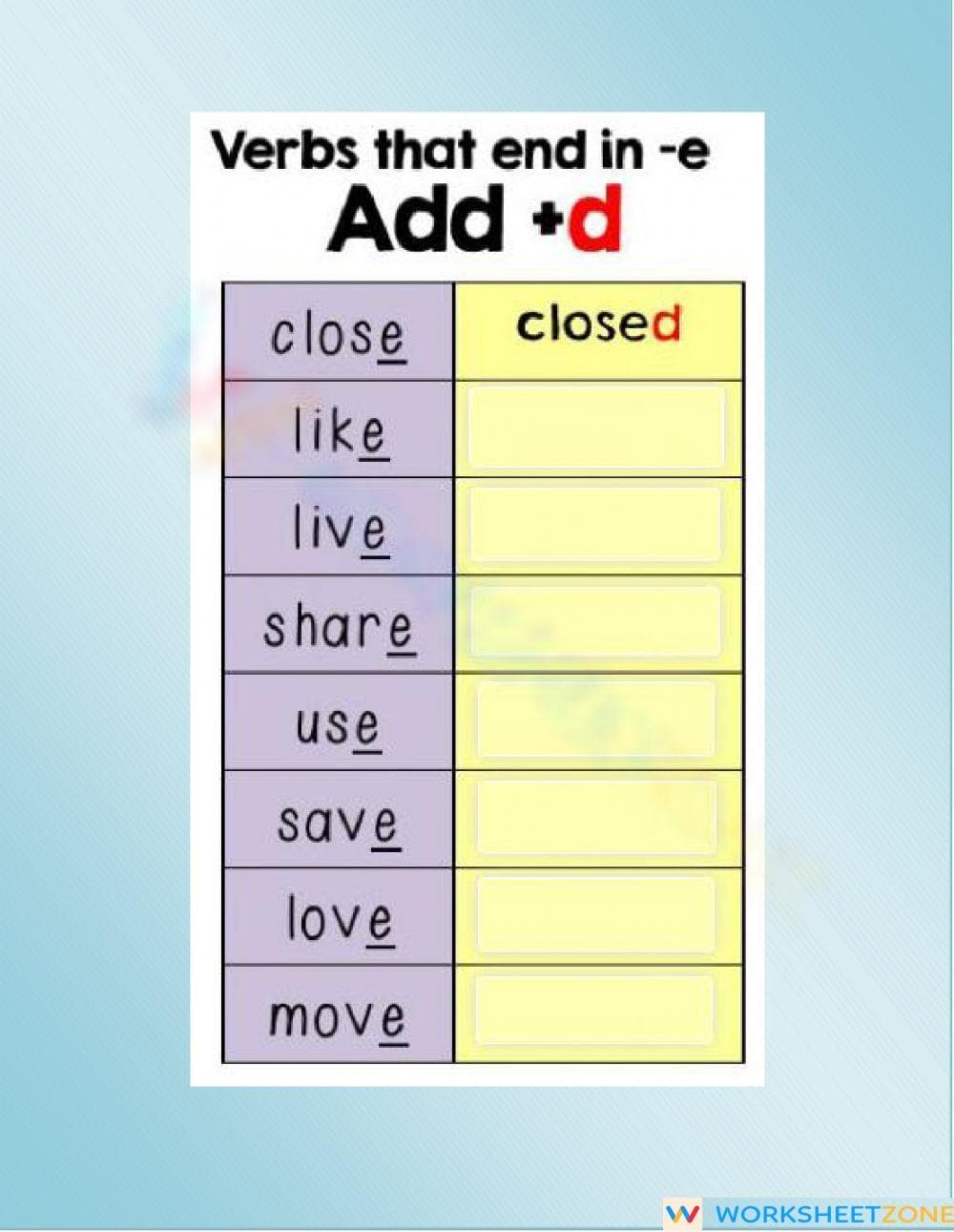

Grade 1 Past Tense Verbs — Printable No-Prep Worksheet
Paste this activity's link or code into your existing LMS (Google Classroom, Canvas, Teams, Schoology, Moodle, etc.).
Students can open and work on the activity right away, with no student login required.
You'll still be able to track student progress and results from your teacher account.
This Grade 1 grammar worksheet provides focused practice for students learning to form the past tense of regular verbs ending in "e". By applying the rule of adding a "d", learners develop the automaticity required for accurate sentence construction. This exercise transforms abstract rules into concrete writing skills.
At a Glance
- Grade: 1 · Subject: English Language Arts (ELA)
- Standard:
CCSS.ELA-LITERACY.L.1.1.e— Use verbs to convey a sense of past, present, and future- Skill Focus: Forming Past Tense of Verbs Ending in -e
- Format: 1 page · 8 problems · Answer key included · PDF
- Best For: Independent Practice / Grammar Center Activity
- Time: 5–10 minutes
What's Inside
This single-page resource features a structured two-column table for clarity. It includes eight high-frequency verbs, with "close" serving as a worked example to model the "+d" suffix rule. Students work through seven remaining tasks including "like," "share," and "move." The clean layout and included answer key ensure the material is easy to navigate for teachers and students.
A Zero-Prep Workflow for Busy Teachers
This worksheet follows a streamlined three-step workflow. First, print the single-page PDF in under one minute for the entire class. Second, distribute the activity as a morning warm-up or station task, taking less than a minute. Finally, review student work in three minutes using the provided answer key. The total teacher prep time is under two minutes.
Standards Alignment
The content is specifically engineered to meet Common Core standard CCSS.ELA-LITERACY.L.1.1.e. This standard expects students to use verbs to convey a sense of the past. By isolating the specific orthographic rule for silent-e verbs, this resource provides the scaffolding for grammatical mastery. Both standard codes can be copied directly into lesson plans, IEP goals, or district curriculum mapping tools.
How to Use It
Integrate this worksheet during the independent practice phase of a grammar lesson or as a formative assessment exit ticket. While students work, observe if they are correctly adding only the "d" rather than an extra "ed." This task typically takes 10 minutes to complete. It serves as an excellent check for understanding before moving toward sentence-level writing tasks.
Who It's For
This tool is for first graders but works for kindergarten enrichment or second grade review. It is a vital resource for English Language Learners who need explicit instruction in morphological rules. Pair this with a classroom anchor chart on verb tenses or a shared reading passage where students search for "-d" suffixes in context.
The instruction provided in this CCSS.ELA-LITERACY.L.1.1.e resource aligns with the gradual release of responsibility framework, specifically targeting the morphological awareness necessary for early literacy success. Research from the RAND AIRS 2024 report indicates that explicit instruction in discrete grammatical rules, such as forming the past tense of verbs ending in "-e", significantly improves written fluency in primary grades. By providing a clear model followed by structured practice, this worksheet ensures that students move beyond rote memorization toward a conceptual understanding of verb conjugation. Educators can rely on this standard-aligned tool to bridge the gap between spoken language and formal written conventions. The inclusion of high-frequency lexical items ensures that the skills practiced are immediately applicable to students' own creative and informational writing projects across the curriculum, fostering long-term retention of core language arts concepts.


