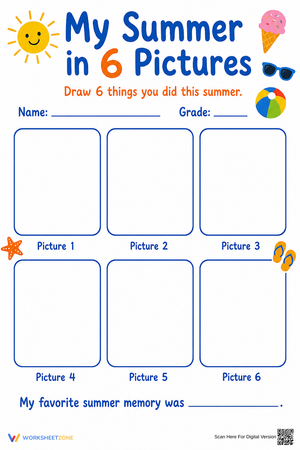
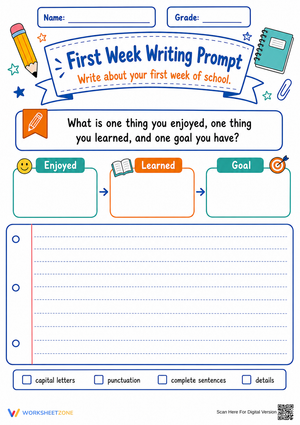
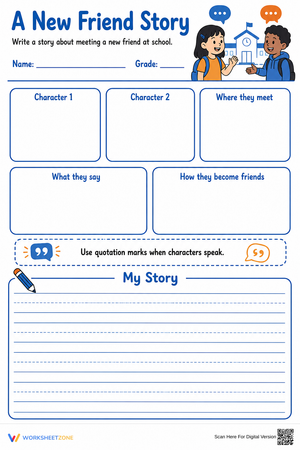
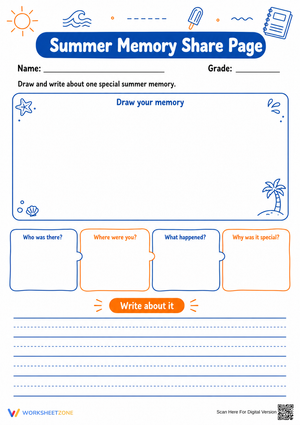
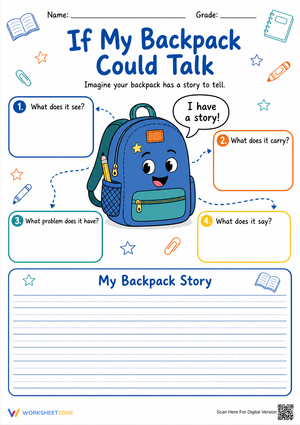
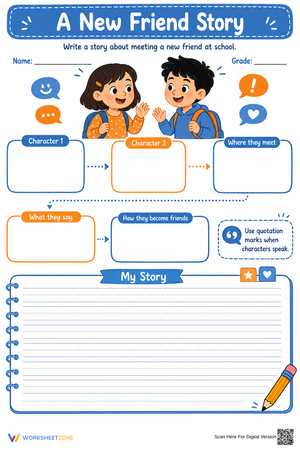
These narrative writing worksheets give K-8 teachers a ready-to-use set of planning and revision tools—story arc organizers, character profile forms, sensory detail planners, and peer review guides—formatted for immediate classroom use. Each worksheet targets a distinct stage of the writing process, from initial brainstorming through final revision, so students build one skill at a time before combining them in a full draft.
What Each Worksheet Targets
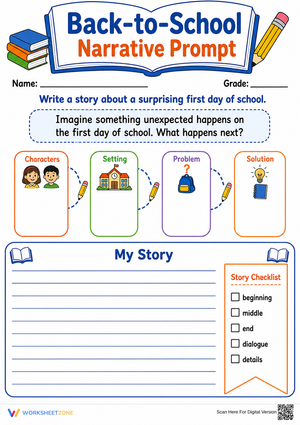
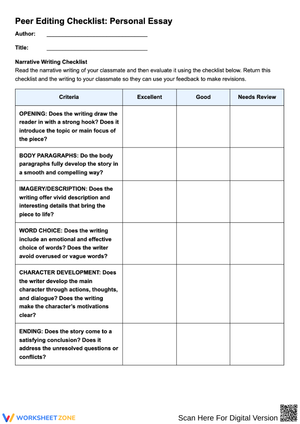
The set moves through the full arc of narrative instruction. Story structure worksheets ask students to map events across a five-part arc—introduction, rising action, climax, falling action, resolution—or, for grades 2 and 3, a simpler three-part frame. Character profile worksheets push students past the flat adjective ("brave," "kind") and into specifics: what does this character want more than anything? What are they afraid of? What do they do when no one is watching? Setting planners work through all five senses—students brainstorm what a place sounds and smells like before they describe what it looks like. Conflict identification worksheets help students name the central tension and track how it builds across the story's middle. Peer review guides give reviewers concrete tasks: underline the sentence where the main conflict first appears, put a star next to the strongest sensory detail, write one question about where the character's motivation could be clearer.
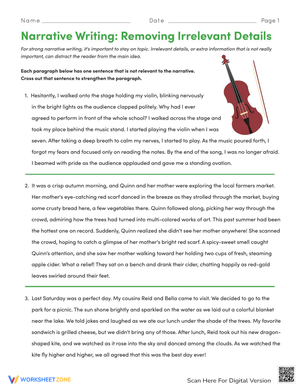
Revision worksheets address the part of the process students are most likely to skip. Students who finish a draft often declare it done; these prompts ask them to re-enter the story looking for one thing at a time—first for places where the conflict slackens, then for dialogue that sounds scripted, then for transitions that add nothing beyond "and then." That one-element-at-a-time approach keeps revision from feeling like restarting from zero.
Building These Worksheets Into Writer's Workshop
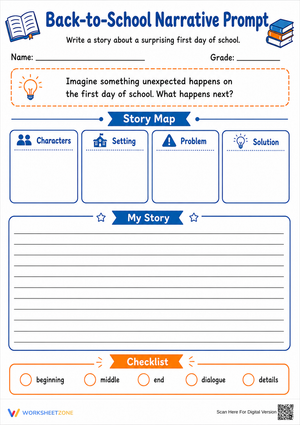
The most effective placement for these resources is during the prewriting phase of a writer's workshop block. Model the story arc organizer on a document camera before students touch their own copies—take a vague story seed ("a kid who finds something weird in the woods") and work through every box out loud, including the moments where you genuinely don't know what happens next. That honest modeling shows students that the organizer is a thinking tool, not a fill-in-the-blank test. Once you've modeled it, have students work with a partner on their own organizers before beginning to draft. Five minutes of paired discussion at this stage prevents the aimless first draft that eats three class periods and ends with the character going home for dinner.
The narrative writing worksheets also function as diagnostic tools between the planning and drafting phases. A quick scan of a student's completed story map reveals whether the conflict is real—the character wants something and something stands in the way—or still vague. That two-minute check lets you pull a small group for a targeted mini-lesson before anyone has spent an hour drafting a story with no driving tension. Keep a few different organizer formats available; some students think in linear timelines, others in cluster maps, and letting them swap when the first one isn't working produces better drafts than insisting on one approach.
Student Error Patterns Worth Anticipating
The most reliable error in student narratives is the collapsed ending. The story builds tension through the middle, the character reaches the climactic moment—and then the resolution takes one sentence: "Then everything was fine and we went home." Students don't see this as a problem because the story is technically finished. A quick exercise using the peer review guide, where the reader times how long the beginning, middle, and ending each take to read aloud, makes the imbalance visible without the teacher having to name it. Students who discover that their resolution lasted eight seconds while their rising action took two minutes generally grasp the problem without further explanation.
Character description is the other consistent weak spot. Students who have been told to "show, not tell" still write that their protagonist is "really brave." The character profile worksheet addresses this directly with a single constraint: write a moment when your character does something that shows bravery—without using that word. That restriction forces behavioral specificity that vague adjective use never achieves. A related issue: students who build a vivid opening setting and then never mention it again. The sensory detail planner includes a prompt asking students to return to that setting at a later point in the story and note how it has changed, which connects setting to plot in a way students often find genuinely surprising.
Tailoring the Set for Mixed-Ability Classrooms
For students who struggle with organization or holding a story structure in working memory, the three-part frame is the better entry point. Personal narrative topics—an argument with a sibling, a moment when something went wrong on a field trip—reduce the cognitive load of inventing a plot while keeping the structural demands intact. Word banks of transition language (meanwhile, just as, right at that moment, hours later) give these students the connective tissue they need without forcing them to stop mid-sentence to search for a word.
Advanced writers benefit from prompts that disrupt the linear structure they've already mastered. A set of worksheets focused on in medias res openings—starting at the moment of highest tension, then flashing back—challenges students who can execute a standard arc in their sleep. Character profile extensions push them to develop a secondary character whose wants directly conflict with the protagonist's, which generates subplot without requiring the teacher to introduce that term as an abstract concept. One honest limitation: students who freeze when confronted with an unfamiliar organizer format will sometimes spend all of prewriting staring at a circular story map. For those students, letting them sketch ideas freehand before transferring to the structured form produces better results than requiring the visual organizer from the start.
Standard Alignment
These worksheets align primarily to CCSS.ELA-LITERACY.W.4.3, which requires students to write narratives using effective technique, descriptive details, and clear event sequences—exactly what the story arc, sensory detail, and character profile worksheets target. The same standard strand runs from W.3.3 through W.8.3, with increasing structural expectations at each grade band. The conflict and revision worksheets map specifically to W.5.3b and W.6.3b, which call for using dialogue, pacing, and description to develop character and plot. In practical classroom terms, the full narrative writing worksheets set addresses the planning, drafting, and revision standards for this genre across the upper elementary and middle school range.
Frequently Asked Questions
Do these worksheets work for both personal and fictional narratives?
Yes. The story arc and revision worksheets apply to either genre. Character profile and conflict worksheets note where prompts shift for personal narrative—for instance, "what your character fears" becomes "what you were afraid of going into this experience." Most teachers keep both options available and let students choose, which tends to produce more invested writing than assigning one mode for the whole class.
How many class periods does a full unit using these worksheets typically take?
A focused unit covering prewriting through peer review runs eight to twelve forty-five-minute sessions, depending on grade level. Younger students need more time on character and setting before they're ready to draft; older students move through the planning phase faster but need longer revision cycles. The set also works as a compressed four-day mini-unit when drafting is assigned as homework between sessions.
Can individual worksheets from the set be used without running a full unit?
Each worksheet stands alone. Teachers regularly pull just the sensory detail planner for a single lesson, or use the peer review guide during revision week without touching anything else in the set. The narrative writing worksheets here also make useful formative checks outside of writing instruction—assigning the character profile worksheet after students finish a class novel reveals whether they can analyze character motivation or whether they're still describing surface traits.
Which version of the story structure worksheet works best for fourth grade?
Fourth grade is the transition point. Students with strong narrative foundations from third grade are ready for the five-part arc; students still working on sustaining a middle section benefit from staying with the three-part frame for another semester before moving up. Running both versions during the first narrative unit of the year and watching which students stall at the rising action box tells you more about readiness than any diagnostic quiz.