


























Views
Plays
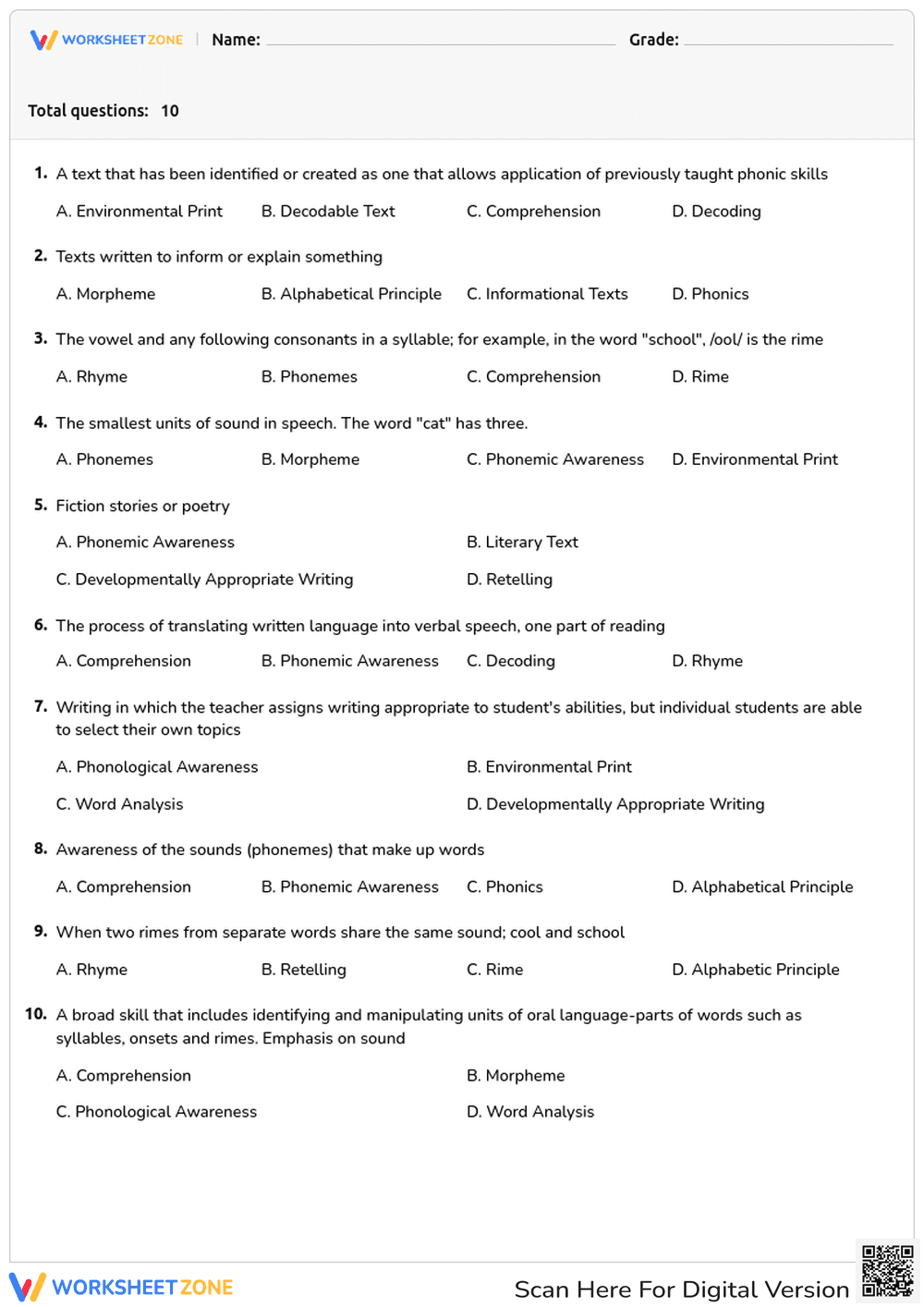

Printable Literacy Vocabulary Quiz | Grade 1 ELA
Paste this activity's link or code into your existing LMS (Google Classroom, Canvas, Teams, Schoology, Moodle, etc.).
Students can open and work on the activity right away, with no student login required.
You'll still be able to track student progress and results from your teacher account.
This foundational reading skills worksheet provides a clear, structured assessment of essential literacy vocabulary. Students and educators evaluate their understanding of core concepts like phonemes, decoding, and informational texts. This multiple-choice format ensures quick comprehension checks while reinforcing the terminology necessary for effective reading instruction and phonics mastery.
At a Glance
- Grade: 1 · Subject: ELA
- Standard:
CCSS.ELA-LITERACY.RF.1.2— Understand spoken words, syllables, and sounds.- Skill Focus: Literacy Vocabulary
- Format: 1 page · 10 problems · Answer key included · PDF
- Best For: Formative assessment
- Time: 10–15 minutes
Inside this resource, you will find a single-page assessment featuring 10 multiple-choice questions focused on critical reading terminology. The layout is clean and straightforward, presenting a definition followed by four distinct vocabulary options such as phonemic awareness, rime, or decodable text. A complete answer key is included to facilitate rapid grading, making it an efficient tool for identifying knowledge gaps in foundational literacy concepts.
This resource offers a highly efficient zero-prep workflow:
- Print (1 minute): Download the PDF and print the single-page assessment.
- Distribute (1 minute): Hand out the quiz. The intuitive multiple-choice layout lets learners begin immediately.
- Review (3 minutes): Use the answer key to quickly score the 10 items.
With total prep time under two minutes, this is perfect for sub plans or quick reviews.
This worksheet is closely aligned with CCSS.ELA-LITERACY.RF.1.2: Demonstrate understanding of spoken words, syllables, and sounds (phonemes). By assessing the terminology behind these skills, it reinforces the structural components of early reading. It also supports general phonics and word analysis competencies. Both standard codes can be copied directly into lesson plans, IEP goals, or district curriculum mapping tools.
Use this assessment as a pre-assessment before a phonics unit to gauge baseline understanding of terms like "decoding." Alternatively, assign it as independent review after direct instruction on text types. As a formative assessment observation tip, watch how quickly participants eliminate incorrect distractors; hesitation between similar terms indicates a need for reteaching. Expected completion time is 10 to 15 minutes.
This resource is primarily designed for Grade 1 students advancing their foundational reading skills, though it serves equally well as a review tool for Grade 2 students or a foundational check for educators and tutors mastering literacy pedagogy. For differentiation, teachers can read the definitions aloud to support emerging readers or English Language Learners. It pairs perfectly with an anchor chart detailing the differences between literary and informational texts, or alongside direct instruction lessons on phoneme segmentation.
Mastering the specific terminology of reading instruction is a critical step in developing robust literacy skills. This resource targets CCSS.ELA-LITERACY.RF.1.2, helping learners understand spoken words, syllables, and sounds by explicitly defining the vocabulary that describes these processes. According to a comprehensive EdReports 2024 analysis, instructional materials that explicitly define and assess foundational reading concepts significantly improve both teacher efficacy and student phonemic awareness outcomes. When learners can accurately identify terms like decoding and rime, they demonstrate a metacognitive awareness of the reading process itself. This targeted 10-question assessment provides a reliable metric for that awareness, ensuring that foundational gaps are identified and addressed early in the instructional cycle. By isolating these specific vocabulary terms, educators can build a stronger, more transparent framework for early literacy success.


