


























Views
Downloads

Printable Line Tracing Worksheet | Grade K
Paste this activity's link or code into your existing LMS (Google Classroom, Canvas, Teams, Schoology, Moodle, etc.).
Students can open and work on the activity right away, with no student login required.
You'll still be able to track student progress and results from your teacher account.
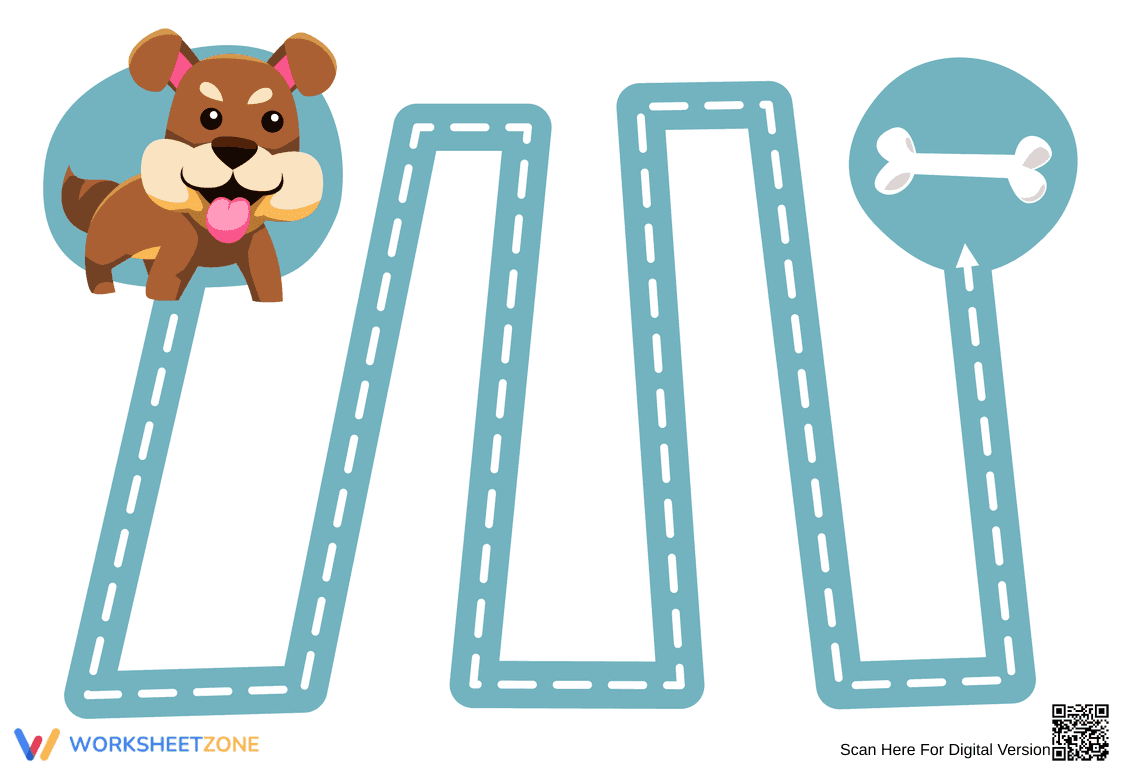
This engaging pre-writing worksheet helps early learners develop essential fine motor control by tracing a continuous, structured path. Students follow the dashed lines to guide the dog to its bone, building the hand-eye coordination and pencil grip required for future letter formation and neat handwriting.
At a Glance
- Grade: K · Subject: Handwriting
- Standard:
CCSS.ELA-LITERACY.L.K.1.A— Print upper- and lowercase letters- Skill Focus: Line tracing and fine motor control
- Format: 1 page · 1 problem · No answer key · PDF
- Best For: Morning work or centers
- Time: 5–10 minutes
This single-page resource features a large, visually appealing path connecting a dog to a bone. The path uses thick, dashed lines forming distinct right angles, challenging students to practice directional changes and pencil control. The uncluttered layout ensures early learners remain focused on the tracing task, making it an ideal tool for foundational handwriting practice.
Zero-Prep Workflow
This resource is designed for immediate classroom implementation.
- Print (1 minute): Print the single-page PDF. It works well in color or grayscale.
- Distribute (1 minute): Hand out with thick pencils or crayons.
- Review (1 minute): Model starting at the dog and staying on the dashed line.
With prep time under two minutes, this activity is perfect for sub plans or morning bins.
Standards Alignment
This tracing activity serves as a critical precursor to CCSS.ELA-LITERACY.L.K.1.A, which requires students to print many upper- and lowercase letters. By mastering the straight lines and sharp corners presented in this path, children develop the specific motor memory needed to form letters like E, F, H, and L. Both standard codes can be copied directly into lesson plans, IEP goals, or district curriculum mapping tools.
How to Use It
Deploy this worksheet during morning work to help students settle into the school day with a quiet, focused task. It also functions perfectly as an independent literacy center activity while the teacher conducts small group instruction. As a formative assessment tip, observe students' pencil grip and their ability to stop and pivot at the sharp corners of the path. The expected completion time ranges from 5 to 10 minutes, depending on the child's current fine motor proficiency.
Who It's For
This worksheet is primarily designed for preschool and kindergarten students who are building foundational pre-writing skills. It is highly effective for occupational therapy sessions or special education classrooms where students require targeted fine motor interventions. For differentiation, teachers can place the printed sheet inside a dry-erase pocket, allowing students to practice the path multiple times with a whiteboard marker. Pair this resource with tactile letter-formation activities or sand-tray tracing for a comprehensive motor-skills lesson.
Developing strong fine motor skills through structured tracing activities is a fundamental step in early childhood education. This worksheet targets the essential pre-writing mechanics that support CCSS.ELA-LITERACY.L.K.1.A, helping students build the capacity to print upper- and lowercase letters. According to a comprehensive 2024 report by EdReports, early interventions focusing on pencil control and directional tracking significantly reduce later struggles with handwriting legibility and writing stamina. When young learners practice navigating complex paths with sharp corners, they strengthen the intrinsic hand muscles required for sustained academic tasks. This targeted practice improves physical dexterity and fosters the cognitive focus necessary for formal literacy instruction. Integrating this tracing exercise into daily routines provides the scaffolding children need to transition smoothly to complex letter writing.


