


























Views
Plays



Electrical Engineering Worksheet | Essential Physics Quiz
Paste this activity's link or code into your existing LMS (Google Classroom, Canvas, Teams, Schoology, Moodle, etc.).
Students can open and work on the activity right away, with no student login required.
You'll still be able to track student progress and results from your teacher account.
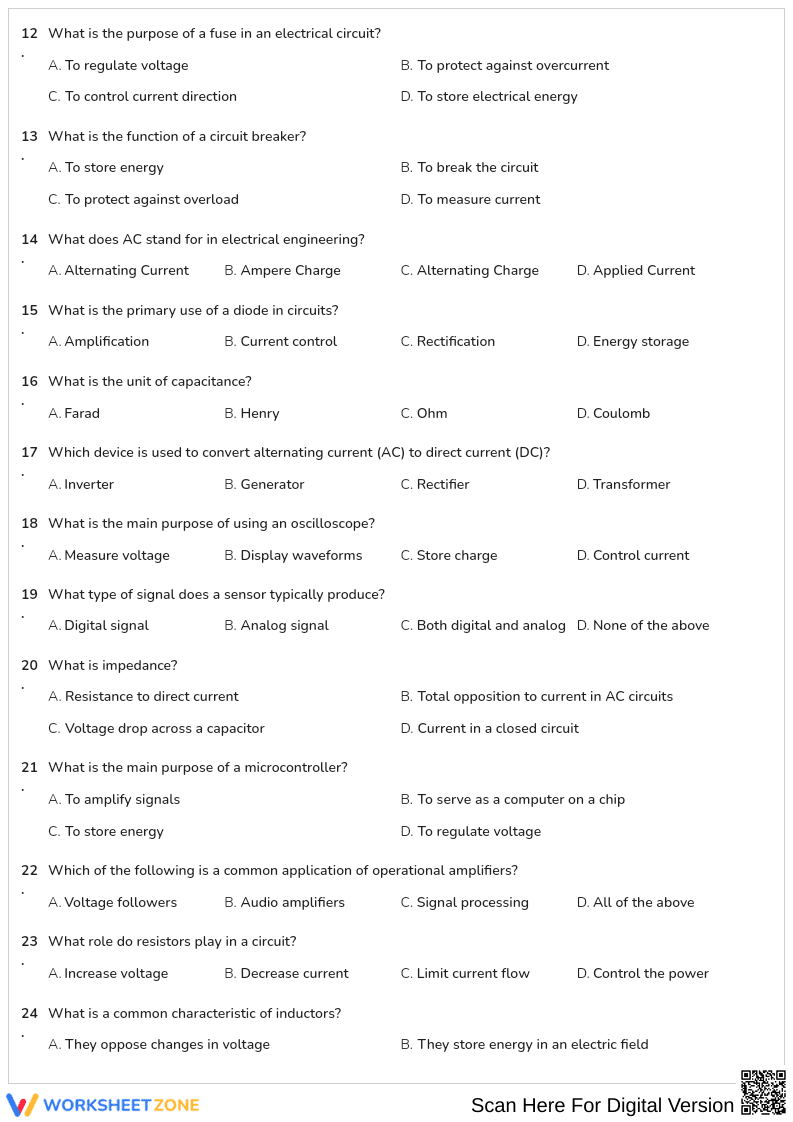
This comprehensive electrical and electronics engineering worksheet provides high school students with a rigorous assessment of fundamental circuit concepts. Students will identify various electronic components, define their primary functions, and apply mathematical formulas to solve for power and resistance. By mastering these core principles, learners build the necessary foundation for advanced physics and vocational engineering pathways.
At a Glance
- Grade: 10-12 · Subject: Physics
- Standard:
HS-PS3-3— Design and refine devices that convert forms of energy within constraints- Skill Focus: Electrical components and Ohm's Law
- Format: 3 pages · 24 problems · Answer key included · PDF
- Best For: High school physics formative assessment
- Time: 20–30 minutes
The worksheet consists of 24 multiple-choice questions spread across three pages, designed to test both breadth and depth of knowledge. It includes specific sections on component identification, electrical units of measurement, and the practical application of Ohm’s Law. The structured layout ensures that students can focus on technical content, while the included answer key allows for rapid grading and immediate feedback.
Zero-Prep Workflow
This resource is designed for immediate classroom implementation with three simple steps:
- Print: Select the 3-page PDF and print enough copies for your class (30 seconds).
- Distribute: Hand out the 24-question assessment as a bell-ringer, exit ticket, or formal quiz (1 minute).
- Review: Use the included answer key to grade or facilitate a peer-review session (5 minutes).
Standards Alignment
This resource is aligned with HS-PS3-3, which requires students to design and refine devices that convert forms of energy within given constraints. By understanding how components like transformers and resistors manipulate electrical energy, students meet the conceptual requirements of this standard. It also supports HS-PS2-5 by reinforcing the relationship between electric current and magnetic fields in inductors.
How to Use It
Use this worksheet as a summative quiz at the end of a circuit unit or as a diagnostic pre-assessment to gauge prior knowledge of electronics. During instruction, teachers can observe which component functions cause the most confusion to inform future re-teaching. Expected completion time is 20–30 minutes, making it an ideal fit for a standard class period or a structured sub plan.
Who It's For
This material is designed for Grade 10–12 Physics students and introductory College-level engineering courses. It is particularly effective for Career and Technical Education (CTE) programs focusing on electronics or robotics. For students requiring additional support, pair this worksheet with a physical component kit or a visual anchor chart displaying circuit symbols. It also serves as an excellent companion to direct instruction.
According to the RAND AIRS 2024 report on technical vocational education, the ability to identify discrete electrical components and their specific functions is a foundational prerequisite for advanced circuit design. This worksheet addresses this need by providing 24 targeted questions that bridge the gap between theoretical physics and practical engineering applications. By focusing on standard units like the Ohm and Farad, alongside critical formulas such as P=IV and V=IR, the resource ensures students develop the technical literacy required for HS-PS3-3 compliance. Research indicates that frequent, low-stakes retrieval practice of component functions significantly improves long-term retention in STEM subjects. This assessment serves as a reliable instrument for measuring student readiness before moving into hands-on laboratory environments or complex projects. The inclusion of modern electronics topics, such as microcontrollers and LEDs, aligns with current industry standards for secondary science curriculum and technical literacy.


