


























Views
Downloads

RL 4.2 Worksheet: Determining Poem Theme — Grade 4 Aligned
Paste this activity's link or code into your existing LMS (Google Classroom, Canvas, Teams, Schoology, Moodle, etc.).
Students can open and work on the activity right away, with no student login required.
You'll still be able to track student progress and results from your teacher account.
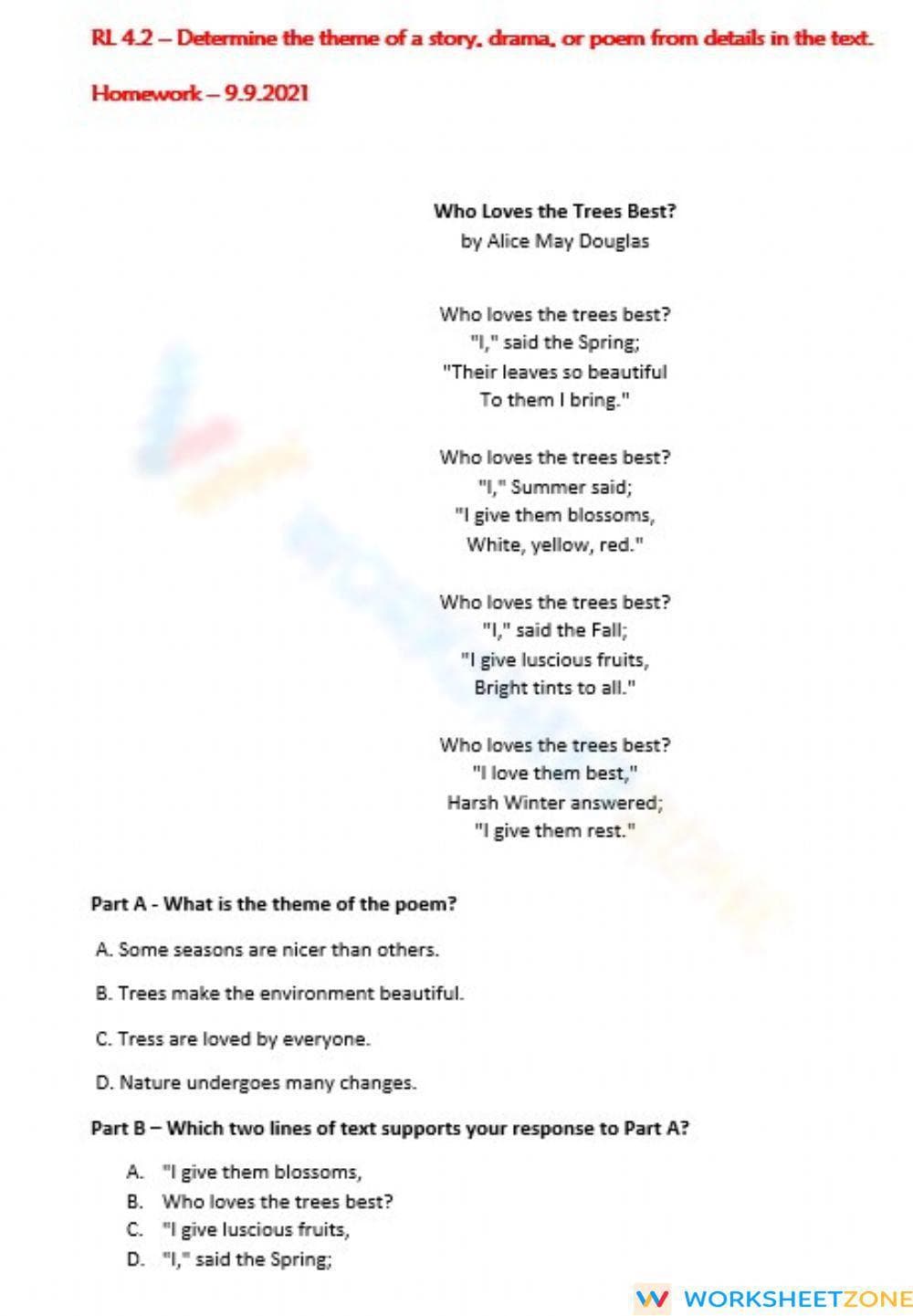
This Grade 4 reading comprehension worksheet helps students identify the deeper meaning within poetry by analyzing textual evidence. Students read the classic poem "Who Loves the Trees Best?" and determine its central theme through a structured two-part assessment. This resource ensures students can move beyond literal interpretation to grasp abstract literary concepts independently.
At a Glance
- Grade: 4 · Subject: English Language Arts
- Standard:
RL 4.2— Determine a theme of a story, drama, or poem from details- Skill Focus: Poem Theme & Text Evidence
- Format: 1 page · 2 problems · Answer key included · PDF
- Best For: Formative assessment and homework reinforcement
- Time: 10–15 minutes
The worksheet features a complete four-stanza poem by Alice May Douglas, providing a rich context for literary analysis. Below the text, a two-part evidence-based question set challenges students to first identify the theme and then select the specific lines that support their conclusion. This single-page PDF includes a clear answer key for rapid grading.
Each task is strategically mapped to the sub-skills of the RL 4.2 standard. Part A evaluates the student's ability to synthesize details into a cohesive theme, while Part B tests their ability to cite evidence. Teachers can use these targeted responses to track progress toward mastery, entering scores directly into gradebooks or IEP progress monitoring systems to document student growth.
The primary focus is `CCSS.ELA-LITERACY.RL.4.2`, which requires students to "Determine a theme of a story, drama, or poem from details in the text; summarize the text." By isolating the theme-identification process, this worksheet provides essential practice for high-stakes testing. Both standard codes can be copied directly into lesson plans, IEP goals, or district curriculum mapping tools.
Use this resource as a formative assessment after direct instruction on poetry elements. Assign it as a "Quick Check" exit ticket to observe which students struggle with abstract reasoning versus evidence selection. The 10-minute completion time makes it an ideal bell-ringer or a focused homework assignment that reinforces classroom learning without overwhelming students.
This worksheet is designed for Grade 4 students but provides excellent review for Grade 5 or remediation for Grade 3. It serves general education classrooms, English Language Learners needing structured practice, and special education students working on RL 4.2 goals. It pairs naturally with anchor charts detailing common literary themes like change or nature.
Determining themes in poetry is a foundational cognitive skill that bridges the gap between basic comprehension and advanced literary criticism. According to the Fisher & Frey (2014) framework for gradual release of responsibility, structured assessments like this worksheet allow students to demonstrate mastery of the CCSS.ELA-LITERACY.RL.4.2 standard by identifying plain-English skills such as theme derivation from specific textual details. This resource provides the necessary scaffolding for students to move from guided practice to independent analysis of complex texts. By focusing on 2 targeted tasks, it ensures that students remain focused on the core objective without cognitive overload. Educational research highlighted in the ScienceDirect TpT Analysis suggests that standards-aligned materials significantly improve student outcomes on state-level assessments when used consistently for formative evaluation and targeted skill reinforcement throughout the academic year.


