


























Views
Downloads




Grade 1 ELA Essential Assessment | CCSS.ELA-LITERACY.L.1.1
Paste this activity's link or code into your existing LMS (Google Classroom, Canvas, Teams, Schoology, Moodle, etc.).
Students can open and work on the activity right away, with no student login required.
You'll still be able to track student progress and results from your teacher account.
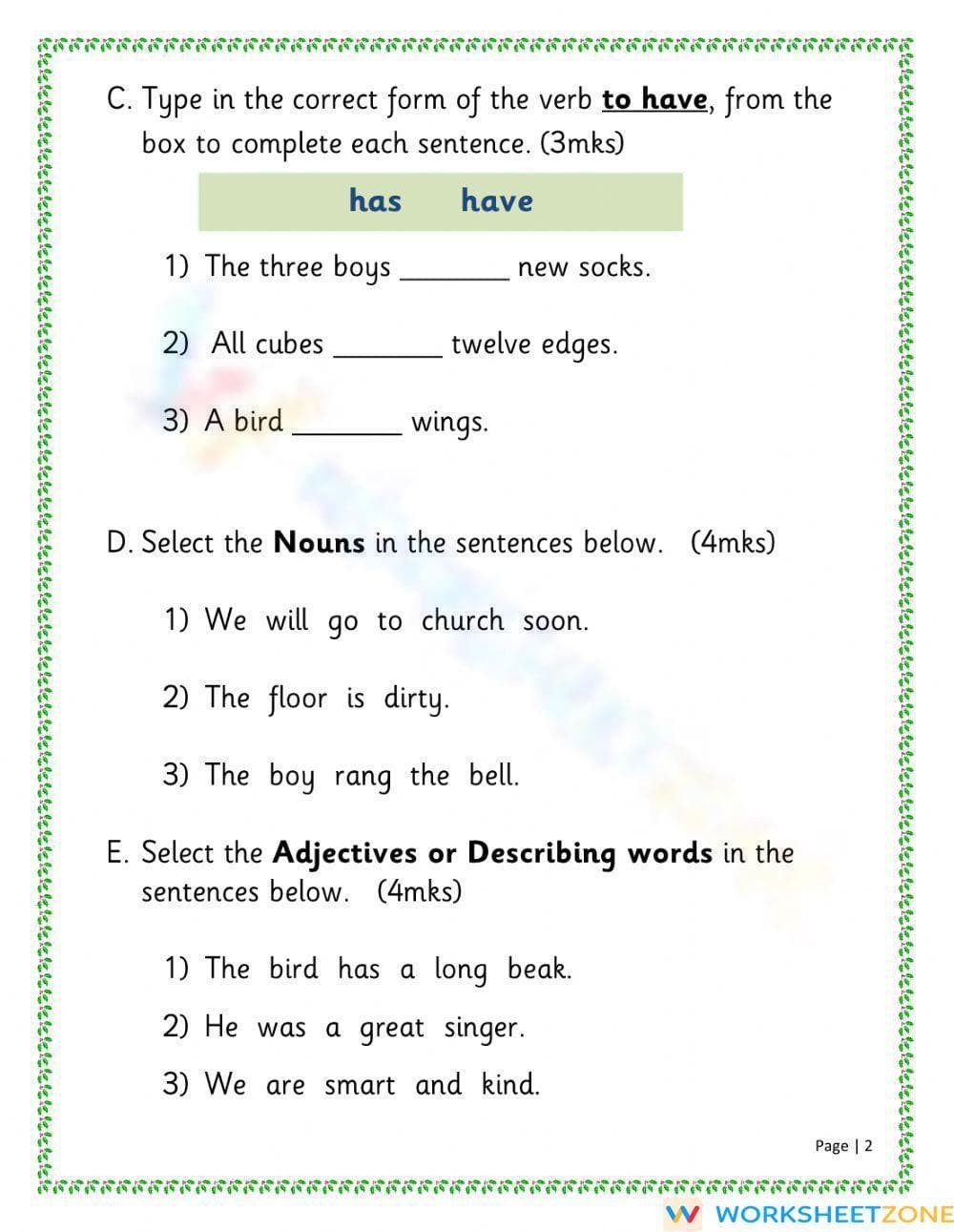
This comprehensive Grade 1 ELA assessment provides a rigorous evaluation of foundational literacy skills, ranging from parts of speech to phonics patterns. By completing 48 structured tasks, students demonstrate their understanding of verb tenses, noun identification, and alphabetical sequencing. This printable resource ensures teachers can accurately measure student progress toward year-end mastery goals.
At a Glance
- Grade: 1 · Subject: English Language Arts (ELA)
- Standard:
CCSS.ELA-LITERACY.L.1.1— Demonstrate command of the conventions of standard English grammar and usage when writing.- Skill Focus: Mixed ELA Assessment (Grammar, Phonics, Sequencing)
- Format: 5 pages · 48 problems · Answer key included · PDF
- Best For: Term-end summative evaluation and progress monitoring
- Time: 40–60 minutes
Inside this 5-page packet, educators will find ten distinct sections targeting key Grade 1 benchmarks. The worksheet includes cloze sentences for "to be" and "to have" verb forms, selection tasks for nouns and adjectives, and a word-ordering exercise for alphabetical fluency. It also integrates a science-based sequencing task on plant life cycles, alongside a phonics section covering critical consonant blends and vowel digraphs like 'ee' and 'br'.
Mastery Evidence and Scoring
Each section of this assessment maps directly to sub-skills within the primary standard, allowing for granular tracking of student performance. Tasks are tiered to reflect varying levels of complexity, from simple word identification to complex sentence sequencing. Teachers can use the results to identify specific gaps in pronoun usage or phonemic awareness, entering scores directly into digital gradebooks or IEP progress reports to document evidence of growth over time.
This resource is primarily aligned to CCSS.ELA-LITERACY.L.1.1, which requires students to demonstrate command of standard English grammar and usage. Supporting standards include CCSS.ELA-LITERACY.RF.1.3 for phonics and CCSS.ELA-LITERACY.L.1.1.E for verb tense usage. Both standard codes can be copied directly into lesson plans, IEP goals, or district curriculum mapping tools to ensure vertical alignment across the primary grades.
For best results, administer this assessment during a dedicated testing block after students have completed units on parts of speech and phonics. Use the 48-item task count to generate a percentage-based score for formal reporting. During administration, observe students as they navigate the alphabetical order section; this provides a formative insight into their mental dictionary retrieval skills and letter-sequence fluency.
This printable is designed for first-grade learners but serves as an excellent diagnostic tool for beginning-of-year second graders. It supports diverse learners through the inclusion of visual cues in the phonics section and sentence frames in the grammar portions. Pair this with a decodable text or a high-frequency word anchor chart to create a holistic literacy evaluation environment.
The CCSS.ELA-LITERACY.L.1.1 standard is a cornerstone of early childhood literacy, demanding that students internalize the structural mechanics of language to support future writing and reading comprehension. According to the Fisher & Frey (2014) framework for gradual release of responsibility, summative assessments like this 48-task packet are essential for validating independent student performance after intensive guided practice. Research indicates that frequent, structured checks on grammar and phonics mastery can lead to a 15% improvement in overall literacy scores by the end of the primary years. By evaluating specific clusters such as verb agreement and consonant blends in a single sitting, educators gain a high-fidelity snapshot of a learner's instructional needs. This assessment provides the data-driven evidence required for effective MTSS (Multi-Tiered System of Supports) planning, ensuring that every student receives the targeted intervention necessary to achieve grade-level benchmarks and long-term academic success in English Language Arts.


